Representative Guy Vander Jagt
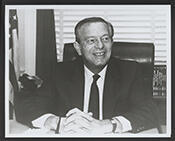
Here you will find contact information for Representative Guy Vander Jagt, including email address, phone number, and mailing address.
| Name | Guy Vander Jagt |
| Position | Representative |
| State | Michigan |
| District | 9 |
| Party | Republican |
| Status | Former Representative |
| Term Start | January 4, 1965 |
| Term End | January 3, 1993 |
| Terms Served | 14 |
| Born | August 26, 1931 |
| Gender | Male |
| Bioguide ID | V000027 |
About Representative Guy Vander Jagt
Guy Adrian Vander Jagt (VAN-dər JAK; August 26, 1931 – June 22, 2007) was a Republican politician from Michigan who served as a Representative in the United States Congress from 1965 to 1993. Over 14 terms in office, he represented a district along the Lake Michigan shoreline and became known nationally for his oratorical skill and his leadership within the House Republican Conference, including service as Chairman of the National Republican Congressional Committee. He was widely regarded as one of the most gifted public speakers of his generation; President Richard Nixon described him as “the best public speaker in America,” and Ronald Reagan remarked that “some call me the great communicator but if there was one thing I dreaded during my eight years in Washington it was having to follow Guy Vander Jagt to the podium.”
Vander Jagt was born in Cadillac, Michigan, to Marie Vander Jagt and Harry Vander Jagt, a Dutch immigrant and rancher. He grew up working on the family’s 120-acre farm near Cadillac, an experience that grounded him in the rural life of northern Michigan. His talent for public speaking emerged early. While a student at Cadillac High School, he began preaching at the Tustin Presbyterian Church, honing the rhetorical and performance skills that later defined his political career. These early experiences in the pulpit and on the farm shaped both his public persona and his connection to the largely conservative, small-town communities he would later represent in Congress.
After graduating from Cadillac High School, Vander Jagt attended Hope College in Holland, Michigan, graduating in 1953. At Hope he distinguished himself as a debater and orator, becoming the state debate champion of Michigan for three consecutive years and winning the National Oratorical Championship during his senior year. He also served as student body president and worked as a radio disc jockey at station WHTC, further developing his communication skills and public presence. He then enrolled at Yale Divinity School, where he earned a Bachelor of Divinity degree in 1955. In 1956, he received a Rotary Foundation Fellowship that enabled him to study for a year at the University of Bonn in Germany, broadening his international perspective and academic training.
Upon returning to West Michigan, Vander Jagt briefly served as interim pastor of the Cadillac Congregational Church, continuing his early vocation in the ministry. He soon transitioned into broadcasting, working at WWTV in Cadillac as a newscaster and news director, where he reportedly memorized the text of each broadcast rather than reading from a script. Seeking further professional advancement, he returned to school to study law, initially at Georgetown University in Washington, D.C., and then transferring to the University of Michigan Law School. He received his J.D. from the University of Michigan in 1960 and began practicing law in Grand Rapids, combining legal work with growing involvement in Republican politics in western Michigan.
Vander Jagt’s formal political career began with his election to the Michigan State Senate in 1964. His rise within the state Republican Party was rapid. Following the death of U.S. Senator Patrick V. McNamara in April 1966, Vander Jagt emerged, along with fellow Republicans Robert P. Griffin and Leroy Augenstein, as a leading contender for appointment to the vacant Senate seat. Michigan Governor George Romney established guidelines requiring a consensus candidate with at least 65 percent support among party leaders. When it became clear that no candidate would meet that threshold, Vander Jagt withdrew and threw his support to Griffin, who was appointed to the Senate in May 1966. In turn, Vander Jagt entered the race to succeed Griffin in Michigan’s 9th congressional district, which stretched from his home in Cadillac along the Lake Michigan shoreline to Muskegon and the suburbs of Grand Rapids.
On November 8, 1966, Vander Jagt ran in two elections simultaneously: a special election to fill the remainder of Griffin’s fifth term and the regular election for the full two-year term beginning in January 1967. He won both contests handily and was subsequently reelected 12 times, never facing serious opposition in what was widely regarded as the most Republican district in Michigan. His service in Congress thus extended from the mid-1960s through the end of the Cold War, a period marked by the Vietnam War, the civil rights movement, the Watergate scandal, the Reagan Revolution, and the realignment of American party politics. Throughout this time, he participated in the legislative process and represented the interests of his constituents in western Michigan as a loyal member of the Republican Party.
In the House of Representatives, Vander Jagt quickly secured important committee assignments. One of his earliest posts was on the House Committee on Science and Astronautics during the formative years of the U.S. space program leading up to the Moon landing. Serving on the Conservation and National Resources Subcommittee, he worked to establish the Sleeping Bear Dunes National Lakeshore near his home region, though he later criticized aspects of the park’s management as illustrating “one of the most reprehensible aspects of the land acquisition process.” As a member of the Committee on Foreign Affairs, he was sent by President Nixon on trade missions to Africa and Asia, reflecting both his international experience and his standing within the party. In 1974 he was appointed to the powerful Ways and Means Committee, where he served on the Trade and Select Revenue Measures Subcommittees and continued to serve for the remainder of his House career. He also served on the Joint Committee on Taxation, a joint body of the U.S. House and Senate, giving him a significant role in shaping federal tax and trade policy.
Vander Jagt’s influence extended beyond committee work into party leadership and national politics. From 1975 until he left the House, he served as Chairman of the National Republican Congressional Committee, directing Republican efforts to recruit candidates and win House seats. In that role he helped cultivate a new generation of Republican leaders; notably, he made a young Newt Gingrich chairman of a Republican long-range planning committee even before Gingrich was sworn in as a member, advancing him ahead of more senior colleagues. In 1980, Ronald Reagan, then the Republican presidential nominee, selected Vander Jagt to deliver the keynote address at the Republican National Convention in Detroit. Vander Jagt delivered the speech on July 16, 1980, without notes, relying entirely on memory, and was at that time considered a potential vice-presidential candidate. Capitalizing on the visibility from the convention, he ran for House Minority Leader after John J. Rhodes of Arizona declined to seek the post again, but he lost the leadership contest to Bob Michel of Illinois.
In the late 1980s, Vander Jagt became a leading congressional proponent of repealing the Twenty-second Amendment to the United States Constitution, which limits presidents to two elected terms. He argued that Ronald Reagan, whom he regarded as “one of the greatest American Presidents of all time,” should be allowed to continue in office if the voters so chose. In 1986, he circulated a fundraising letter to support a campaign to repeal the amendment, and he subsequently introduced measures in the House to that effect in 1986, 1987, 1989, and 1991. These efforts did not succeed, but they underscored his strong support for Reagan and his broader commitment to conservative Republican principles during an era of significant ideological polarization.
Vander Jagt’s long tenure in Congress came to an end after redistricting in the early 1990s. In 1992, his district was renumbered as Michigan’s 2nd district, and for the first time since his initial run in 1966 he faced a serious primary challenge. His opponent was Pete Hoekstra, a Herman Miller executive and fellow Dutch-American who had never previously run for public office. Hoekstra gained attention by riding his bicycle across the district and campaigned on the theme that Vander Jagt had been in Congress for too long, noting that Vander Jagt had first been elected when Hoekstra was 13 years old. In a significant upset, Hoekstra defeated Vander Jagt in the Republican primary by more than six percentage points, dominating in the more populous southern portion of the district, including Muskegon and the Grand Rapids suburbs, while Vander Jagt’s margins in the northern counties were insufficient to overcome Hoekstra’s lead.
After leaving Congress, Vander Jagt returned to private legal practice. He joined the Cleveland-based law firm BakerHostetler, where he continued to work in law and public affairs, drawing on his extensive experience in tax, trade, and legislative matters. His congressional papers were deposited primarily at the Joint Archives of Holland at Hope College, with additional collections held by Grand Valley State University’s Special Collections and University Archives, preserving a record of his long career in public service. Vander Jagt died from pancreatic cancer at a hospice facility in Washington, D.C., on June 22, 2007, at the age of 75. His career left a legacy as a prominent Republican voice from Michigan, a key figure in House campaign politics, and one of the most celebrated orators in modern congressional history.