Representative Halbert Stevens Greenleaf
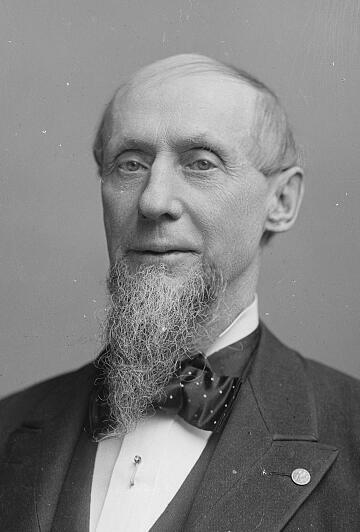
Here you will find contact information for Representative Halbert Stevens Greenleaf, including email address, phone number, and mailing address.
| Name | Halbert Stevens Greenleaf |
| Position | Representative |
| State | New York |
| District | 30 |
| Party | Democratic |
| Status | Former Representative |
| Term Start | December 3, 1883 |
| Term End | March 3, 1893 |
| Terms Served | 2 |
| Born | April 12, 1827 |
| Gender | Male |
| Bioguide ID | G000432 |
About Representative Halbert Stevens Greenleaf
Halbert Stevens Greenleaf (April 12, 1827 – August 25, 1906) was an American Civil War military officer, manufacturer, and Democratic Representative from New York who served in the United States House of Representatives during the 1880s and early 1890s. Born in Guilford, Vermont, he attended the common schools and completed an academic course before beginning his career in manufacturing and public service. He later became known both for his military leadership as colonel of the 52nd Massachusetts Infantry Regiment and for his role as Brigadier General commanding the First New York Veteran Brigade.
After his schooling, Greenleaf moved to Shelburne Falls, Massachusetts, where he engaged in the manufacture of locks, an industry that would define much of his professional life. His abilities and standing in the community led to his appointment as a justice of the peace in 1856 by the governor of Massachusetts. The following year, in 1857, he served as a captain in the Massachusetts Militia. In 1861, during the early years of the American Civil War, he co-founded with Linus Yale Jr. the Yale & Greenleaf Lock Company in Shelburne Falls. Through this partnership he became closely connected to the Yale family; he was the brother-in-law of Linus Yale Jr., who was married to his wife’s half sister, and his nephews included Julian L. Yale and John B. Yale.
With the outbreak of the Civil War, Greenleaf entered active military service. He enlisted as a private in the Union Army in August 1862 and was soon commissioned captain of Company E, Fifty-second Regiment, Massachusetts Volunteers, on September 12, 1862. On October 23, 1862, he was elected colonel and commandant of the 52nd Massachusetts Infantry Regiment, one of the eighteen state regiments formed in response to President Abraham Lincoln’s call for additional troops. Serving under Major General Nathaniel P. Banks, one of Lincoln’s political major generals, Colonel Greenleaf led his regiment in operations in Louisiana, including service on the flank at the Battle of Fort Bisland and other engagements in the Department of the Gulf.
Following the war, Greenleaf continued in government-related and industrial pursuits. He was given command of the government steamer Col. Benedict on the lower Mississippi River and later worked for several years in a salt works near New Orleans, Louisiana. In 1867 he settled in Rochester, New York, where he resumed the manufacture of locks and became a prominent industrialist. His firm, Sargent & Greenleaf, developed and held patents for magnetic, automatic, chronometer, and other burglar locks, as well as combination safe locks, padlocks, drawer, trunk, house, chest, store, door, and other locks, and night-latches. His growing prominence in business and veterans’ circles led to broader civic and political involvement in his adopted state.
Greenleaf’s political profile rose during the presidential campaign of 1880, when, as a Democrat, he devoted himself to the support of General Winfield Scott Hancock, the Democratic candidate for president. He organized and commanded the “Hancock Brigade,” a political-military organization of veterans and supporters opposed to the Republican Party. In 1882 he was given command of the First New York Veteran Brigade and received the rank of brigadier general, a title by which he was widely known thereafter. He also became active in civic affairs, serving as a member of the board of trustees of the Rochester Savings Bank, on the Rochester park commission, and as a trustee of St. Lawrence University in Canton, New York, as well as of the Soldiers’ and Sailors’ Home at Bath, New York.
Halbert Stevens Greenleaf’s congressional service occurred during a significant period in American history, and he served two nonconsecutive terms in the U.S. House of Representatives as a Democrat from New York. He was first elected to the Forty-eighth Congress, serving from March 4, 1883, to March 3, 1885, during which he participated in the legislative process and represented the interests of his Rochester-area constituents. He was an unsuccessful candidate for reelection in 1884 to the Forty-ninth Congress. Returning to politics several years later, Greenleaf was elected to the Fifty-second Congress, serving from March 4, 1891, to March 3, 1893. He was not a candidate for renomination in 1892. Throughout his time in Congress, he contributed to the work of the House of Representatives as a member of the Democratic Party during an era marked by debates over tariffs, veterans’ issues, and economic policy.
After leaving Congress, Greenleaf resumed his former business activities in Rochester, continuing his leadership in the lock manufacturing industry until his retirement in 1896. In his later years he remained a respected figure in both veterans’ and civic organizations, reflecting his long record of military, industrial, and public service. He was married to Jean Brooks Greenleaf, a noted suffragist who became a prominent leader in the women’s rights movement, and together they were part of Rochester’s reform-minded civic community.
Halbert Stevens Greenleaf died at his summer home in the town of Greece, near Charlotte, New York, on August 25, 1906. He and his wife Jean Brooks Greenleaf were interred in Mount Hope Cemetery in Rochester, New York. His life encompassed service as a Civil War officer, industrial innovator in lock manufacturing, Democratic Party leader, and two-term Representative from New York, and he remained closely associated with both New England and upstate New York throughout his long career.