Representative Hallett Sydney Ward
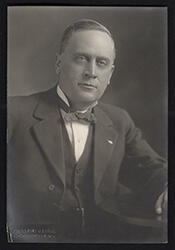
Here you will find contact information for Representative Hallett Sydney Ward, including email address, phone number, and mailing address.
| Name | Hallett Sydney Ward |
| Position | Representative |
| State | North Carolina |
| District | 1 |
| Party | Democratic |
| Status | Former Representative |
| Term Start | April 11, 1921 |
| Term End | March 3, 1925 |
| Terms Served | 2 |
| Born | August 31, 1870 |
| Gender | Male |
| Bioguide ID | W000132 |
About Representative Hallett Sydney Ward
Hallett Sydney Ward (August 31, 1870 – March 31, 1956) was a Democratic U.S. Congressman from North Carolina who represented his state in the United States House of Representatives between 1921 and 1925. He was born near Gatesville, in Gates County, North Carolina, where he spent his early years and attended the local public schools. Growing up in a rural community in northeastern North Carolina during the post-Reconstruction era, he was educated in the county school system before pursuing higher education and a professional career in law.
Ward studied law at the University of North Carolina at Chapel Hill, then the principal institution for legal education in the state. After completing his legal studies, he was admitted to the bar in 1893. That same year he began the practice of law in Winton, North Carolina, the county seat of Hertford County. His early legal career in Winton established him as a practicing attorney in the region and provided the foundation for his subsequent entry into public office and state politics.
Ward’s political career began at the state level. He was first elected to the North Carolina Senate in 1899 and was returned for a second term in 1901, participating in the legislative affairs of the state at a time of significant political and social change in North Carolina. After his service in the General Assembly, he entered municipal government and served as mayor of the town of Plymouth, North Carolina, from 1902 to 1903. In 1904, he moved to the town of Washington, in Beaufort County, North Carolina, which would remain his home for the rest of his life. That same year he was appointed solicitor for the first judicial district of North Carolina, a prosecutorial office he held from 1904 until 1910, during which he was responsible for representing the state in criminal cases across the district while continuing to build his reputation as a lawyer.
Following his tenure as solicitor, Ward resumed the private practice of law in Washington, North Carolina, and remained active in Democratic Party affairs. In the 1920 election, he was chosen as a Democrat to represent North Carolina in the 67th United States Congress. He took his seat in the House of Representatives on March 4, 1921. Ward was reelected and served in the 68th Congress as well, holding office continuously from March 4, 1921, to March 3, 1925. During his two terms in Washington, D.C., he represented his coastal and eastern North Carolina constituency in the immediate post–World War I period, a time marked by economic adjustment and the early stirrings of national debate over agricultural policy, transportation, and federal involvement in regional development.
In 1924, Ward declined to be a candidate for renomination to the House, choosing instead to return to his legal practice in Washington, North Carolina. He resumed his work as an attorney and remained a figure in state and local public life. Demonstrating his continued engagement with state politics, he was elected to one additional term in the North Carolina Senate in 1931, returning briefly to the legislative body where his political career had begun more than three decades earlier.
Ward spent his later years in Washington, North Carolina, where he continued to practice law and to be identified with the civic and political life of his community. He died there on March 31, 1956. His career encompassed service at the municipal, state, and federal levels, reflecting the trajectory of a lawyer-politician who moved from local office to the state legislature, to the U.S. Congress, and back again to state service and private practice in eastern North Carolina.