Representative Hamilton Glover Ewart
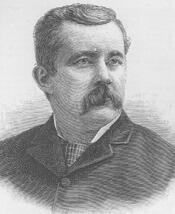
Here you will find contact information for Representative Hamilton Glover Ewart, including email address, phone number, and mailing address.
| Name | Hamilton Glover Ewart |
| Position | Representative |
| State | North Carolina |
| District | 9 |
| Party | Republican |
| Status | Former Representative |
| Term Start | December 2, 1889 |
| Term End | March 3, 1891 |
| Terms Served | 1 |
| Born | October 23, 1849 |
| Gender | Male |
| Bioguide ID | E000274 |
About Representative Hamilton Glover Ewart
Hamilton Glover Ewart (October 23, 1849 – April 28, 1918) was a United States Representative from North Carolina and a United States district judge of the United States District Court for the Western District of North Carolina. A member of the Republican Party, he served one term in the United States House of Representatives from 1889 to 1891 and later held a series of judicial and legislative posts at the state and federal levels.
Ewart was born on October 23, 1849, in Columbia, Richland County, South Carolina. He attended private schools in his youth and, during the American Civil War, moved with his parents in 1862 to Hendersonville, Henderson County, North Carolina, which became his long-term home and the base of his professional and political career. He pursued legal studies and was admitted to the bar in 1870, commencing the practice of law in Hendersonville. He subsequently formalized his legal education, receiving a Bachelor of Laws from the University of South Carolina School of Law in 1876.
Early in his career, Ewart combined legal work with growing involvement in public affairs. In 1872 he was appointed Referee in Bankruptcy for the United States District Court for the Western District of North Carolina, a position that reflected his early engagement with the federal judicial system. He emerged as an active Republican in a predominantly Democratic region and served as a delegate to the 1876 Republican National Convention. Locally, he was elected Mayor of Hendersonville, serving from 1878 to 1879, and he built a reputation as a civic leader. He entered state-level politics as a member of the North Carolina House of Representatives, serving his first term in that body from 1887 to 1889.
Ewart was elected as a Republican from North Carolina’s 9th congressional district to the United States House of Representatives in the 51st United States Congress. He served from March 4, 1889, to March 3, 1891. During this single term in Congress, he represented the interests of his western North Carolina constituents and participated in the legislative process at a time of significant political and economic change in the post-Reconstruction South. His service in Congress occurred during a notable period in American history, as national debates over tariffs, federal elections legislation, and economic development were prominent. He was an unsuccessful candidate for reelection in 1890 to the 52nd United States Congress, ending his initial period of federal legislative service after one term.
After leaving Congress, Ewart returned to state and local judicial service while maintaining his legal practice. He served as Judge of the Henderson County Criminal Court from 1895 to 1896. At the same time, he reentered the North Carolina House of Representatives, serving again from 1895 to 1897, reflecting his continued influence in state politics. He was then elevated to the bench as a Judge of the North Carolina Superior Court for the Twelfth Judicial District, serving from 1897 to 1898. His combined legislative and judicial roles underscored his prominence in North Carolina’s Republican ranks during the late nineteenth century.
Ewart’s judicial career reached the federal level through a series of recess appointments to the United States District Court for the Western District of North Carolina. He was first nominated by President William McKinley to that court on January 27, 1898, to fill the seat vacated by Judge Robert P. Dick, but the United States Senate did not act on the nomination. On July 13, 1898, McKinley granted Ewart a recess appointment to the same position, and he was formally nominated again on December 13, 1898. His service under this appointment terminated on March 3, 1899, when the Senate again failed to vote on his nomination. McKinley extended a second recess appointment to Ewart on April 13, 1899, effectively returning him to the same seat he had just vacated. The President renominated him on December 19, 1899, but his service on the federal bench ended on June 7, 1900, after the Senate once more declined to vote on his confirmation. These unsuccessful recess appointments made Ewart a notable example of contested federal judicial nominations in the era.
Following his final departure from the federal bench, Ewart resumed the private practice of law in Hendersonville. He remained active in public life and returned yet again to the North Carolina House of Representatives, serving from 1911 to 1913. He also sought to reenter Congress, but he was an unsuccessful candidate for election to the United States House of Representatives in 1904. In the later years of his career, he expanded his professional activities beyond North Carolina, continuing his legal practice in Chicago, Illinois, from 1916 to 1918.
Ewart died on April 28, 1918, in Chicago, Illinois, of diarrhea-related dehydration. His remains were returned to North Carolina, and he was interred in Oakdale Cemetery in Hendersonville. Throughout his career, Hamilton Glover Ewart contributed to the democratic and judicial processes at the local, state, and federal levels, serving as a legislator, mayor, state judge, and twice-appointed but unconfirmed federal district judge.