Representative Hal Daub
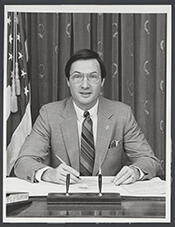
Here you will find contact information for Representative Hal Daub, including email address, phone number, and mailing address.
| Name | Hal Daub |
| Position | Representative |
| State | Nebraska |
| District | 2 |
| Party | Republican |
| Status | Former Representative |
| Term Start | January 5, 1981 |
| Term End | January 3, 1989 |
| Terms Served | 4 |
| Born | April 23, 1941 |
| Gender | Male |
| Bioguide ID | D000065 |
About Representative Hal Daub
Harold John Daub Jr. (born April 23, 1941) is an American lawyer and Republican politician from Nebraska who served four terms as a Representative from Nebraska in the United States Congress from 1981 to 1989 and later as the 48th Mayor of Omaha, Nebraska. Over the course of his career he also served on the Social Security Advisory Board and, beginning in 2012, on the Board of Regents of the University of Nebraska system.
Daub was born at Fort Bragg, near Fayetteville, North Carolina, where his father was stationed in the military. His family later settled in Nebraska, and he grew up in North Omaha. He attended Omaha’s Benson High School, from which he graduated before enrolling at Washington University in St. Louis. He received a Bachelor of Science degree from Washington University in 1963. He then returned to Nebraska for legal studies, earning his Juris Doctor from the University of Nebraska College of Law in Lincoln in 1966. An active participant in youth leadership, he achieved the rank of Distinguished Eagle Scout, an honor recognizing exceptional service and achievement in the Boy Scouts of America.
Following law school, Daub served in the United States Army from 1966 to 1968. He was an infantry officer and attained the rank of captain while serving in Korea. After completing his military service, he settled in Omaha, Nebraska, where he entered the private practice of law. In Omaha he became increasingly active in the Republican Party, building a political base in the city and within the state’s Second Congressional District.
Daub first sought federal office in 1978, running as the Republican candidate for the United States House of Representatives from Nebraska’s Omaha-based 2nd congressional district. He was defeated in that race by the incumbent Democrat, John J. Cavanaugh III. When Cavanaugh declined to seek reelection in 1980, Daub again ran for the seat and was elected to the House of Representatives, defeating Democrat Richard Fellman. A member of the Republican Party, he contributed to the legislative process during four terms in office and represented the interests of his constituents during a significant period in American history. He was reelected three times, in 1982, 1984, and 1986, serving continuously in Congress from January 3, 1981, to January 3, 1989. During the 1980s, future conservative activist Ginni Thomas, later the wife of Supreme Court Justice Clarence Thomas, worked in his congressional office, initially as an assistant and eventually as his legislative director; the families had known one another previously.
While serving in the House, Daub sought higher office. In March 1987, following the death of Nebraska’s senior U.S. Senator Edward Zorinsky, Governor Kay A. Orr appointed businessman David Karnes to the Senate. Daub challenged Karnes in the 1988 Republican primary for election to a full term but lost by nine points; Karnes subsequently lost the general election to former Democratic Governor Bob Kerrey. In 1990, Daub was the Republican nominee against Nebraska’s other Democratic senator, J. James Exon. He won the Republican primary easily but was defeated by a substantial margin in the general election. After leaving Congress in 1989, he returned to legal practice and remained active in public affairs and Republican politics.
Daub reentered elective office at the municipal level in the mid‑1990s. In 1995, he won a special election for Mayor of Omaha following the resignation of Mayor P.J. Morgan, defeating city councilwoman Brenda Council. He was narrowly elected to a full term in 1997, again defeating Council. As Omaha’s 48th mayor, he served until 2001, when he was defeated for reelection in a close race by insurance executive Mike Fahey. Remaining engaged in civic life, Daub later served for five years on the board of Omaha’s Metropolitan Entertainment and Convention Authority (MECA), which oversees major public venues and events in the city.
After his mayoral tenure, Daub continued to hold federal and advisory positions and to seek higher office. From 2002 to 2006 he served as a member of the Social Security Advisory Board, contributing to national discussions on retirement and disability policy. In 2005 he joined the Missouri-based law firm Blackwell Sanders Peper Martin LLP (now Husch Blackwell), where he held positions that included work as a lobbyist; he has also held lobbying roles with Deloitte. In 2007, he briefly entered the race for the U.S. Senate seat being vacated by Senator Chuck Hagel, but withdrew to endorse former Nebraska governor and U.S. Secretary of Agriculture Mike Johanns, who went on to win the seat.
Daub remained active in Omaha politics into the 21st century. In 2008, he announced that he would run again for Mayor of Omaha in the 2009 election. He led the April 2009 primary, receiving the most votes, but in the May 2009 runoff he was narrowly defeated by Jim Suttle, with unofficial final results of 48.7 percent to 50.7 percent; in that election Democrats also gained control of the city council. At the state level, Daub expanded his role in higher education governance. In 2012, he was elected to the Board of Regents of the University of Nebraska system, which oversees the state’s public university campuses. He served a single term on the board and was defeated for reelection in 2018 by Barbara Weitz.
In his later public life, Daub at times drew attention for his comments on controversial issues. As a University of Nebraska regent, he publicly criticized Nebraska Cornhuskers football players who knelt during the national anthem in 2017 as a protest against police violence, and he was reported as calling for the players’ removal from the team; he later denied having called for their removal, and head coach Mike Riley stated that Daub’s view of the protest as unpatriotic was a misinterpretation. In 2022, when Nebraska state senator Julie Slama reported that she had been sexually assaulted by political figure Charles Herbster, Daub remarked that he would like to put Slama on the witness stand to ask what she had been wearing and suggested she was trying to attract Herbster’s attention to aid her reelection. These comments drew public criticism. Daub remains involved in political reform efforts as a member of the ReFormers Caucus of Issue One, a bipartisan group of former elected officials advocating for changes to strengthen American democratic institutions.