Representative Harold Orrin Lovre
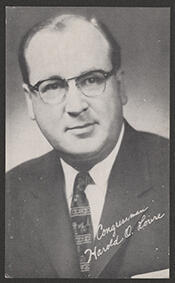
Here you will find contact information for Representative Harold Orrin Lovre, including email address, phone number, and mailing address.
| Name | Harold Orrin Lovre |
| Position | Representative |
| State | South Dakota |
| District | 1 |
| Party | Republican |
| Status | Former Representative |
| Term Start | January 3, 1949 |
| Term End | January 3, 1957 |
| Terms Served | 4 |
| Born | January 30, 1904 |
| Gender | Male |
| Bioguide ID | L000468 |
About Representative Harold Orrin Lovre
Harold Orrin Lovre (January 30, 1904 – January 17, 1972) was an American lawyer and Republican politician who served as a Representative from South Dakota in the United States Congress from 1949 to 1957. Over the course of four consecutive terms in the House of Representatives, he contributed to the legislative process during a significant period in American history, representing the interests of his South Dakota constituents and participating actively in the democratic process.
Lovre was born on January 30, 1904, in Toronto, Deuel County, South Dakota. He grew up in a rural environment typical of the northern Great Plains in the early twentieth century, an upbringing that informed his later interest in agricultural and regional issues. His early life in South Dakota, then still a relatively young state, exposed him to the concerns of farmers, small-town professionals, and local businesses, shaping his understanding of the economic and social challenges facing his future constituents.
Lovre pursued higher education in law, preparing for a professional career that would serve as the foundation for his later public service. After completing his legal studies and being admitted to the bar, he began practicing law in South Dakota. As an attorney, he developed a reputation for diligence and attention to detail, and his legal practice brought him into close contact with local government, business, and civic affairs. This experience provided him with practical knowledge of the legal and regulatory issues that would later come before him as a legislator.
Before entering Congress, Lovre built a career that combined law and public life, positioning himself as a prominent Republican figure in his state. He became active in party affairs and local governance, gaining experience in the workings of political organizations and the needs of communities across South Dakota. His professional background and political engagement made him a credible and appealing candidate for national office, reflecting both his legal expertise and his familiarity with regional concerns.
Lovre was elected as a Republican to the United States House of Representatives in the post–World War II era, taking office in 1949. Serving four terms, he remained in Congress until 1957. His tenure coincided with the early years of the Cold War, the beginning of the Korean War, and the domestic adjustments that followed wartime mobilization. As a member of the House of Representatives, Harold Orrin Lovre participated in debates and votes on national security, economic policy, and federal programs that affected rural states such as South Dakota. Throughout his service, he worked to ensure that the interests of his constituents were represented in federal legislation, reflecting the priorities of a largely agricultural state within the broader national agenda.
During his years in Congress, Lovre’s work was shaped by the Republican Party’s approach to governance in the mid-twentieth century, including attention to fiscal responsibility, support for business and agriculture, and a strong stance on national defense. He contributed to the legislative process through committee work, floor deliberations, and constituent services, helping to connect the concerns of South Dakotans with the policymaking mechanisms of the federal government. His four-term service provided continuity of representation for his district during a period of rapid economic and geopolitical change.
After leaving Congress in 1957, Lovre returned to private life and to the legal and civic activities that had defined his earlier career. He remained identified with the Republican Party and with the public issues that had occupied him in office, continuing to be regarded as a figure of experience and authority in South Dakota political circles. His post-congressional years reflected a continued engagement with the community and the legal profession, even as he no longer held elective office.
Harold Orrin Lovre died on January 17, 1972. His career spanned the transformation of South Dakota from its early twentieth-century rural character into a more modern, interconnected state, and his eight years in the United States House of Representatives placed him at the center of national decision-making during a formative period in American history.