Representative Harold Clement McGugin
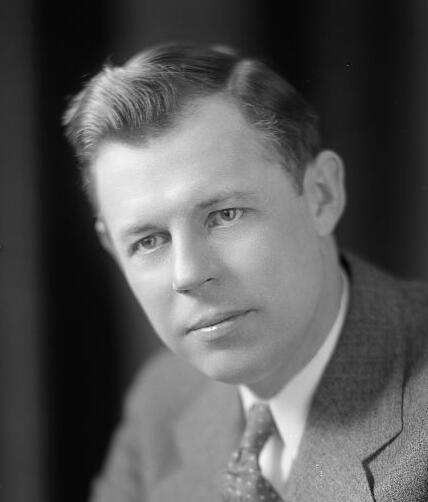
Here you will find contact information for Representative Harold Clement McGugin, including email address, phone number, and mailing address.
| Name | Harold Clement McGugin |
| Position | Representative |
| State | Kansas |
| District | 3 |
| Party | Republican |
| Status | Former Representative |
| Term Start | December 7, 1931 |
| Term End | January 3, 1935 |
| Terms Served | 2 |
| Born | November 22, 1893 |
| Gender | Male |
| Bioguide ID | M000463 |
About Representative Harold Clement McGugin
Harold Clement McGugin (November 22, 1893 – March 7, 1946) was an American lawyer, a veteran of both World War I and World War II, and a Republican politician who served two terms as a U.S. Representative from Kansas from 1931 to 1935. He was born on a farm near Liberty, Montgomery County, Kansas, where he attended the local public schools. In 1908 he moved with his family to Coffeyville, Kansas, a growing industrial and commercial center in the southeastern part of the state. He graduated from Coffeyville High School in 1912, marking the beginning of a trajectory that would combine legal training, military service, and public office.
Following his secondary education, McGugin pursued legal studies at Washburn College in Topeka, Kansas. He completed the law department there in 1915 and, in the same year, was admitted to the bar. He immediately commenced the practice of law in Coffeyville, establishing himself professionally in the community where he had grown up. After World War I, he further broadened his legal education by taking a postgraduate course at the Inns of Court in London, England, in 1919, an experience that exposed him to the British legal tradition and added an international dimension to his professional background.
McGugin’s public service began with his military duty during World War I. He served overseas as a second lieutenant in the Adjutant General’s Department at Brest, France, a major port of embarkation and debarkation for American forces. His responsibilities in this administrative and personnel branch of the Army placed him within the organizational framework that supported U.S. military operations in Europe. After the war and his postgraduate study in London, he returned to Coffeyville to continue his law practice, building a reputation that would soon lead him into elective office.
Entering state politics as a Republican, McGugin served as a member of the Kansas House of Representatives from 1927 to 1929. In this role he participated in state-level legislative deliberations during a period marked by agricultural challenges and the approach of the Great Depression. In 1929 he became the city attorney of Coffeyville, providing legal counsel to the municipal government and further solidifying his standing as a public servant and legal practitioner. These positions at the state and local levels formed the foundation for his subsequent congressional career.
McGugin was elected as a Republican to the Seventy-second and Seventy-third Congresses, serving in the U.S. House of Representatives from March 4, 1931, to January 3, 1935. Representing Kansas during the early years of the Great Depression, he contributed to the legislative process over two terms in office and participated in the democratic governance of the nation at a time of profound economic and social upheaval. As a member of the House of Representatives, he represented the interests of his Kansas constituents while engaging with national policy debates that accompanied the transition from the Hoover administration to the New Deal era. He was an unsuccessful candidate for reelection in 1934 to the Seventy-fourth Congress and again in 1936, when he sought election to the Seventy-fifth Congress.
After leaving Congress, McGugin resumed the practice of law in Coffeyville. Remaining active in Republican politics, he sought higher statewide office and in 1938 ran for Governor of Kansas. In that campaign he was unsuccessful, losing in the Republican primary to Payne Ratner, who would go on to win the governorship. Despite this setback, McGugin’s candidacy reflected his continued prominence within Kansas political circles and his ongoing commitment to public life.
With the outbreak of World War II and the subsequent involvement of the United States, McGugin returned to military service. He enlisted in the United States Army in 1942 and, drawing on his prior experience and professional background, advanced from the rank of captain to lieutenant colonel. He again served in France, this time during the Second World War, where he contracted an incurable disease while on active duty. His service in two global conflicts underscored a career marked by repeated calls to national service in both military and civilian capacities.
Harold Clement McGugin died in the Army and Navy General Hospital at Hot Springs, Arkansas, on March 7, 1946, while still in military service. He was interred in Restlawn Cemetery in Coffeyville, Kansas, returning in death to the community that had shaped his early life and professional career. His life encompassed significant roles as a lawyer, state legislator, city attorney, congressman, and Army officer in two world wars, reflecting a sustained engagement with both public office and national defense during some of the most consequential decades in American history.