Representative Harold S. Sawyer
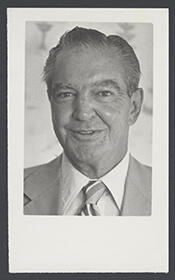
Here you will find contact information for Representative Harold S. Sawyer, including email address, phone number, and mailing address.
| Name | Harold S. Sawyer |
| Position | Representative |
| State | Michigan |
| District | 5 |
| Party | Republican |
| Status | Former Representative |
| Term Start | January 4, 1977 |
| Term End | January 3, 1985 |
| Terms Served | 4 |
| Born | March 21, 1920 |
| Gender | Male |
| Bioguide ID | S000087 |
About Representative Harold S. Sawyer
Harold Samuel Sawyer (March 21, 1920 – April 2, 2003) was an American attorney and Republican politician from the state of Michigan who represented Michigan’s 5th congressional district in the United States House of Representatives from January 3, 1977, to January 3, 1985. Born and raised in the San Francisco Bay Area, he served four consecutive terms in Congress during a significant period in American political history, participating in the legislative process and representing the interests of his constituents in western Michigan.
Sawyer was born in San Francisco, California, on March 21, 1920. He attended the public schools of the San Francisco Bay Area and went on to study at Marin Junior College in Kentfield, California, now known as the College of Marin. After completing his studies there, he enrolled at the University of California, Berkeley, from which he graduated in 1940. He then pursued legal studies at the University of California, Hastings College of the Law, earning his Juris Doctor degree in 1943, thus preparing for a professional career in law.
During World War II, Sawyer served in the United States Navy, contributing to the nation’s war effort in uniform. Following his military service, he left California and settled in Grand Rapids, Michigan. There he established a successful private law practice, building a reputation in the local legal community. His work as an attorney in Grand Rapids laid the foundation for his later involvement in public service and state-level legal reform.
Sawyer’s formal public career in Michigan began with his appointment to the Michigan Law Revision Commission, on which he served from 1968 to 1976. In that capacity he participated in efforts to review and modernize the state’s statutory law. From 1975 to 1976, he served as prosecuting attorney for Kent County, Michigan, gaining further prominence as a public official and sharpening his experience in criminal law and public administration. These roles positioned him as a leading Republican figure in the Grand Rapids area and set the stage for his entry into national politics.
In 1976, Sawyer ran for Congress in Michigan’s 5th congressional district and defeated incumbent Democrat Richard Vander Veen, thereby reclaiming the seat for the Republican Party. The district had long been a Republican stronghold and had been represented by Gerald R. Ford from 1949 until Ford’s appointment as Vice President of the United States; it had remained in Republican hands without interruption from 1913 until Vander Veen’s special-election victory following Ford’s elevation to the vice presidency. Sawyer’s victory in 1976 restored Republican control of the district, and he benefited politically from Ford’s presence atop the national ticket as the Republican nominee for a full term as president.
Sawyer was elected to the Ninety-fifth and to the three succeeding Congresses, serving four terms from January 3, 1977, to January 3, 1985. Although he held the seat for eight years, his tenure was marked by competitive elections. In 1978 he narrowly defeated Democratic challenger Dale Sprik by just 0.7 percent of the vote, a margin of roughly 1,100 votes. He faced Sprik again in a subsequent election and won by a more comfortable margin of seven percentage points. In 1982, he defeated former state representative Stephen Monsma with 53 percent of the vote. These contests were among the last in the 20th century in which a Democratic candidate managed to secure 40 percent of the vote in that district, which was later renumbered as the 3rd congressional district in 1993. During his years in the House of Representatives, Sawyer contributed to the legislative process as a Republican member, engaging in debates and committee work on behalf of his Michigan constituents.
Among his notable assignments in Congress, Sawyer served on the House Select Committee on Assassinations, which was charged with investigating the assassinations of President John F. Kennedy and the Reverend Martin Luther King Jr. He was one of four members who dissented from the Committee’s conclusion that acoustic evidence from a Dictabelt recording suggested Kennedy was “probably assassinated as a result of a conspiracy.” Skeptical of the evidentiary basis for that finding, Sawyer remarked that if he were at the Department of Justice, he would “file it in a circular file,” indicating he believed the report’s conclusions rested on “supposition upon supposition upon supposition.” His stance reflected a cautious, evidentiary approach to high-profile historical investigations.
After leaving Congress in 1985, Sawyer returned to private life in Michigan. He continued to be regarded as an influential figure in the Grand Rapids area and within Michigan Republican circles, drawing on his experience as an attorney, prosecutor, and legislator. He spent his later years in Algoma Township, Michigan, north of Grand Rapids. On April 2, 2003, Harold Samuel Sawyer died of throat cancer at his home in Algoma Township. He was interred in Rockford Cemetery in Rockford, Michigan, closing a career that spanned military service, legal practice, state law reform, and four terms in the United States House of Representatives.