Representative Harry Luther Haines
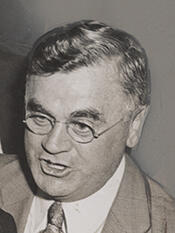
Here you will find contact information for Representative Harry Luther Haines, including email address, phone number, and mailing address.
| Name | Harry Luther Haines |
| Position | Representative |
| State | Pennsylvania |
| District | 22 |
| Party | Democratic |
| Status | Former Representative |
| Term Start | December 7, 1931 |
| Term End | January 3, 1943 |
| Terms Served | 5 |
| Born | February 1, 1880 |
| Gender | Male |
| Bioguide ID | H000026 |
About Representative Harry Luther Haines
Harry Luther Haines (February 1, 1880 – March 29, 1947) was an American businessman and Democratic politician who represented Pennsylvania in the United States House of Representatives for five terms between 1931 and 1943. He was born in Red Lion, York County, Pennsylvania, where he spent much of his life and later built a career in both local business and public service.
Haines received his early education in the public schools of Red Lion. He continued his studies at the State Normal School in Lock Haven, Pennsylvania, an institution focused on training teachers, and then attended Patrick’s Business College in York, Pennsylvania. This combination of general, pedagogical, and business education prepared him for a career in private enterprise and later provided a foundation for his administrative and legislative work in public office.
Entering the cigar industry in the early twentieth century, Haines became engaged in the manufacture and brokerage of cigars from 1906 to 1934, a period during which the cigar trade was a significant component of the regional economy in south-central Pennsylvania. Alongside his business activities, he became increasingly involved in local and state politics. He served as burgess of Red Lion, a position comparable to mayor, from 1921 to 1930, overseeing municipal affairs during a decade of social and economic change. He also participated in party politics at the state level, serving as a delegate to the Democratic State Convention in 1918, which helped establish his standing within the Democratic Party of Pennsylvania.
Haines’s growing prominence in local and state Democratic circles led to his election to the United States House of Representatives. He was elected as a Democrat to the Seventy-second Congress and to the three succeeding Congresses, serving continuously from March 4, 1931, to January 3, 1939. His service in Congress occurred during a significant period in American history, encompassing the Great Depression and the early years of the New Deal. As a member of the House of Representatives, Harry Luther Haines participated in the legislative process, contributed to national policymaking, and represented the interests of his Pennsylvania constituents during a time of economic crisis and extensive federal reform. Despite his incumbency, he was an unsuccessful candidate for reelection in 1938.
After leaving Congress at the beginning of 1939, Haines remained active in public service at the state level. He served in the office of the Pennsylvania State Treasurer in 1939 and 1940, contributing to the administration of the Commonwealth’s financial affairs. In 1940 he successfully returned to national office, winning election to the Seventy-seventh Congress and serving from January 3, 1941, to January 3, 1943. This final term placed him in Congress during the critical early years of American involvement in World War II. He was, however, an unsuccessful candidate for reelection in 1942, bringing his congressional career, which had spanned five terms between 1931 and 1943, to a close.
Following his final departure from Congress, Haines resumed private life while maintaining ties to the industrial community of York County. From 1943 to 1944 he worked as editor of the plant magazine of the York Safe & Lock Company, a prominent manufacturer in the region. In this role he drew on both his business background and his experience in public communication and administration.
Harry Luther Haines died in his hometown of Red Lion, Pennsylvania, on March 29, 1947. He was interred in Red Lion Cemetery, reflecting his lifelong connection to the community where he was born, built his business and political career, and to which he returned after his years of state and national service.