Senator Harry Stewart New
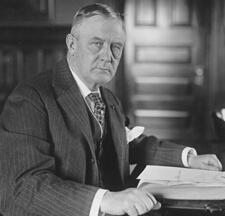
Here you will find contact information for Senator Harry Stewart New, including email address, phone number, and mailing address.
| Name | Harry Stewart New |
| Position | Senator |
| State | Indiana |
| Party | Republican |
| Status | Former Representative |
| Term Start | April 2, 1917 |
| Term End | March 3, 1923 |
| Terms Served | 1 |
| Born | December 31, 1858 |
| Gender | Male |
| Bioguide ID | N000059 |
About Senator Harry Stewart New
Harry Stewart New (December 31, 1858 – May 9, 1937) was a U.S. politician, journalist, and Spanish–American War veteran who became a prominent Republican leader in the early twentieth century. He served as Chairman of the Republican National Committee, a United States senator from Indiana, and United States Postmaster General. Over the course of his public life, New played a notable role in national politics, party organization, and the development of modern political campaigning.
New’s early years were spent in Indiana, where he was raised and educated before entering journalism and public affairs. He became associated with the newspaper business in Indianapolis, a connection that helped shape his understanding of public opinion and political communication. His work as a journalist brought him into close contact with state and national political figures and laid the groundwork for his later prominence in the Republican Party. During the Spanish–American War in 1898, New served in the military, gaining experience as a veteran of that conflict and further enhancing his public standing.
Building on his journalistic and military background, New rose steadily within Republican ranks in Indiana and at the national level. He became active in party organization and strategy, eventually serving as Chairman of the Republican National Committee, a position that placed him at the center of national campaign planning and party leadership. His organizational skills and political connections in Indiana contributed to his selection as a candidate for the United States Senate, reflecting his growing influence within the party.
Harry Stewart New served as a Senator from Indiana in the United States Congress from 1917 to 1923. A member of the Republican Party, he contributed to the legislative process during one term in office, representing the interests of his constituents during a significant period in American history that included the final years of World War I and the early postwar era. As a member of the Senate, New participated in the democratic process and engaged in the debates and policymaking that characterized this transformative time. In late March 1922, he became the first senator to use radio in his campaign, at a time when broadcasting political speeches was not widely done by candidates. His address was transmitted by the U.S. Navy station NOF in Washington, D.C., which prompted a complaint by Democrats about the use of a government facility for partisan purposes and quickly led to a ban on further political use of that station.
New’s Senate career came to an end in 1922 when he was defeated for renomination by former senator Albert J. Beveridge. Beveridge subsequently lost the general election to Democrat Samuel M. Ralston, but New’s own service in the Senate concluded with the close of his term in 1923. Despite this setback, his standing within the Republican Party and his experience in national affairs remained strong, and he soon returned to high office in the federal government.
In 1923, New was appointed Postmaster General in the cabinet of President Warren G. Harding, assuming responsibility for the administration of the United States Post Office Department at a time when communications and mail service were of growing importance to a modernizing nation. He was reappointed to the same post by President Calvin Coolidge in 1925, underscoring the confidence placed in his administrative abilities and political judgment. As Postmaster General, New oversaw postal operations during a period of expanding services and technological change, drawing on his background in journalism and his interest in new methods of communication.
After the end of the Coolidge Administration in 1929, New retired from active business pursuits and continued to reside in Washington, D.C., maintaining his connections to public life while largely withdrawing from day-to-day political activity. In 1933, he returned briefly to public service when he was appointed a United States Commissioner to the Century of Progress Exposition in Chicago, Illinois, a major world’s fair that highlighted American innovation and industry during the early years of the Great Depression.
Harry Stewart New died in Baltimore, Maryland, on May 9, 1937. He was interred in Crown Hill Cemetery in Indianapolis, Indiana, returning in death to the state that had formed the base of his journalistic career and political life. His career encompassed service as a soldier, newspaperman, party leader, United States senator, and cabinet officer, reflecting the broad scope of his involvement in American public affairs during the late nineteenth and early twentieth centuries.