Representative Harry Richard Sheppard
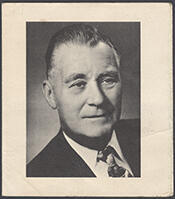
Here you will find contact information for Representative Harry Richard Sheppard, including email address, phone number, and mailing address.
| Name | Harry Richard Sheppard |
| Position | Representative |
| State | California |
| District | 33 |
| Party | Democratic |
| Status | Former Representative |
| Term Start | January 5, 1937 |
| Term End | January 3, 1965 |
| Terms Served | 14 |
| Born | January 10, 1885 |
| Gender | Male |
| Bioguide ID | S000335 |
About Representative Harry Richard Sheppard
Harry Richard Sheppard (January 10, 1885 – April 28, 1969) was an American businessman and Democratic politician who served 14 consecutive terms as a U.S. Representative from California from 1937 to 1965. Over nearly three decades in the House of Representatives, he participated actively in the legislative process during a period marked by the Great Depression, World War II, the early Cold War, and the beginnings of the modern civil rights era, representing and advancing the interests of his California constituents.
Born on January 10, 1885, Sheppard came of age in the closing years of the nineteenth century, a time of rapid industrial and economic change in the United States. Details of his early family life and upbringing are less extensively documented than his public career, but his formative years preceded his entry into business and later politics, shaping the practical outlook he would bring to his work in both fields. His early experiences helped prepare him for a career that would bridge private enterprise and public service.
Before entering national politics, Sheppard established himself as a businessman, gaining experience that informed his later legislative priorities. His work in business provided him with firsthand knowledge of economic conditions and the challenges faced by employers and workers alike. This background contributed to his credibility as a representative of a rapidly growing state whose economy was diversifying in agriculture, industry, and defense-related production during the first half of the twentieth century.
Sheppard’s election to the U.S. House of Representatives in 1936 placed him in the 75th Congress, which convened in January 1937, at the height of the New Deal era. A member of the Democratic Party, he aligned with the congressional majority that supported President Franklin D. Roosevelt’s efforts to address the lingering effects of the Great Depression. During his 14 terms in office, he took part in debates and votes on major national issues, including wartime mobilization, postwar reconstruction, and the expansion of federal programs affecting housing, transportation, veterans, and social welfare. His long tenure reflected sustained support from voters in his California district, who returned him to office through successive elections.
Throughout his congressional service, which extended through the administrations of Roosevelt, Harry S. Truman, Dwight D. Eisenhower, and John F. Kennedy, Sheppard witnessed and contributed to the evolution of federal policy in an era of profound change. He served during World War II and the Korean War, as Congress grappled with questions of national security, foreign policy, and the balance between defense spending and domestic priorities. As a representative from California, a state central to the nation’s defense and aerospace industries and a destination for large-scale migration, he was positioned at the intersection of regional growth and national policy, working to secure resources and infrastructure that would support his constituents’ economic development.
Sheppard remained in the House of Representatives until 1965, concluding a congressional career that spanned 28 years. His service encompassed the early stages of the civil rights movement and the beginning of the Great Society initiatives, and he participated in the democratic process as the federal government’s role in American life expanded significantly. Over the course of his 14 terms, he became part of the institutional continuity of the House, contributing to committee work, floor deliberations, and the day-to-day functioning of Congress during a transformative period in U.S. history.
After leaving Congress in 1965, Sheppard retired from public office, closing a long chapter of service to California and the nation. He lived to see the mid-1960s, a time when many of the trends that had developed during his years in Congress—rapid population growth in the West, the intensification of the Cold War, and the acceleration of civil rights reforms—continued to shape American society. Harry Richard Sheppard died on April 28, 1969. His nearly three decades in the House of Representatives left a record of sustained participation in the legislative process during some of the most consequential years of the twentieth century.