Representative Helen Delich Bentley
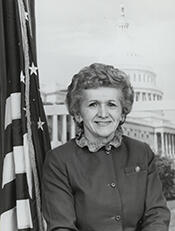
Here you will find contact information for Representative Helen Delich Bentley, including email address, phone number, and mailing address.
| Name | Helen Delich Bentley |
| Position | Representative |
| State | Maryland |
| District | 2 |
| Party | Republican |
| Status | Former Representative |
| Term Start | January 3, 1985 |
| Term End | January 3, 1995 |
| Terms Served | 5 |
| Born | November 28, 1923 |
| Gender | Female |
| Bioguide ID | B000392 |
About Representative Helen Delich Bentley
Helen Delich Bentley (née Delich; November 28, 1923 – August 6, 2016) was an American journalist, maritime expert, and Republican politician who served as a member of the United States House of Representatives from Maryland from January 3, 1985, to January 3, 1995. Over five terms in Congress she represented Maryland’s 2nd congressional district, participating actively in the legislative process and advocating for the interests of her constituents, particularly in matters related to trade, transportation, and the maritime industry.
Bentley was born on November 28, 1923, in the copper-mining town of Ruth, Nevada, to immigrant Serbian parents. Her father worked as a miner and died of silicosis, a common miner’s disease, when she was eight years old. Following his death, Bentley took a part-time job in a dress shop, while her mother took in boarders to support the family. During high school in nearby Ely, Nevada, she developed an early interest in journalism and politics while working on the local weekly newspaper, published by Republican state legislator Charles Russell. Her aptitude for reporting and public affairs earned her scholarships to study journalism at the University of Missouri, where she graduated with honors in 1944 with a Bachelor of Arts degree. While in college, she worked on the successful 1942 U.S. Senate campaign of Nevada Democrat James G. Scrugham and subsequently served as his Senate secretary, gaining early exposure to national politics and legislative work.
After graduating, Bentley began her journalism career at small-town newspapers in Fort Wayne, Indiana, and Lewiston, Idaho. Determined to cover hard news at a major publication at a time when most female journalists were relegated to society pages, she wrote to leading East Coast newspapers seeking a reporting position. In 1945, The Baltimore Sun hired her as a reporter. She initially covered labor and union issues before being assigned to the maritime and waterfront beat, a critical area in a city whose port was central to Maryland’s economy. Bentley became one of the nation’s foremost maritime reporters, covering issues ranging from dock labor to port development and shipping policy, and she also wrote for port agencies and shipping companies. Beginning in 1950, she expanded into television, hosting and producing a pioneering local program on Baltimore’s WMAR-TV, The Port That Built a City, later retitled The Port That Built a City and State. The show, which she produced until 1965, featured early live remote broadcasts from ships in Baltimore Harbor and helped educate the public and policymakers about the economic importance of maritime trade. During the Vietnam War, Bentley traveled to Southeast Asia to report on severe congestion at the port of Saigon, and her reporting on logistical problems in supplying American troops drew the attention of President Lyndon B. Johnson, contributing to subsequent improvements at port facilities in Cam Ranh Bay.
Bentley’s expertise in maritime affairs led to her appointment to federal office. In 1969, she was offered a seat on the Federal Maritime Commission; she declined the associate position and instead requested the chairmanship. President Richard Nixon appointed her chair of the Federal Maritime Commission, a post she held from 1969 to 1975. In that role, she became the highest-ranking woman in the Nixon administration. As chair, she advocated vigorously for federal support of American shipbuilding yards and the U.S. Merchant Marine, emphasizing the strategic and economic importance of a strong domestic maritime industry. Her tenure solidified her national reputation as a forceful and knowledgeable advocate for maritime and trade policy.
Bentley entered electoral politics in Maryland at the start of the 1980s. She challenged Democratic incumbent Clarence D. Long for Maryland’s 2nd congressional district in 1980 and again in 1982, narrowly losing both races. On her third attempt, in the 1984 election, she defeated Long and was elected to the 99th Congress. She was subsequently reelected to the four succeeding Congresses, serving five consecutive terms from January 3, 1985, to January 3, 1995. As a Republican member of the House of Representatives, Bentley was known for her strong advocacy of protectionist trade policies designed to bolster U.S. manufacturing, shipbuilding, and the U.S. Merchant Marine fleet. She played a key role in legislation that authorized dredging of the Chesapeake Bay, enabling larger cargo vessels to access the Port of Baltimore and thereby strengthening the regional economy. Her service in Congress took place during a significant period in American history, spanning the final years of the Cold War, the Gulf War, and the early post–Cold War era, and she consistently emphasized infrastructure, trade, and industrial competitiveness. In the 1990s, reflecting her Serbian heritage, she expressed sympathy for Serbians during the civil war in Yugoslavia and opposed U.S. military intervention in the conflict.
In 1994, Bentley chose not to seek reelection to the 104th Congress and instead ran for governor of Maryland as a Republican. Despite receiving an unusual cross-party endorsement from the incumbent Democratic governor, William Donald Schaefer, she was defeated in the Republican primary by Ellen Sauerbrey, who ran as the more conservative candidate. Bentley returned to private life but remained politically active. When her congressional successor, Bob Ehrlich, vacated the 2nd district seat to run for governor in 2002, she sought to regain her former seat. By that time, redistricting had altered the district’s boundaries, adding a substantial portion of Baltimore City that she had not previously represented and making the district more Democratic. She lost the general election to Baltimore County Executive C. A. Dutch Ruppersberger.
After leaving Congress in 1995, Bentley founded Helen Bentley & Associates, Inc., a consulting firm specializing in international trade, business, and government affairs. She continued to serve as a consultant to the Maryland Port Administration and the Port of Baltimore, lending her expertise to efforts to maintain and expand the port’s competitiveness. She also served on the Board of Trustees of the Baltimore Museum of Industry and was involved with the Maritime Industries Academy High School, reflecting her longstanding commitment to maritime education and industrial heritage. Her contributions to the maritime field were widely recognized: in 2004 she was inducted into the International Maritime Hall of Fame, and in 2006, as part of the Port of Baltimore’s 300th anniversary celebrations, the port was officially renamed the Helen Delich Bentley Port of Baltimore in her honor. She was also inducted into the Maryland Women’s Hall of Fame and received several major awards from the State of Maryland, including the Speaker’s Medallion, the First Citizen Award, and the Governor’s International Leadership Award.
Helen Delich Bentley married William Roy Bentley, who predeceased her in 2003 after suffering a stroke; the couple had no children. She remained a prominent figure in Maryland public life and maritime circles well into her later years. Bentley died of brain cancer at her home in Timonium, Maryland, on August 6, 2016, at the age of 92.