Representative Helen Chenoweth-Hage
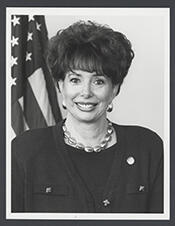
Here you will find contact information for Representative Helen Chenoweth-Hage, including email address, phone number, and mailing address.
| Name | Helen Chenoweth-Hage |
| Position | Representative |
| State | Idaho |
| District | 1 |
| Party | Republican |
| Status | Former Representative |
| Term Start | January 4, 1995 |
| Term End | January 3, 2001 |
| Terms Served | 3 |
| Born | January 27, 1938 |
| Gender | Female |
| Bioguide ID | C000345 |
About Representative Helen Chenoweth-Hage
Helen Margaret Palmer Chenoweth-Hage (born Helen Margaret Palmer; January 27, 1938 – October 2, 2006) was an American politician from the state of Idaho who served three terms as a Republican Representative in the United States House of Representatives from 1995 to 2001. She remains one of only two women ever to represent Idaho in the United States Congress and the only one from the Republican Party. During her tenure, she was regarded as one of the most conservative members of the House and became a prominent, often polarizing, figure in Idaho and national politics.
Chenoweth-Hage was born on January 27, 1938, in Kansas. When she was a year old, her family moved west to Los Angeles, California, and when she was 12 they moved again, settling in southern Oregon to run a dairy farm near Grants Pass. She grew up as a musician, horse enthusiast, and athlete, interests that would remain with her throughout her life. Talented on the double bass, she attended Whitworth College in Spokane, Washington, on a music scholarship. While working in the college cafeteria—she as a waitress and he as a cook—she met fellow student Nick Chenoweth. The two married in 1958.
Following their marriage, Helen and Nick Chenoweth settled in Orofino, Idaho, Nick’s hometown, where they had two children, Michael and Margaret (“Meg”). The couple operated a ski shop near the modest Bald Mountain ski area, reflecting their interest in outdoor recreation. As her husband later attended the University of Idaho College of Law in Moscow, Helen developed and managed the Northside Medical Clinic. In that role she initiated a physician recruitment practice focused on bringing medical professionals to underserved rural communities, an early indication of her interest in rural issues and local autonomy. The Chenoweths divorced in 1975. After the divorce, she moved to Boise, Idaho, where she became executive director of the Idaho Republican Party, marking her full-time entry into partisan politics.
In 1977, Chenoweth began working for then-Congressman Steve Symms as his district director, a position she held through his re-election in 1978. This experience gave her direct exposure to congressional operations and constituent service. After leaving Symms’s office, she founded her own firm, Consulting Associates, and became a noteworthy lobbyist in Idaho’s capital city. During the 1980s she also worked for a natural-resources consulting firm, a period during which she later acknowledged having carried on a six-year extramarital relationship with rancher Vernon Ravenscroft. She would later distinguish this episode from the conduct of public officials by emphasizing that she was a private citizen at the time and stating that she had sought and received God’s forgiveness.
Chenoweth entered electoral politics in her own right in 1994. That year she sought the Republican nomination for Idaho’s 1st Congressional District, running on a strongly conservative platform that emphasized limited government, opposition to federal regulation, and support for property rights and school prayer. She won the Republican primary over former Lieutenant Governor David H. Leroy and two other challengers, and she pledged to serve no more than three terms in the U.S. House if elected. In the general election she defeated two-term Democratic incumbent Larry LaRocco by a margin of 55 percent to 45 percent, a swing of nearly 31 points from LaRocco’s 20-point victory in 1992. Her campaign attacked LaRocco for his support of the Omnibus Budget Reconciliation Act of 1993, noting that he was the only member of Idaho’s congressional delegation in either chamber to back the bill. Her victory came amid the 1994 Republican wave that returned the party to control of the House for the first time in 40 years and was part of a broader reversion of historically Republican districts to GOP representation.
Taking office in January 1995, Chenoweth quickly emerged as one of the “true believers” in the large Republican freshman class. She was widely regarded as one of the most conservative members of the House; one measure later placed her as the most conservative woman to serve in Congress between 1937 and 2004. She was a staunch opponent of what she viewed as excessive federal regulation, particularly in environmental and land-use policy, and she was a strong supporter of school prayer and a broad conception of individual liberties. With her election, she became the second woman, after Democrat Gracie Pfost, to represent Idaho in Congress. She was also one of the relatively few members to be chosen by her colleagues to chair a subcommittee after only one term, becoming chair of the House Subcommittee on Forests and Forest Health. She insisted on being addressed as “Congressman Chenoweth,” a usage that drew public comment at a time when “Congresswoman” was more common.
Chenoweth-Hage’s congressional career was marked by both fervent support from her base and sharp criticism from opponents. She articulated and defended what she described as a “freedom” philosophy, emphasizing private property rights and skepticism of federal authority, particularly in the rural West. Her critics sometimes referred to her as a “poster-child for the militias,” reflecting concern over her alignment with anti-federal sentiments. In February 1995 she drew national attention when she voiced suspicions that armed federal agents were landing “black helicopters” on Idaho ranchers’ property to enforce the Endangered Species Act, echoing a longstanding conspiracy theory. She stated that although she had never seen such helicopters herself, “enough people in my district have become concerned that I can’t just ignore it. We do have some proof.” She also gained notice for holding “endangered salmon bakes” at campaign fundraisers, serving canned salmon to ridicule the listing of Idaho salmon as an endangered species, and was quoted as saying, “It’s the white, Anglo-Saxon male that’s endangered today.”
Electorally, Chenoweth proved resilient in a competitive district. In 1996 she faced a strong challenge from Democratic activist Dan Williams and was narrowly reelected, 49 percent to 48 percent, likely aided by Republican presidential nominee Bob Dole’s strong performance in the district. She again faced Williams in 1998 and won by a wider margin, 55 percent to 45 percent. Throughout her three terms, she remained a loyal Republican and a consistent critic of the Clinton administration. In November 1997 she was one of eighteen House Republicans to co-sponsor a resolution by Representative Bob Barr seeking to initiate an impeachment inquiry into President Bill Clinton, a move that predated the Clinton–Lewinsky scandal. After that scandal became public, she was among the first members of Congress to call for Clinton’s resignation. On October 8, 1998, she voted in favor of opening a formal impeachment inquiry, and on December 19, 1998, she voted in favor of all four proposed articles of impeachment against the president, two of which were adopted by the House.
During her final term in Congress, Chenoweth married Nevada rancher and author Wayne Hage in Boise in 1999 and thereafter used the name Helen Chenoweth-Hage. Despite later expressing regret over her self-imposed term limit pledge and calling term limits “bad policy,” she honored her commitment and did not seek a fourth term in 2000. She left office in January 2001 and was succeeded by Republican Lieutenant Governor C. L. “Butch” Otter. Since her retirement, no woman has represented Idaho in either house of Congress, underscoring the rarity of her service as a female member of the state’s delegation. Her three terms from 1995 to 2001 coincided with a significant period in American political history, including the Republican takeover of Congress and the impeachment of a sitting president, and she participated actively in the legislative and oversight processes during that time.
After leaving Congress, Chenoweth-Hage moved to Hage’s Pine Creek Ranch in central Nevada, where the couple continued to write and speak on private property rights and federal land-use issues, remaining influential in Western conservative and ranching circles. She also continued to draw public attention for her views on civil liberties and federal authority. In 2003, at Boise Airport, she was selected by the Transportation Security Administration for a hand search before boarding a flight to Nevada. When officials declined her request to see the regulation authorizing such a search without specific cause, she refused to submit and instead rented a car for the 300-mile trip. She criticized the incident by saying, “Our borders are wide open and yet they’re shaking down a 66-year-old white grandmother they greeted by name. It’s time the American people say no to this kind of invasion. It’s a question of personal privacy. There shouldn’t be that kind of search without reasonable cause.”
Chenoweth-Hage’s later years were marked by personal as well as public events. Her first husband, Nick Chenoweth, died in 2002 at age 66. Her second husband, Wayne Hage, died on June 5, 2006, at age 68 after being treated for cancer. On October 2, 2006, Helen Chenoweth-Hage was killed when the sport utility vehicle in which she was a passenger overturned on an isolated highway in central Nevada near Tonopah. She was not wearing a seatbelt and was thrown from the vehicle; her stepdaughter-in-law and grandson, who were also in the vehicle, suffered only minor injuries. A memorial service for Chenoweth-Hage was held in Meridian, Idaho, on October 9, 2006, and she was buried alongside her husband Wayne Hage at the Pine Creek Ranch Family Cemetery in Monitor Valley, Nevada.