Representative Helen S. Meyner
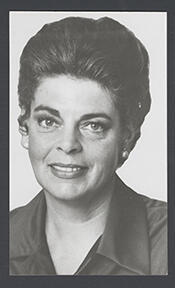
Here you will find contact information for Representative Helen S. Meyner, including email address, phone number, and mailing address.
| Name | Helen S. Meyner |
| Position | Representative |
| State | New Jersey |
| District | 13 |
| Party | Democratic |
| Status | Former Representative |
| Term Start | January 14, 1975 |
| Term End | January 3, 1979 |
| Terms Served | 2 |
| Born | March 5, 1929 |
| Gender | Female |
| Bioguide ID | M000685 |
About Representative Helen S. Meyner
Helen Day Stevenson Meyner (March 5, 1929 — November 2, 1997) was an American politician from New Jersey and a member of the Democratic Party who served as a U.S. Representative from New Jersey from 1975 to 1979. Over two terms in the House of Representatives, she contributed to the legislative process during a significant period in American political history, representing the interests of her constituents in a newly redistricted district. She was also widely known as the wife of New Jersey Governor Robert B. Meyner and served as First Lady of New Jersey from 1957 to 1962. Earlier in her life, she had served overseas during the Korean War as a Red Cross nurse and Clubmobile worker, experiences that shaped her outlook on public service and international affairs.
Meyner was born Helen Stevenson in New York City to William E. and Eleanor B. Stevenson, members of a prominent Democratic family. Her father, William E. Stevenson, was a founder of the law firm that later became Debevoise & Plimpton, served as president of Oberlin College, and was appointed United States Ambassador to the Philippines. Through her family, she was connected to the broader Stevenson political lineage, which included Illinois governor and two-time Democratic presidential nominee Adlai Stevenson II. Raised in a politically engaged household, she was exposed early to public affairs and Democratic Party politics, influences that would later inform her own political career.
Stevenson received her early education at Rosemary Hall, a preparatory school that later became part of Choate Rosemary Hall in Connecticut, graduating in 1946. She went on to attend Colorado College, where she studied history and earned a Bachelor of Arts degree in 1950. Her academic training in history, combined with her family’s tradition of public service, provided a foundation for her later work in government and politics. Shortly after completing her undergraduate studies, she chose to serve overseas with the American Red Cross during the Korean War, a decision that placed her in close proximity to the human costs of conflict.
From 1950 to 1952, Stevenson worked as a field worker for the American Red Cross in East Asia, initially serving as a nurse in an American military hospital in Japan from 1950 to 1951. The hospital was severely understaffed and under-equipped, and she observed firsthand the inadequacies in care, particularly in addressing the mental health needs of wounded soldiers. Through her patients she learned of the conditions in Korea and came to believe that Western media coverage did not accurately reflect the realities of the war. In April 1951 she was transferred to Pusan, Korea, where she served as a Clubmobile worker, providing coffee, doughnuts, and recreational support to soldiers returning to base. She described Korea as extremely impoverished and “dirty” in comparison to Japan and wrote candidly about the poverty she witnessed among Koreans. Her letters from this period, preserved in the Meyner Papers at Skillman Library at Lafayette College, offer a detailed personal account of her duties, her discontent with Red Cross administration and the treatment of volunteers, and her reflections on gender, race, and hierarchy within the multinational forces. She noted the particular attention she received as one of the few white American women in the war zone and commented on the preferential treatment afforded to American troops compared with foreign soldiers. These letters later became a source for scholarly work, including Kara Dixon Vuic’s 2019 book “The Girls Next Door: Bringing the Home Front to the Front Lines,” which highlighted Meyner in a chapter titled “Dancing for Democracy,” and images from this period have been featured in the online exhibit “Coffee, Doughnuts, and a Witty Line of Chatter.”
On January 19, 1957, Helen Stevenson married Robert B. Meyner, then serving as governor of New Jersey, in a ceremony held in Oberlin, Ohio. Through this marriage she became First Lady of New Jersey, a role she held from 1957 until the end of her husband’s second term in 1962, when he left office due to term limits. As first lady, she participated in the ceremonial and public aspects of state government, supporting her husband’s administration and engaging in civic and charitable activities typical of gubernatorial spouses in that era. Her experience in the governor’s mansion further acquainted her with the workings of state government and the demands of public life, deepening her involvement in Democratic politics in New Jersey.
Meyner’s own electoral career began in earnest in the early 1970s. In 1972, she ran as the Democratic nominee for the U.S. House of Representatives from New Jersey’s newly redistricted 13th Congressional District, which included her home in Phillipsburg and encompassed Hunterdon, Sussex, and Warren Counties, along with portions of Mercer and Morris Counties. The district leaned Republican, and she was defeated by the Republican candidate, Joseph J. Maraziti. Two years later, in the 1974 elections, held in the aftermath of the Watergate scandal and amid Democratic gains nationwide, she again sought the seat. This time she defeated Maraziti, winning election to the 94th Congress and beginning her service in the House of Representatives in January 1975. She was known as a liberal Democrat, aligning with the more progressive wing of her party during a period marked by debates over post-Watergate reforms, economic challenges, and evolving foreign policy.
During her tenure in Congress from 1975 to 1979, Meyner served two consecutive terms, participating in the democratic process at the federal level and representing the interests of her constituents in northwestern New Jersey. She was re-elected in 1976 in a closely contested race against Republican William E. Schluter, reflecting the competitive nature of her district. In the House, she contributed to legislative deliberations during a time of significant national transition, though the record provided here does not enumerate specific committee assignments or bills. In the 1978 elections she sought a third term but was defeated by Republican James A. Courter, ending her congressional service in January 1979. Her prominence as a female officeholder in this period was recognized in 1979 when she was included in the Supersisters trading card set, a series produced and distributed to highlight notable women; one of the cards featured her name and picture.
In her later years, Meyner remained associated with the legacy of public service that had characterized both her family of birth and her married life. Her wartime correspondence continued to attract scholarly interest, and her role as a pioneering woman in New Jersey and national politics was noted in historical treatments of the era. Helen Day Stevenson Meyner died on November 2, 1997, closing a life that spanned service in wartime, duties as a governor’s spouse, and two terms in the United States Congress.