Senator Henrik Shipstead
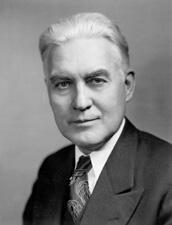
Here you will find contact information for Senator Henrik Shipstead, including email address, phone number, and mailing address.
| Name | Henrik Shipstead |
| Position | Senator |
| State | Minnesota |
| Party | Republican |
| Status | Former Representative |
| Term Start | December 3, 1923 |
| Term End | January 3, 1947 |
| Terms Served | 4 |
| Born | January 8, 1881 |
| Gender | Male |
| Bioguide ID | S000369 |
About Senator Henrik Shipstead
Henrik Shipstead (January 8, 1881 – June 26, 1960) was a Norwegian-American dentist and politician who served as a United States Senator from Minnesota from March 4, 1923, to January 3, 1947. Over the course of four terms in the Senate, he became one of the most consistent opponents of U.S. foreign interventionism in Congress, even as he rejected the label of “isolationist” and ultimately voted to declare war on Japan after the attack on Pearl Harbor. His long career in public life was marked both by his influence on foreign policy debates and by his notoriety for antisemitism and support of anti-Jewish conspiracy theories.
Shipstead was born on a farm in Kandiyohi County, Minnesota, on January 8, 1881, to Norwegian immigrant parents. Raised in a rural Scandinavian-American community, he grew up in an environment that shaped both his cultural identity and his later political base, which drew heavily on Minnesota’s large Scandinavian population. In the early twentieth century, after completing his professional training, he established himself as a dentist. He opened a dental practice in Glenwood in neighboring Pope County, where he quickly became a prominent local citizen. His standing in the community led to his election as president of the village council of Glenwood, an early indication of his interest in public affairs and local governance.
Shipstead’s formal political career began in state politics as a member of the Republican Party. He was elected to the Minnesota House of Representatives and served one term from 1917 to 1919. In 1918, he sought higher office by running in the Republican primary for Minnesota’s 7th congressional district, narrowly losing to the incumbent, Andrew Volstead. Undeterred, he ran for governor of Minnesota in 1920 as an Independent, challenging Republican J. A. O. Preus. Although he was defeated, he finished a strong second with over 35 percent of the vote, demonstrating his appeal beyond traditional party structures and positioning himself as a significant figure in the state’s emerging progressive and agrarian reform movements.
In 1922, Shipstead returned to public office when he was elected to the United States Senate from Minnesota under the banner of the newly formed Minnesota Farmer-Labor Party. He took his seat on March 4, 1923, becoming the first Farmer-Laborite elected to the Senate and, for many years, the only member of that party in the chamber. While he generally supported the Farmer-Labor Party’s left-leaning and agrarian reform agenda, he rejected the more extreme anti-capitalist positions espoused by some within the movement. Despite his third-party affiliation, he secured appointment to the powerful Senate Foreign Relations Committee, where he would leave his most enduring legislative and ideological mark. He was reelected as a Farmer-Labor senator in 1928 and 1934, continuing to represent Minnesota’s agrarian and labor interests during the tumultuous years of the Great Depression.
Throughout his Senate career, Shipstead was a prominent critic of U.S. involvement in international organizations and foreign interventions. He opposed American entry into the League of Nations and the World Court and called for the cancellation of German reparations after World War I, which he regarded as vindictive and destabilizing. Unlike many non-interventionists associated with the Old Right, he also condemned U.S. military occupations in Haiti, the Dominican Republic, and Nicaragua, attributing these actions to the Roosevelt Corollary to the Monroe Doctrine, which he argued had turned the United States into an overbearing “policeman of the western continent.” At the same time, he did not consider himself an isolationist; he distinguished between political and military non-intervention abroad and what he saw as economic isolationism at home. He opposed the Smoot-Hawley Tariff of 1930, denouncing it as “one of the greatest and most vicious isolationist policies this government has ever enacted,” and argued that high tariffs raised prices for consumers, enriched monopolies, and impoverished ordinary people. Known as affable and dignified in personal dealings, he once remarked, “It doesn’t necessarily follow that a radical has to be a damned fool.”
In addition to his foreign policy positions, Shipstead played a role in shaping the physical and aesthetic development of the nation’s capital. Along with Representative Robert Luce of Massachusetts, he co-sponsored legislation that expanded the authority of the United States Commission of Fine Arts. Their measure, known as the Shipstead–Luce Act, extended the commission’s purview to include the review of new buildings on private land facing federal property in Washington, D.C. The commission, originally established in 1910, was charged with reviewing new buildings, memorials, monuments, and public art on federal property; the Shipstead–Luce Act, which remains in effect, significantly broadened federal oversight of the capital’s architectural and visual environment.
By the late 1930s, Shipstead had grown increasingly disillusioned with the direction of the Farmer-Labor Party, charging that Communist elements were gaining control within its ranks. He left the party and returned to the Republican Party, under whose banner he successfully sought reelection in 1940, beginning his final term as a Republican senator in 1941. His service in Congress from 1923 to 1947 thus spanned four terms and two party affiliations—first as a Farmer-Labor senator from 1923 to 1941, and then as a Republican from 1941 to 1947. During this period, he continued to participate actively in the legislative process, representing Minnesota’s interests and maintaining his distinctive stance on foreign policy. He was a vocal opponent of President Franklin D. Roosevelt’s efforts to move the United States toward involvement in the European war prior to Pearl Harbor, and he remained one of the most tenacious congressional critics of intervention. After the Japanese attack on Pearl Harbor in December 1941, however, he voted in favor of the declaration of war on Japan, even as he continued to assert his independence from the Roosevelt administration. He opposed the Selective Service Acts in both 1940 and October 1942, placing himself among a small minority in the Senate willing to vote against conscription during wartime.
Shipstead’s congressional career was also marked by his antisemitism and his association with prominent figures who espoused similar views. He was an outspoken ally of industrialist Henry Ford and aviator Charles Lindbergh, both of whom were known for their antisemitic rhetoric. Shipstead trafficked in anti-Jewish conspiracy theories and openly endorsed The Protocols of the Elders of Zion, a notorious antisemitic forgery, which he claimed to believe was factual and which he frequently urged others to read. His views on foreign policy and his perceived “isolationism” drew criticism both at home and abroad. In April 1943, British diplomat and political analyst Isaiah Berlin, in a confidential report to the British Foreign Office, described him as “a rabid Isolationist of Norwegian descent, elected largely by the Scandinavian vote,” calling him “a very narrow, bigoted, crotchety man” and noting his intense antagonism toward Minnesota Governor Harold Stassen. Within the Senate, his positions sometimes provoked personal protest; on one occasion, southern senators J. Lister Hill, John H. Bankhead II, Tom Stewart, Kenneth McKellar, Richard Russell Jr., and Walter F. George rose from the Senate lunch counter and left when Shipstead attempted to join them, later explaining that they “would not associate” with him because of his isolationist views. After a private argument with the same group, Shipstead complained of what he termed the “extreme Anglophilia of the southern states,” while Russell reportedly said that Shipstead was “a chicken” who was “in kahoots” with Germany.
In the final phase of his Senate career, Shipstead’s long-standing opposition to international organizations culminated in his stance on the creation of the United Nations. His vote against U.S. entry into the United Nations was widely seen as the predictable capstone of decades of resistance to foreign entanglements. He feared that the UN would foster a world superstate and believed that the major powers would use it as an instrument to dominate smaller nations. He and Senator William Langer of North Dakota were the only two senators to vote against the United Nations Charter, and both were also among the seven senators who opposed full United States entry into the organization. These positions, taken at a moment when a new bipartisan “internationalist” consensus was forming in American politics, likely contributed to his political downfall. In 1946, as internationalist Republicans led by Governor Edward John Thye and former Governor Harold Stassen gained control of the Minnesota Republican Party, Shipstead lost the Republican primary for his Senate seat to Thye, ending his twenty-four-year tenure in the Senate.
After his defeat in 1946, Shipstead retired from public life and returned to rural western Minnesota. He withdrew from national politics and lived quietly in retirement, far from the intense foreign policy debates that had defined much of his congressional career. Henrik Shipstead died in Minnesota on June 26, 1960, closing the life of a figure who had played a prominent, controversial, and often contrarian role in American political and foreign policy history during the first half of the twentieth century.