Representative Henry William Blair
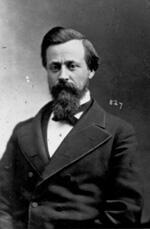
Here you will find contact information for Representative Henry William Blair, including email address, phone number, and mailing address.
| Name | Henry William Blair |
| Position | Representative |
| State | New Hampshire |
| District | 1 |
| Party | Republican |
| Status | Former Representative |
| Term Start | December 6, 1875 |
| Term End | March 3, 1895 |
| Terms Served | 5 |
| Born | December 6, 1834 |
| Gender | Male |
| Bioguide ID | B000524 |
About Representative Henry William Blair
Henry William Blair (December 6, 1834 – March 14, 1920) was a United States Representative and Senator from New Hampshire and a prominent Republican legislator during the late nineteenth century. Born in Campton, Grafton County, New Hampshire, he was orphaned at an early age and raised by relatives, working on farms and in local industries during his youth. Despite limited formal schooling, he pursued self-education and studied law while supporting himself through various occupations, including work as a teacher and in a sawmill. His early experiences in rural New Hampshire and his self-made path into the professions helped shape his later interest in social reform, public education, and the welfare of working people.
Blair studied law in Plymouth, New Hampshire, and was admitted to the bar in 1859, commencing practice in Plymouth. He quickly became active in public affairs and aligned himself with the emerging Republican Party. With the outbreak of the American Civil War, he entered the Union Army, serving with distinction and rising to the rank of lieutenant colonel. His wartime service as a faithful soldier in the war of the rebellion reinforced his standing in Republican circles and deepened his commitment to the Union cause, veterans’ interests, and the broader program of Reconstruction that followed.
After the war, Blair resumed his legal practice and entered state politics. He served in the New Hampshire House of Representatives and later in the New Hampshire Senate, where he gained a reputation as an able, honest, and courageous advocate of Republican principles and moral reform. Identified initially with the Radical Republicans, he supported strong federal measures to secure the rights of formerly enslaved people and to reshape Southern society. Over time, however, he became associated with the moderate “Half-Breed” faction of the Republican Party, which emphasized civil service reform and administrative efficiency, often at the expense of the more sweeping racial and social equality efforts championed by earlier Radical leaders.
Blair was first elected as a Representative from New Hampshire to the United States House of Representatives in the Forty-fourth Congress, beginning his service in Washington in 1875. A member of the Republican Party, he contributed to the legislative process during a period of postwar adjustment and industrial expansion, representing the interests of his New Hampshire constituents and participating actively in the democratic process. In 1879 he was elected to the United States Senate, where he served until 1891. During his years in both chambers, his record in Congress, as an advocate of radical Republican principles in his early career and of a range of moral reforms—particularly temperance reform—was highly spoken of by contemporaries.
As a senator, Blair became best known for his work on education and labor issues. He served as chairman of the Committee on Education and Labor during the Forty-seventh through the Fifty-first Congresses, using that position to promote an expanded federal role in public education. In the 1880s he repeatedly introduced what became known as the “Blair Education Bill,” which proposed substantial federal aid to public schools, with the goal of improving literacy and educational opportunity, especially in the South. The bill passed the Senate on three occasions and received endorsement from presidents, but it never secured passage in the House of Representatives. Blair’s correspondence with African American leaders, including Frederick Douglass—whom he told that the Republican Party must “return to the fundamental issues which stir the heart and touch the life of the Republic”—reflected his belief that education and moral reform were central to the nation’s future.
Blair’s legislative interests extended beyond education. Like many Republicans of his era, he favored higher protective tariffs, the gold standard, and generous pensions for Union veterans of the Civil War. He was a vigorous supporter of temperance and sought to address alcohol abuse through federal policy. During late 1882 and early January 1883, he attached an amendment to the Pendleton Civil Service Reform Act that would have prohibited the hiring of habitual drunkards to federal government positions, illustrating his effort to link civil service reform with moral improvement. Although he played a role in shaping the debate, he ultimately did not vote on the final passage of the Pendleton Act. His broader record in Congress earned him a reputation as a diligent and principled legislator and a faithful member of the national House and Senate.
In 1891 President Benjamin Harrison offered Blair an appointment as judge of the United States District Court for the District of New Hampshire, which Blair declined. That same year, on March 6, 1891, he accepted appointment as Envoy Extraordinary and Minister Plenipotentiary to China. His nomination, however, provoked strong objections from the Chinese government, which declared him persona non grata because of his role in and abusive remarks pertaining to the passage of the Chinese Exclusion Act. As a result of this diplomatic impasse, Blair tendered his resignation from the post, and his resignation was accepted on October 6, 1891. This episode marked a notable setback in an otherwise steady public career and underscored the international repercussions of U.S. exclusionary immigration policies.
Blair returned to electoral politics soon thereafter. Again elected to the United States House of Representatives in 1892, he served from March 4, 1893, to March 3, 1895. This period brought his total House service to five terms between 1875 and 1895, complementing his twelve years in the Senate and marking two decades of influence in Congress during a significant period in American history. He was not a candidate for reelection in 1894 and instead chose to retire from elective office. After leaving Congress, Blair engaged in the practice of law in Washington, D.C., where he remained professionally active and continued to be identified with Republican politics, veterans’ causes, and educational reform.
Henry William Blair died in Washington, D.C., on March 14, 1920. His long public career—from Civil War service and early Radical Republicanism to leadership on education and labor issues and later association with the Half-Breed reformers—reflected the major political and social currents of the post–Civil War United States. He was remembered by supporters as an able, honest, and courageous man, a faithful soldier in the Union cause, and a persistent advocate of moral and educational reform in national life.