Representative Henry Taylor Blow
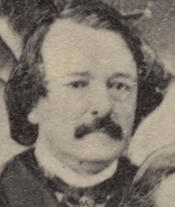
Here you will find contact information for Representative Henry Taylor Blow, including email address, phone number, and mailing address.
| Name | Henry Taylor Blow |
| Position | Representative |
| State | Missouri |
| District | 2 |
| Party | Republican |
| Status | Former Representative |
| Term Start | December 7, 1863 |
| Term End | March 3, 1867 |
| Terms Served | 2 |
| Born | July 15, 1817 |
| Gender | Male |
| Bioguide ID | B000572 |
About Representative Henry Taylor Blow
Henry Taylor Blow (July 15, 1817 – September 11, 1875) was a Missouri industrialist, abolitionist, state legislator, diplomat, and two-term Republican Representative in the United States Congress. He also served as United States Minister to Venezuela and to Brazil, and played a notable role in the events surrounding the Dred Scott case and in the congressional debates over Reconstruction following the Civil War.
Blow was born in Southampton County, Virginia, the eighth of ten children of Captain Peter Blow and Elizabeth (Taylor) Blow, slaveholders who owned Dred Scott before selling him to Dr. John Emerson. In Henry’s childhood the family left Virginia for Huntsville, Alabama, where his father unsuccessfully attempted farming, and in 1830 they moved again to St. Louis, Missouri. There Peter Blow opened a boarding house and hired out his enslaved laborers, including Dred Scott, who worked as a roustabout. Henry’s mother died in 1831 and his father in 1832, leaving the family in straitened circumstances. Although Peter Blow’s estate was left to his two unmarried daughters and Henry’s younger brothers, Taylor and William, Henry—then only about fifteen—was expected to support himself. His married sister, Charlotte Taylor Blow, who had wed Joseph Charless Jr. in 1831, likewise received no inheritance, and the Charless family became important to Henry’s early livelihood.
Blow attended Saint Louis University, from which he graduated before beginning an apprenticeship in a law office. The deaths of his parents, however, forced him to abandon legal training and seek immediate employment. He became a clerk in the wholesale drug and paint business of his brother‑in‑law, Joseph Charless Jr., whose father had founded the first newspaper west of the Mississippi River. When Joseph Charless Sr. retired in 1836, Blow was made a partner in the firm, which in 1838 was renamed Charless, Blow & Company. The partnership was dissolved in 1844: Charless retained the drugstore, while Blow took over the manufacturing side of the enterprise, which evolved into the Collier White Lead and Oil Company, later one of the largest factories in St. Louis. Blow expanded his business interests beyond paints and oils. With his brother Peter he organized the Granby Mining and Smelting Company, and he served as president of the Iron Mountain Railroad for a time, helping to develop rail access to Missouri’s mineral resources. He also assisted in establishing a furnace for the iron industry in Carondelet, then a separate city south of St. Louis.
Despite his Southern birth and family background in slaveholding, Blow became an abolitionist. His family’s earlier ownership of Dred Scott and Scott’s later residence in free territories shaped his views. After Scott had been sold to Dr. Emerson and taken to Illinois and the Wisconsin Territory—both free jurisdictions—Scott eventually returned to St. Louis and sought to claim his freedom. Blow encouraged Scott to sue, arguing that Scott’s residence on free soil should entitle him to emancipation, and both men contributed funds to support the litigation. The case, Dred Scott v. Sandford, ultimately reached the United States Supreme Court, which in 1857 ruled that enslaved people were property and not citizens, and that Congress lacked authority to prohibit slavery in the territories. Although Scott lost in court, he did later obtain his freedom when Dr. Emerson’s widow transferred him to Henry’s brother Taylor Blow, who manumitted him. Blow, a convert to Catholicism, later ensured that Dred Scott was buried in Calvary Cemetery in St. Louis.
Blow’s antislavery convictions drew him into politics. In 1854 he joined the newly formed Republican Party, attracted by its opposition to the expansion of slavery. That same year he was elected to the Missouri Senate, where he served from 1854 to 1858. In 1860 he was a Missouri delegate to the Republican National Convention in Chicago, which nominated Abraham Lincoln for the presidency. Recognizing his political loyalty and commercial experience, President Lincoln appointed Blow United States Minister to Venezuela in 1861. In that post, which he held until 1862, Blow worked to improve trade relations between Venezuela and the Mississippi Valley, but he soon resigned and returned home in order to support the Union cause more directly during the Civil War.
In 1862 Blow was elected as a Republican and Immediate Emancipationist to the United States House of Representatives from Missouri, serving in the Thirty‑eighth Congress (March 4, 1863 – March 3, 1865) and winning reelection to the Thirty‑ninth Congress (March 4, 1865 – March 3, 1867). His tenure in Congress thus coincided with the final years of the Civil War and the beginning of Reconstruction, a significant period in American history. As a member of the House of Representatives, he participated in the legislative process and represented the interests of his Missouri constituents while advancing his long‑held antislavery principles. Blow served on the powerful Joint Committee on Reconstruction, which drafted the Fourteenth Amendment to the United States Constitution, defining national citizenship and guaranteeing equal protection of the laws. After two terms in office, he declined to run for reelection in 1866, choosing instead to return to his extensive business interests in St. Louis when his service ended in 1867.
Blow reentered national public service in 1869 when President Ulysses S. Grant appointed him United States Minister to Brazil. In that capacity he represented American interests in the Brazilian Empire during a period of growing U.S. commercial and diplomatic engagement in South America. After returning from Brazil, Blow continued to be called upon for public duties. In 1874 he was appointed to the board of commissioners charged with reorganizing the government of the District of Columbia under a new territorial-style system. He served for about six months before resigning “for personal considerations.”
In his private life, Blow married Minerva Grimsley (1821–1875) in 1840. She was the daughter of Colonel Thornton Grimsley, a prosperous saddle manufacturer, and Susan (Stark) Grimsley. The couple had nine children, six of whom survived them. Blow encouraged his daughters to obtain formal educations, an uncommon stance for the era. One daughter, Susan Elizabeth Blow, became a pioneering educator and is credited with founding the nation’s first all‑district public school kindergarten in St. Louis. After a fire destroyed the family’s St. Louis home in 1849 and a cholera epidemic swept the city, Blow moved his family to Carondelet, where Colonel Grimsley had given them seventeen acres. There Blow built a substantial Victorian mansion that included a richly appointed library with elaborate paneling and stained glass windows; these windows were later installed in the Missouri History Museum.
Beyond business and politics, Blow was active in civic and cultural affairs in St. Louis. He helped establish a Presbyterian church, the Philosophical Society, the St. Louis Philharmonic Society, the Twentieth Century Club, the Western Academy of Art, and a public school in Carondelet. His influence on the city’s development and institutions was commemorated in several ways: Blow Street, which runs through several neighborhoods in south St. Louis, was named in his honor, and a public school in Washington, D.C., was named the H.T. Blow School. That institution later merged with Franklin Pierce Elementary School to form Blow‑Pierce Elementary, and in more recent years became a charter school known as Friendship Blow Pierce Elementary School.
Henry Taylor Blow died on September 11, 1875, at the age of 58 in Saratoga, New York, only about three months after the death of his wife Minerva, with whom he had been married for thirty‑five years. His funeral in St. Louis was an elaborate affair, reportedly lasting two hours, with a special train commissioned to carry mourners from St. Louis to his home in Carondelet. The funeral procession was said to extend for a mile and cover twenty‑five miles to his final resting place. Blow was interred in Bellefontaine Cemetery in St. Louis and was survived by six of his children. His life left a multifaceted legacy as an industrial leader, an early Republican lawmaker, a diplomat, an advocate of emancipation and Reconstruction, and a benefactor of educational and cultural institutions in Missouri and the nation’s capital.