Representative Henry Bonilla
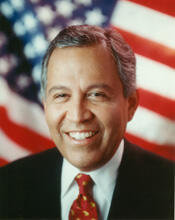
Here you will find contact information for Representative Henry Bonilla, including email address, phone number, and mailing address.
| Name | Henry Bonilla |
| Position | Representative |
| State | Texas |
| District | 23 |
| Party | Republican |
| Status | Former Representative |
| Term Start | January 5, 1993 |
| Term End | January 3, 2007 |
| Terms Served | 7 |
| Born | January 2, 1954 |
| Gender | Male |
| Bioguide ID | B000617 |
About Representative Henry Bonilla
Henry Bonilla (born January 2, 1954) is an American politician and former congressman who represented Texas’s 23rd congressional district in the United States House of Representatives from January 3, 1993, to January 3, 2007. A member of the Republican Party, he served seven consecutive terms in Congress, during which he participated in the legislative process and represented the interests of his South and West Texas constituents through a period of significant political and demographic change in the state and the nation.
Bonilla was born in San Antonio, Texas, the son of Anita Arellano and Enrique A. Bonilla. Raised on the city’s South Side, he grew up in a predominantly working-class, Hispanic community. As a young student, he joined a TRIO Educational Talent Search program, a federal initiative designed to provide academic support and college awareness activities to students from disadvantaged backgrounds. He graduated from South San Antonio High School in 1972. Benefiting from the opportunities fostered by these programs and his own academic achievement, he went on to attend the University of Texas at Austin, where he earned a Bachelor of Journalism degree in 1976.
Before entering electoral politics, Bonilla pursued a career in broadcast journalism. He worked at San Antonio’s CBS affiliate, KENS-TV, rising to the position of television news executive. His experience in journalism and management at the station helped establish his public profile in the San Antonio area. His former wife, Deborah Knapp (born December 1, 1954), became and remains a prominent news anchor at KENS-TV. After their divorce, Bonilla later married Sheryl White Shelby (born 1959).
Bonilla’s political career began in earnest in 1992, when he sought the Republican nomination for Texas’s 23rd congressional district, a vast, largely rural district stretching from San Antonio toward the Mexican border that had been held by Democrats since its creation in 1967. In March 1992, he won the Republican nomination and then mounted a vigorous campaign against four-term Democratic incumbent Albert G. Bustamante. Bonilla charged that Bustamante had neglected the needs of his constituents, pointed to Bustamante’s involvement in the House banking scandal—alleging that he had written 30 “cheques calientes” at the House Bank—and criticized what he described as excessive and questionable foreign junkets. He benefited from a redistricting decision by the Texas legislature that left a heavily Republican area of western San Antonio in the 23rd District while carving much of its former territory into the new 28th District. Although he was outspent—Bustamante’s campaign raised $758,453 to Bonilla’s $594,032—and the district was carried at the presidential level by Democrat Bill Clinton that year, Bonilla defeated Bustamante by a 59 to 38 percent margin, the largest margin of defeat for an incumbent House member in 1992. He took office on January 3, 1993.
During his seven terms in the House of Representatives, Bonilla developed a reputation as a reliably conservative Republican, even though the 23rd District retained a slight Democratic lean for much of his tenure. He was part of a growing cadre of Hispanic Republicans in Congress and became a visible figure in national party politics. In March 1999, then–Texas Governor George W. Bush named Bonilla as the only Texan on his presidential exploratory committee. Bonilla frequently represented Bush on national news programs and served as a surrogate speaker during the 2000 presidential campaign. His popularity in San Antonio and his strong fundraising allowed him to avoid serious electoral challenges until 2002, when Democrat Henry Cuellar, a former Texas secretary of state, came within two percentage points of unseating him.
Bonilla also became involved in efforts to recruit and support minority Republican candidates. In 1999, he took charge of an independent political fund called American Dream PAC, stating that its mission was to provide “significant, direct financial assistance to first-rate minority GOP candidates.” Between 1999 and the end of 2003, the PAC raised approximately $547,000, of which about $48,750—roughly 8.9 percent—went to minority office-seekers, predominantly Hispanic Americans, with 27 minority candidates receiving mostly small donations. More than $100,000 was directed to Republican Party organizations or causes. Bonilla defended the PAC’s record, saying, “We did the best we could,” and contended that it was sometimes difficult to identify “good, solid minority candidates to expend the funds on.” In July 2003, the PAC’s treasurer pleaded guilty to embezzling $119,021 from the PAC between 1999 and 2003 and was sentenced to 15 months in prison. Bonilla later described the episode as “a black mark on my judgment” in a 2004 interview.
Mid-decade redistricting in Texas in 2003, championed by U.S. House Majority Leader Tom DeLay, significantly altered the political landscape of Bonilla’s district. The legislature removed most of Laredo—a Democratic stronghold and one of the historic cores of the 23rd District—into the neighboring 28th District and added several heavily Republican suburbs of San Antonio that had previously been in the 21st District. The changes effectively secured Bonilla’s hold on the seat and discouraged a planned 2004 rematch by Henry Cuellar, who instead ran successfully in the 28th District, defeating incumbent Democrat Ciro Rodriguez in the primary and winning the general election. Bonilla’s American Dream PAC contributed money to support the redistricting effort. After the 2004 elections, Bonilla drew criticism when he proposed a procedural rule change in the House that would have allowed party leaders to retain their leadership positions even if indicted by a state grand jury. The proposal was widely viewed as an effort to allow Tom DeLay to remain as Majority Leader despite an indictment by the Travis County district attorney’s office for possible campaign finance violations, and many of Bonilla’s constituents believed he was repaying a political favor for the favorable redrawing of the 23rd District.
The 2003 redistricting plan was later challenged in court, culminating in the Supreme Court’s decision in League of United Latin American Citizens v. Perry, issued on June 29, 2006. With Justice Anthony Kennedy writing the controlling opinion, the Court held that the configuration of Bonilla’s district violated the Voting Rights Act by diluting Latino voting strength. Although the reconfigured 23rd District was 55 percent Latino overall, only 46 percent of its voting-age population was Latino, and the Court found that the Texas legislature had improperly removed most of Laredo from the district without creating a compact, majority-Latino replacement district. As a result, the Court struck down the 23rd District’s boundaries, effectively requiring the redrawing of nearly every congressional district from El Paso to San Antonio. A new map, issued on August 7, 2006, moved all of Laredo into the 28th District and increased the Latino share of the 23rd District’s population to about 65 percent. The redrawn district also removed many of the strongly Republican areas Bonilla had gained in 2003 and added heavily Democratic portions of south San Antonio, including neighborhoods where Bonilla had grown up and which had been part of the 23rd District from 1967 to 1993. Federal Election Commission records show that in 2006 Bonilla’s campaign paid the Los Angeles law firm Latham & Watkins $100,000 to argue in an amicus brief before the Supreme Court that the redistricting plan was constitutional.
Under the court-ordered map, the 2006 elections in the 23rd District were conducted as an all-party special election on November 7, with a December runoff if no candidate received more than 50 percent of the vote. The ballot included Bonilla, six Democrats—including former congressman Ciro Rodriguez and Vietnam War veteran Rick Bolaños, who had won the Democratic primary earlier in the year—and one independent candidate. Rodriguez’s home and much of his former base were included in the new 23rd District, and he entered the race against Bonilla. In the November special election, Bonilla led the field with 48 percent of the vote, while Rodriguez finished second with 20 percent. Because no candidate achieved a majority, a runoff was held on December 12, 2006. In that runoff, Rodriguez defeated Bonilla with 54 percent of the vote to Bonilla’s 46 percent. Bonilla thus became the first Republican incumbent in Texas to be unseated by a Democrat in a decade, since Nick Lampson’s defeat of Steve Stockman in a 1996 runoff election. Bonilla attributed his loss in part to the changed district boundaries. His campaign had aired controversial commercials alleging that Rodriguez had taken funds from terrorists, which media outlets described as “bold claims”; Bonilla later apologized to the press to anyone who took offense, while standing by the substance of his statements. Many Hispanic and Latino residents of the district expressed dissatisfaction with Bonilla, contending that he had grown out of touch with minority concerns; some critics labeled him “Henry Vanilla,” suggesting he no longer related closely to his cultural roots. His defeat occurred in a broader national context in which issues such as the Iraq War, illegal immigration, and proposals for a border fence contributed to a shift of Latino voters away from the Republican Party. Bonilla’s final term ended on January 3, 2007, when the 110th Congress convened.
Following his departure from Congress, Bonilla was nominated by President George W. Bush to serve as Permanent Representative of the United States of America to the Organization of American States, with the rank of Ambassador. After two months without Senate action on the nomination, Bonilla requested that the president withdraw it. He subsequently entered the private sector, joining The Normandy Group, a Washington-based government relations and consulting firm, where he continued to engage in public policy and advocacy work. In December 2016, during the presidential transition following the election of Donald J. Trump, Bonilla was among three prominent Texas Republicans—along with Texas Agriculture Commissioner Sid Miller and former commissioner Susan Combs—who were interviewed for the position of United States Secretary of Agriculture in the incoming administration.