Representative Henry Bowen
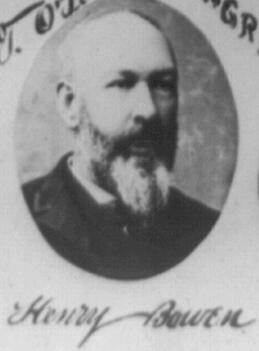
Here you will find contact information for Representative Henry Bowen, including email address, phone number, and mailing address.
| Name | Henry Bowen |
| Position | Representative |
| State | Virginia |
| District | 9 |
| Party | Republican |
| Status | Former Representative |
| Term Start | December 3, 1883 |
| Term End | March 3, 1889 |
| Terms Served | 2 |
| Born | December 26, 1841 |
| Gender | Male |
| Bioguide ID | B000683 |
About Representative Henry Bowen
Henry Bowen (December 26, 1841 – April 29, 1915) was a Virginia lawyer, soldier, and politician from Tazewell County, Virginia, who served as a Representative from Virginia in the United States Congress from 1883 to 1889. A member first of the Readjuster Party and later of the Republican Party, he contributed to the legislative process during two nonconsecutive terms in the House of Representatives and was also a member of the Virginia House of Delegates. His public career spanned the Civil War, Reconstruction, and the late nineteenth-century realignment of Virginia politics.
Bowen was born at “Maiden Spring,” near Tazewell, in Tazewell County, Virginia. He was the son of Democratic Congressman Rees Bowen and the nephew of Senator John Warfield Johnston, a postwar member of the Conservative Party of Virginia, and he was also a cousin of Tennessee’s last Whig governor, William Bowen Campbell. Raised in a prominent political family in southwestern Virginia, he received a private education suitable to his social and economic standing. He later attended Emory and Henry College in Emory, Virginia, an institution that educated many future leaders of the region. After his studies, Bowen initially engaged in farming in his native county.
With the outbreak of the American Civil War, Bowen entered Confederate service in 1861. He helped raise a unit that became associated with the 22nd Virginia Cavalry and entered the Confederate Army as a captain in Company H of the 8th Virginia Cavalry. His command served with Payne’s brigade in Lee’s division of the Army of Northern Virginia, participating in the cavalry operations that supported the principal Confederate field army. On December 21, 1864, he was captured by Union cavalry under General Philip Sheridan at Lacy Springs, Virginia. Bowen was held as a prisoner of war until he was paroled on June 19, 1865, after which he returned to Tazewell County and resumed farming at “Maiden Spring.”
In the early years of Reconstruction, Bowen transitioned from military to political life. He was elected as one of Tazewell County’s representatives in the Virginia House of Delegates in 1869 and was re-elected, serving continuously until 1873. During this period he participated in the reestablishment of civil government in Virginia and the contentious debates over the state’s postwar direction, including issues of public finance and readjustment of the prewar debt that would later define his congressional affiliation.
Bowen’s national political career began with his election to the United States House of Representatives as a member of the Readjuster Party. In 1883 he was elected to the Forty-eighth Congress as a Readjuster, representing Virginia and serving from March 4, 1883, to March 3, 1885. His service in Congress occurred during a significant period in American history, as Virginia and the South continued to grapple with the legacies of the Civil War and Reconstruction. As a member of the House of Representatives, Henry Bowen participated in the democratic process and represented the interests of his constituents in Tazewell County and the surrounding region. He failed to win renomination in 1884, temporarily interrupting his congressional service.
Bowen returned to Congress two years later under a different partisan banner. He was elected as a Republican to the Fiftieth Congress, serving from March 4, 1887, to March 3, 1889. During this second term, he aligned with the national Republican Party at a time when Republicans were seeking to strengthen their position in the South through alliances with Readjusters and other reform elements. A member of the Republican Party in this period, Bowen again contributed to the legislative process and continued to advocate for the interests of his Virginia constituents. He was an unsuccessful candidate for reelection in 1888 to the Fifty-first Congress, which ended his service in the U.S. House of Representatives.
After leaving Congress, Bowen remained active in Republican politics. In 1892 he served as a delegate to the Republican National Convention, reflecting his continued prominence within the party in Virginia. Outside of formal office, he devoted himself primarily to agricultural pursuits. He returned to his farm at “Maiden Spring” in Tazewell County, where he raised livestock and managed his agricultural interests, maintaining his position as a leading figure in the local community.
Henry Bowen died at his home, “Maiden Spring,” in Tazewell County, Virginia, on April 29, 1915. He was buried in Jeffersonville Cemetery in Tazewell, Virginia. His life encompassed service as a Confederate cavalry officer, a member of the Virginia House of Delegates, and a two-term member of the United States House of Representatives, first as a Readjuster and then as a Republican, reflecting the complex political transformations of Virginia in the half-century following the Civil War.