Representative Henry Champion Deming
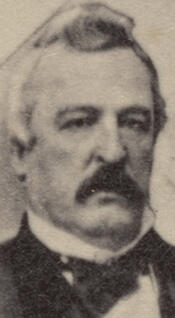
Here you will find contact information for Representative Henry Champion Deming, including email address, phone number, and mailing address.
| Name | Henry Champion Deming |
| Position | Representative |
| State | Connecticut |
| District | 1 |
| Party | Republican |
| Status | Former Representative |
| Term Start | December 7, 1863 |
| Term End | March 3, 1867 |
| Terms Served | 2 |
| Born | May 23, 1815 |
| Gender | Male |
| Bioguide ID | D000227 |
About Representative Henry Champion Deming
Henry Champion Deming (May 23, 1815 – October 8, 1872) was an American politician, lawyer, and writer who served as a U.S. Representative from Connecticut, mayor of Hartford, acting military mayor of New Orleans during the Civil War, a member of the Connecticut House of Representatives and State Senate, and later as Collector of Internal Revenue. A member of the Republican Party, he represented Connecticut in the United States Congress from 1863 to 1867, serving two terms during a critical period in American history and contributing to the legislative process in the House of Representatives.
Deming was born on May 23, 1815, in Colchester, Connecticut, the son of General David Deming and Abigail (Champion) Deming. His father had served as a general in the American Revolutionary War and took part in the Battle of Bunker Hill, giving the younger Deming a family heritage closely tied to the nation’s founding struggles. Raised in Connecticut, he pursued classical studies in preparation for college. He entered Yale College and graduated in 1836, distinguishing himself as a talented writer and orator and becoming an initiate of the Skull and Bones Society that same year. He continued his education at Harvard Law School, from which he graduated in 1839. In recognition of his intellectual and professional achievements, Trinity College conferred upon him the honorary degree of LL.D. in 1861.
After completing his legal studies, Deming was admitted to the bar in 1839 and began practicing law in New York City. Although trained as a lawyer, he devoted much of his early professional life to literature and journalism, which interested him more deeply than legal practice. He became associated with Park Benjamin Sr. in editing The New World, a literary weekly, and during this period he published a translation of Eugène Sue’s popular novel The Wandering Jew. In 1847 he left New York and moved to Hartford, Connecticut, where he opened a law office and established permanent residence. Hartford would remain his home for the rest of his life and the principal base of his legal, political, and literary activities.
Deming’s political career in Connecticut began with service in the state legislature. He was elected to the Connecticut House of Representatives from Hartford and served from 1849 to 1850, and again from 1859 to 1861. In 1851 he served in the Connecticut State Senate, further solidifying his position in state politics. He was elected mayor of Hartford in 1854 and held that office through 1858, overseeing the city during a period of growth and increasing sectional tension in the nation. He again served as mayor beginning in 1860, remaining in office until his resignation in 1862. His repeated elections reflected his prominence in Hartford civic life and his reputation as an effective municipal leader.
With the outbreak of the American Civil War, Deming entered military service on the Union side. In September 1861 he joined the Union Army and was appointed colonel of the 12th Connecticut Infantry Regiment. He accompanied Major General Benjamin Butler’s expedition that resulted in the capture of New Orleans in the spring of 1862. After Union forces secured the city, Deming was detached from regimental duty and assigned to civil administration. From October 1862 until January 1863 he served as the acting military mayor of New Orleans, which was then under martial law. His tenure there was closely associated with General Butler’s controversial “Women Order,” which declared that any woman who insulted or showed contempt for a Union officer or soldier could be treated as a “woman of the town plying her avocation.” Contemporary accounts suggested that one of the incidents contributing to Butler’s issuance of the order involved a person, presumed to be a woman, emptying a can of dirty water on Deming and Admiral David Farragut while they were walking in full uniform. Deming resigned both his military commission and his civil position in January 1863, citing concerns for his own health and that of his wife, and returned to Hartford.
Upon his return to Connecticut, Deming was elected as a Republican to the United States House of Representatives. He served in the Thirty-eighth and Thirty-ninth Congresses, from March 4, 1863, to March 4, 1867, representing Connecticut at a time when Congress grappled with the conduct of the Civil War and the beginnings of Reconstruction. During his two terms in office, he was chairman of the House Committee on Expenditures in the Department of War in both the Thirty-eighth and Thirty-ninth Congresses, and he also served on the House Committee on War Expenditures. In these roles he participated in overseeing wartime spending and administration, reflecting both his wartime experience and his party’s concern with accountability in the War Department. He was an unsuccessful candidate for reelection in 1866 to the Fortieth Congress, ending his formal congressional career in March 1867.
After leaving Congress, Deming continued his public service at the federal level. In 1869 President Ulysses S. Grant appointed him Collector of Internal Revenue, a position of considerable responsibility in the postwar federal tax system. He held this office from 1869 until his death in 1872. His appointment by Grant reflected not only his standing within the Republican Party but also a personal friendship and admiration that Deming had long expressed for the general-turned-president.
Throughout his life, Deming remained deeply engaged in literature, public speaking, and journalism alongside his legal and political work. In addition to his early editorial work on The New World, he published numerous speeches, including several of his congressional addresses. He delivered and later published a widely noted “Eulogy of Abraham Lincoln” before the General Assembly of Connecticut in 1865, commemorating the slain president. Earlier, in 1854, he delivered an oration at the completion of the monument to Revolutionary War General David Wooster in Danbury, Connecticut, which was also published. Deming authored The Life of U. S. Grant, published in 1868, a biography of his friend Ulysses S. Grant that enjoyed extensive circulation and was regarded as influential in shaping public perceptions of Grant. His Yale obituary observed that his writings “abundantly attest his great fertility of intellect,” and contemporaries noted that his power as an orator matched his productivity as a writer.
Deming’s personal life was closely connected to prominent American families. In 1850 he married Sarah Clerc, the daughter of Laurent Clerc, the pioneering deaf-mute instructor who was instrumental in establishing formal education for the deaf in the United States. Henry and Sarah Deming had three sons and one daughter together. Sarah Deming died in July 1869. In 1871 he married Mrs. Annie Putnam Jillson, a great-granddaughter of Revolutionary War General Israel Putnam. Annie Jillson Deming survived her husband when he died in Hartford on October 8, 1872, while still serving as Collector of Internal Revenue.