Representative Henry De La Warr Flood
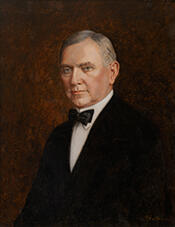
Here you will find contact information for Representative Henry De La Warr Flood, including email address, phone number, and mailing address.
| Name | Henry De La Warr Flood |
| Position | Representative |
| State | Virginia |
| District | 10 |
| Party | Democratic |
| Status | Former Representative |
| Term Start | December 2, 1901 |
| Term End | March 3, 1923 |
| Terms Served | 11 |
| Born | September 2, 1865 |
| Gender | Male |
| Bioguide ID | F000210 |
About Representative Henry De La Warr Flood
Henry De La Warr Flood (September 2, 1865 – December 8, 1921) was a Democratic representative from the Commonwealth of Virginia to the United States House of Representatives, serving from 1901 until his death in 1921. Over the course of 11 consecutive terms in Congress, he became a prominent legislative figure, notably chairing key committees and helping to shape American foreign policy during a transformative period that included World War I. He was the brother of U.S. Representative Joel West Flood and the uncle of U.S. Senator Harry Flood Byrd.
Flood was born on September 2, 1865, at “Eldon” in Appomattox County, Virginia. He was the son of former Virginia state senator and Confederate States Army Major Joel Walker Flood (1839–1916) and his first wife, Ella Faulkner (1844–1885). He had an elder sister, Eleanor Bolling Flood Byrd (1864–1957), and a younger half-brother, Joel West Flood (1894–1964), who would later follow him into Congress. Raised in post–Civil War Virginia, Flood attended public schools in Appomattox and Richmond, Virginia, before pursuing higher education. He received his undergraduate degree from Washington and Lee University and subsequently earned a law degree from the University of Virginia, preparing for a career in the legal profession and public service.
Admitted to the bar in 1886, Flood commenced the practice of law in Appomattox, Virginia. His legal career quickly intersected with local public office. He was elected Commonwealth’s Attorney for Appomattox County in 1891 and was re-elected to that position in 1895 and 1899, reflecting the confidence of his community in his legal abilities and public judgment. At the same time, he began to build a parallel legislative career. Voters elected him as Appomattox County’s delegate to the Virginia House of Delegates, where he served from 1887 to 1891, a part-time position that allowed him to continue his legal practice. He then advanced to the Senate of Virginia, serving as a state senator from 1891 to 1903. During this period he also participated in the Virginia Constitutional Convention of 1901, which undertook a major revision of the state’s fundamental law. He was an unsuccessful candidate for election to the Fifty-fifth Congress before ultimately securing a seat in the U.S. House of Representatives.
Flood entered national office when he was elected as a Democrat to the Fifty-seventh Congress and to the ten succeeding Congresses, serving from March 4, 1901, until his death on December 8, 1921. Representing Virginia in the United States Congress from 1901 to 1923, he contributed to the legislative process during 11 terms in office and participated actively in the democratic process on behalf of his constituents. His congressional service occurred during a significant period in American history, spanning the Progressive Era, the administration of multiple presidents, and World War I. In his first term, he proposed the creation of what ultimately became Shenandoah National Park, a conservation initiative that was realized more than a decade after his death through the efforts of his nephew Harry F. Byrd, who became one of Virginia’s U.S. Senators in 1933.
Within the House of Representatives, Flood rose to positions of considerable influence. He served as chair of the Committee on Territories in the Sixty-second Congress and as chair of the Committee on Foreign Affairs from the Sixty-second through the Sixty-fifth Congresses. In these roles he helped shape national policy on territorial governance and international relations. In 1911, he authored the Flood amendment to the enabling act for New Mexico statehood, which provided that amendments to the New Mexico Constitution could be ratified by a simple majority, a provision that had lasting implications for that state’s constitutional development. During World War I, he played a central role in bringing the United States formally into the conflict. In 1917, as a leading member of the House, he was the author of the resolutions declaring a state of war to exist between the United States and Germany and between the United States and Austria-Hungary, thereby helping to define the nation’s wartime posture.
Flood married relatively late in life. On April 18, 1914, the middle-aged bachelor wed Anna Florence Portner (1888–1966), daughter of German-born beer brewer and inventor Robert Portner. The wedding took place at All Souls Unitarian Church in Washington, D.C., followed by a reception at the Pan American Union Building, reflecting the couple’s social and political connections in the capital. Their family life was marked by both joy and tragedy. Their daughter Anna Portner Flood, born in 1916, died in infancy, and their young namesake son, Henry D. Flood III, born in 1920, also died in the year of his birth. Two of their children survived to adulthood: Bolling Byrd Flood (1915–2000) and Eleanor Faulkner Flood Schoellkopf (1917–1975), who outlived both parents.
Henry De La Warr Flood died in office on December 8, 1921, in Washington, D.C., becoming one of the members of the United States Congress who died while still serving between 1900 and 1949. His death brought to a close more than two decades of continuous service in the U.S. House of Representatives. He was interred in a mausoleum on the courthouse green at Appomattox, Virginia, in the Appomattox Historic District, near the center of the community where his legal and political career had begun. His public life, intertwined with that of a prominent Virginia political family, left a legacy that extended through the subsequent careers of his brother Joel West Flood and his nephew Harry Flood Byrd.