Representative Henry B. Gonzalez
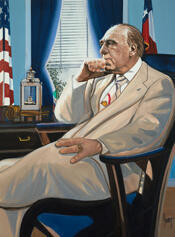
Here you will find contact information for Representative Henry B. Gonzalez, including email address, phone number, and mailing address.
| Name | Henry B. Gonzalez |
| Position | Representative |
| State | Texas |
| District | 20 |
| Party | Democratic |
| Status | Former Representative |
| Term Start | January 3, 1961 |
| Term End | January 3, 1999 |
| Terms Served | 19 |
| Born | May 3, 1916 |
| Gender | Male |
| Bioguide ID | G000272 |
About Representative Henry B. Gonzalez
Henry Barbosa González (born Enrique Barbosa González; May 3, 1916 – November 28, 2000) was an American Democratic politician from San Antonio, Texas, who represented Texas’s 20th congressional district in the United States House of Representatives from 1961 to 1999. A member of the Democratic Party, he served 19 terms in Congress and became the longest-serving Hispanic member of Congress, as well as a founding member of the Congressional Hispanic Caucus. His nearly four decades in the House spanned a significant period in American history, during which he participated actively in the legislative process and represented the interests of his San Antonio–area constituents.
González was born in San Antonio, Texas, the son of Mexican-born parents Genoveva (née Barbosa) and Leonides González, who had immigrated from Mapimí, Durango, during the turmoil of the Mexican Revolution. Growing up in a Mexican American family in early twentieth-century Texas, he experienced firsthand the discrimination and economic challenges that shaped his later commitment to civil rights and social justice. In 1950 he was scoutmaster of Boy Scout Troop 90 in San Antonio, of which his son was a member, reflecting his early engagement in youth and community activities.
After attending local schools, González received an associate’s degree from San Antonio College. He then continued his education at the University of Texas at Austin, where he completed his undergraduate studies. Determined to pursue a career in law and public service, he earned a Juris Doctor from St. Mary’s University School of Law in San Antonio. Upon graduation, he became a probation officer in Bexar County, Texas, and was quickly promoted to chief probation officer. In 1945 he resigned from that position after a judge refused to allow him to add an African American probation officer to his staff, an early and public demonstration of his opposition to racial discrimination.
González’s formal political career began at the local level. He served on the San Antonio City Council from 1953 to 1956, where he played a key role in efforts to desegregate swimming pools and other public accommodations in the city. His advocacy for equal access to public facilities helped lay the groundwork for broader civil rights reforms in Texas. In 1956 he was elected to the Texas Senate, defeating Republican candidate Jesse Oppenheimer. He was reelected in 1960, defeating another Republican, Ika “Ike” Simpson Kampmann Jr., and served in the state Senate until 1961. During his tenure, he set a filibuster record in the chamber at the time by speaking for thirty-six consecutive hours against a package of segregationist bills, eight of the ten measures ultimately being abandoned. In 1958 he ran for governor of Texas and finished second in the Democratic primary to Price Daniel, a significant achievement in what was then a solidly Democratic state. In May 1961 he sought a U.S. Senate seat in the special election to replace Lyndon B. Johnson, who had become vice president, but finished sixth, in part because he split the liberal and Hispanic vote with fellow San Antonian Maury Maverick Jr.
González entered national politics later in 1961. When President John F. Kennedy appointed Representative Paul J. Kilday of Texas’s 20th congressional district to the Court of Military Appeals, a special election was called for the San Antonio–based House seat. González ran as the Democratic candidate in November 1961 and defeated a strong Republican opponent, attorney John W. Goode, who had been personally endorsed in San Antonio by former President Dwight D. Eisenhower. Mexican film star Cantinflas campaigned with Vice President Lyndon B. Johnson at shopping centers and supermarkets in San Antonio to support González. That race proved to be the closest contest of his congressional career; he was unopposed for a full term in 1962 and was reelected seventeen times thereafter. Over the course of his 19 terms, he faced Republican opposition only five times and prevailed easily whenever challenged, running unopposed in 1970, 1974, 1976, 1978, 1982, and 1984. His long tenure made him a central figure in Texas politics and a prominent Hispanic leader in Congress.
In Congress, González became known for his staunchly liberal views and his strong support for civil rights. Unlike many Southern politicians of his era, he consistently backed major civil rights legislation, voting in favor of the Civil Rights Act of 1964, the Voting Rights Act of 1965, and the Civil Rights Act of 1968. His outspoken positions sometimes provoked controversy. In 1963 Republican Representative Ed Foreman called him “a communist” and “a pinko,” prompting a direct confrontation between the two. In 1986, when a man at Earl Abel’s restaurant in San Antonio again called him “a communist,” the 70-year-old congressman responded by punching the man in the face; the assault charge was later dropped, and González was acquitted when the complainant declined to pursue the case. Throughout his service, he was an active participant in the democratic process, using his position in the House of Representatives to advocate for his constituents and for broader social and economic reforms.
González’s congressional career intersected with pivotal national events. He was in President Kennedy’s motorcade in Dallas on November 22, 1963, and later recalled rolling down his car window as it neared the Texas School Book Depository and hearing three distinct shots. His vehicle proceeded to Parkland Memorial Hospital, where he saw a blood-soaked bouquet of roses in the presidential limousine and initially believed Jacqueline Kennedy had been shot. At the hospital he observed Lyndon and Lady Bird Johnson, Mrs. Kennedy, and President Kennedy’s sheet-covered body, and he helped place the casket in the hearse that carried it to Air Force One. Deeply affected by the assassinations of John F. Kennedy, Robert F. Kennedy, and Martin Luther King Jr., González in 1975 pressed for a House investigation into these killings. The United States House Select Committee on Assassinations was created in 1976, and he succeeded Thomas N. Downing as its chairman in January 1977. After a power struggle with the committee’s chief counsel, he resigned the chairmanship later that year. Contemporaries such as FBI official Robert P. Gemberling suggested that González, like Downing, harbored “preconceived conspiracy theories,” and González himself did not rule out the possibility that more than the three shots he heard in Dallas had been fired, possibly from a silenced weapon.
González also became a persistent critic of presidential and executive power. Following the United States invasion of Grenada in 1983, he suggested the impeachment of President Ronald Reagan. In 1987 he introduced articles of impeachment related to the Iran–Contra affair and referred them to the House Judiciary Committee, though no further action was taken. He later called for the impeachment of President George H. W. Bush for initiating the 1991 Gulf War without prior congressional authorization. Early in President Bill Clinton’s administration, González used his committee authority to block hearings into the Whitewater controversy, insisting on certain conditions before proceeding; he ultimately agreed to hold hearings in 1994. A long-standing critic of the Federal Reserve System, he advocated for greater transparency and accountability, proposed an audit of the Federal Reserve, and introduced measures to impeach Chairman Paul Volcker and other members of the Board of Governors. Over the course of his 19 terms in office, his legislative work and public stands made him a prominent voice for civil rights, economic fairness, and congressional oversight of the executive branch and financial institutions.
In 1997 González fell ill and was unable to return to the House for more than a year. Concluding that he could not continue the demanding schedule of congressional service, he decided not to run for a 19th full term in 1998, bringing to a close a congressional career that had begun in 1961. He had long groomed his son, Charlie González, to succeed him, and Charlie won the election to the 20th district seat easily in 1998. Between them, father and son represented the district for 51 consecutive years, until Charlie González left office in January 2013. Henry B. González died in a San Antonio hospital on November 28, 2000.
In the years following his death, González’s legacy has been honored in multiple ways. National Taco Day is celebrated on his birthday, May 3, as a way to commemorate his achievements in Congress. On October 24, 2006, it was announced that his personal notes, correspondence, and mementos would become part of the Congressional History Collection at the University of Texas at Austin’s Center for American History. The Henry B. González Convention Center in downtown San Antonio bears his name, reflecting his importance to the city he represented. Several elementary schools across Texas, including those in the Edgewood, Eagle Pass, La Joya, and Dallas Independent School Districts, are also named in his honor. On May 1, 2016, two days before what would have been his 100th birthday, the San Antonio Express-News published a series of articles reflecting on his long career and enduring influence on Texas and national politics.