Representative Henry J. Hyde
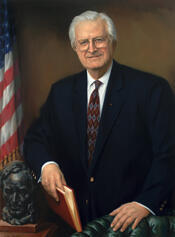
Here you will find contact information for Representative Henry J. Hyde, including email address, phone number, and mailing address.
| Name | Henry J. Hyde |
| Position | Representative |
| State | Illinois |
| District | 6 |
| Party | Republican |
| Status | Former Representative |
| Term Start | January 14, 1975 |
| Term End | January 3, 2007 |
| Terms Served | 16 |
| Born | April 18, 1924 |
| Gender | Male |
| Bioguide ID | H001022 |
About Representative Henry J. Hyde
Henry John Hyde (April 18, 1924 – November 29, 2007) was an American politician who served as a Republican member of the United States House of Representatives from 1975 to 2007, representing the 6th District of Illinois, an area of Chicago’s northwestern suburbs. Over 16 consecutive terms in office, he contributed to the legislative process during a significant period in American history, participating in the democratic process and representing the interests of his constituents. He rose to national prominence as a leading conservative voice in the House, particularly on judicial, foreign policy, and social issues, and became widely known as a vocal opponent of abortion and the primary sponsor of the Hyde Amendment, which largely bars the payment of abortions with federal funds.
Hyde was born on April 18, 1924, in Chicago, Illinois. He was raised in the city and educated in local schools before attending Georgetown University in Washington, D.C. His college education was interrupted by World War II, during which he served in the United States Navy from 1942 to 1946. After the war, he completed his undergraduate studies at Georgetown University, receiving a Bachelor of Science degree in 1947. He then returned to Illinois and enrolled at Loyola University Chicago School of Law, where he earned his Juris Doctor degree in 1949, preparing for a career in law and public service.
Following his admission to the bar, Hyde practiced law in the Chicago area and became active in Republican politics. He served in the Illinois House of Representatives from 1967 to 1974, rising to the position of majority leader. During his tenure in the state legislature, he developed a reputation as a skilled debater and a committed social conservative, particularly on issues related to abortion and criminal justice. His work in Springfield laid the foundation for his subsequent congressional career and established him as a prominent figure within the Illinois Republican Party.
In 1974, Hyde was elected to the U.S. House of Representatives from Illinois’s 6th Congressional District, taking office on January 3, 1975. He would serve in the House until January 3, 2007, representing Chicago’s northwestern suburbs for 16 terms. As a member of the House of Representatives, Henry John Hyde participated actively in the legislative process and became one of the most influential Republicans in Congress. Early in his congressional career, he emerged as a leading opponent of abortion. In 1976, he authored the Hyde Amendment, a legislative provision that prohibits the use of certain federal funds, particularly through Medicaid, to pay for most abortions. Renewed regularly by Congress, the amendment became a central feature of federal abortion policy and a cornerstone of the pro-life movement.
Hyde’s committee assignments and leadership roles expanded his influence over time. He served on the House Judiciary Committee for many years and was its Chairman from 1995 to 2001, during the period of Republican control following the 1994 elections. In that capacity, he oversaw major legislative initiatives on crime, civil justice, and constitutional issues, and played a central role in the House’s consideration of impeachment proceedings against President Bill Clinton. From 2001 to 2007, he served as Chairman of the House International Relations Committee (often referred to as the House Foreign Relations Committee), where he was involved in some of the highest-level debates concerning U.S. foreign policy, including the response to the September 11, 2001, terrorist attacks. In the immediate aftermath of the attacks, he cautioned against attacking Iraq in the absence of clear evidence of Iraqi complicity, telling CNN’s Robert Novak that such a move “would be a big mistake.” Nevertheless, one year later he voted in support of the October 10, 2002, House resolution that authorized the president to go to war with Iraq. In response to Representative Ron Paul’s resolution requesting a formal declaration of war, Hyde argued that the constitutional mechanism of a declaration of war had become, in his words, “inappropriate, anachronistic, it isn’t done anymore,” reflecting his view that some constitutional provisions had been overtaken by events and time. In 2006, he expressed skepticism about the Bush Administration’s broad objective of promoting democracy in the Middle East, warning that “lashing our interests to the indiscriminate promotion of democracy” could lead not to peace and stability but to revolution in countries lacking a long-term guiding presence.
Hyde was also a prominent figure in several major national controversies. As a member of the congressional panel investigating the Iran-Contra affair in the late 1980s, he vigorously defended the Ronald Reagan administration and several participants accused of wrongdoing, particularly Lieutenant Colonel Oliver North. Citing Thomas Jefferson, Hyde contended that while some individuals had lied in testimony before Congress, their actions were excusable because they were undertaken in pursuit of the broader goal of fighting communism. Later, as Chairman of the House Judiciary Committee, he became one of the central architects of the impeachment of President Bill Clinton. Hyde argued that the House had a constitutional and civic duty to impeach the president for perjury and obstruction of justice, insisting that the matter was about the rule of law rather than partisan politics. In the Resolution on Impeachment of the President, he wrote that the House was reaffirming values “tarnished and dim these days,” and urged his colleagues to “catch the falling flag as we keep our appointment with history.” Clinton was impeached by the House on two charges—perjury and obstruction of justice—and Hyde served as chief House manager (prosecutor) at the Senate trial. In his closing argument, he warned that failure to convict would signal that “lying under oath, while unpleasant and to be avoided, is not all that serious,” and that it would reduce perjury to “a breach of etiquette, but only if you are the President.” Despite his efforts, President Clinton was acquitted on both charges, with 45 senators voting for conviction on perjury and 50 on obstruction of justice, short of the two-thirds majority required. Notwithstanding their opposing roles during impeachment, Hyde maintained cordial personal relationships across the aisle; Representative Barney Frank, a leading Democratic critic, later praised Hyde’s efforts to keep the impeachment process “personality free.”
Hyde’s long career was not without controversy outside the legislative arena. In 1981, after leaving the House Banking Committee, he joined the board of directors of Clyde Federal Savings and Loan, whose chairman was one of his political contributors. According to later accounts, from 1982 until he left the board in 1984, Hyde used his position to support the institution’s investment in risky financial options. In 1990, the federal government placed Clyde Federal in receivership and paid approximately $67 million to cover insured deposits. In 1993, the Resolution Trust Corporation filed suit against Hyde and other directors for $17.2 million, alleging “gross negligence” in connection with the savings and loan’s failure. Four years later, before pretrial investigation and depositions, the government settled with the defendants for $850,000 and made an arrangement under which Hyde himself did not have to pay. He was reported to be the only sitting member of Congress sued for gross negligence in an S&L failure, an episode that drew significant public and media scrutiny.
After more than three decades in Congress, Hyde chose not to seek reelection in 2006 and retired from the House at the conclusion of his term on January 3, 2007. In recognition of his long service, he received various honors in his later years, and his colleagues in both the House and Senate entered memorial tributes into the Congressional Record following his death. Henry John Hyde died on November 29, 2007, in Chicago, Illinois. His passing prompted formal memorial addresses and a memorial service in his honor, reflecting his stature as a major figure in late twentieth-century American legislative and political history, particularly in the realms of judicial policy, foreign affairs, and the national debate over abortion.