Representative Henry Sterling Magoon
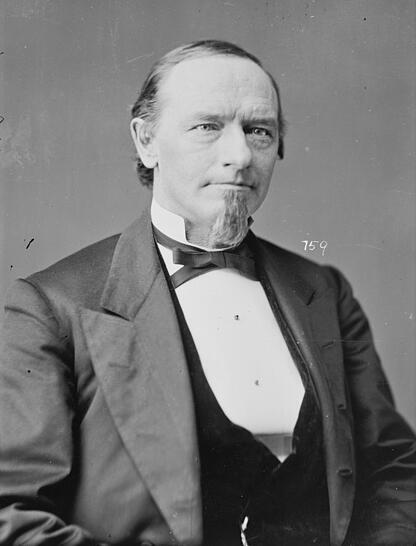
Here you will find contact information for Representative Henry Sterling Magoon, including email address, phone number, and mailing address.
| Name | Henry Sterling Magoon |
| Position | Representative |
| State | Wisconsin |
| District | 3 |
| Party | Republican |
| Status | Former Representative |
| Term Start | December 6, 1875 |
| Term End | March 3, 1877 |
| Terms Served | 1 |
| Born | January 31, 1832 |
| Gender | Male |
| Bioguide ID | M000054 |
About Representative Henry Sterling Magoon
Henry Sterling Magoon (January 31, 1832 – March 3, 1889) was an American lawyer, educator, and Republican politician who served one term in the United States House of Representatives, representing Wisconsin’s 3rd congressional district from 1875 to 1877. A member of the Republican Party, he contributed to the legislative process during this single term in office, participating in the democratic process and representing the interests of his constituents during a significant period in American history.
Magoon was born on January 31, 1832, in Monticello, in the Wisconsin Territory. He was among the earliest generation of native-born Wisconsinites and would later become notable as the first native of Wisconsin to serve either in the Wisconsin State Senate or in the United States House of Representatives. His early life unfolded in a frontier environment as Wisconsin transitioned from territorial status toward statehood, shaping his perspective as a public figure who embodied the emergence of locally born leadership in the state’s political life.
Magoon pursued a substantial formal education for his time. He attended Rock River Seminary in Mount Morris, Illinois, an institution known for its rigorous preparatory curriculum. He then enrolled at the Western Military College in Drennon, Kentucky, from which he graduated in 1853. After completing his undergraduate studies, he turned to the law, studying at the Montrose Law School in Frankfort, Kentucky. His academic interests extended beyond legal training; he subsequently served as a professor of ancient languages at the University of Nashville, reflecting both his classical education and his early engagement in higher education as an instructor.
In 1857, Magoon returned to Wisconsin, where he was admitted to the bar and commenced the practice of law in Darlington, Lafayette County. His legal ability and local prominence quickly led him into public office. Just a year after beginning his practice, he was elected district attorney of Lafayette County, a position in which he gained practical experience in public law and local administration. His growing reputation as a lawyer and public servant laid the groundwork for his later legislative career at both the state and federal levels.
Magoon’s formal political career advanced when he was elected to the Wisconsin State Senate, where he served in 1871 and 1872. In this role, he was recognized as the first native-born Wisconsinite to sit in that body, marking a generational shift in the state’s political leadership from pioneers who had migrated to the territory to those born within its borders. His service in the State Senate enhanced his standing within the Republican Party and positioned him for higher office, as he became increasingly involved in shaping state policy during the post–Civil War era.
Building on his state-level experience, Magoon was elected as a Republican to the Forty-fourth Congress, serving from March 4, 1875, to March 3, 1877, as the representative of Wisconsin’s 3rd congressional district. During this term in the United States House of Representatives, he participated in national legislative debates in the decade following the Civil War, a period marked by Reconstruction issues, economic adjustment, and evolving federal policy. His tenure in Congress, though limited to one term, reflected both his party’s priorities and the interests of his Wisconsin constituents. He sought renomination in 1876 but was defeated at the Republican district convention, bringing his congressional service to a close at the end of the Forty-fourth Congress.
After leaving Congress, Magoon resumed the practice of law, this time in Milwaukee, Wisconsin, where he continued his professional career. In addition to his legal work, he remained engaged in public and educational affairs. He served for one term as a regent of the University of Wisconsin–Madison, contributing to the governance and oversight of the state’s leading institution of higher learning. This role was consistent with his earlier experience as a university professor and reflected his continuing interest in education and public service beyond elective office.
Henry Sterling Magoon died on March 3, 1889, while on a visit to his summer home in Darlington, Wisconsin. His death occurred in the community where he had first established his legal practice and launched his public career. He was interred in Union Grove Cemetery. Magoon’s life and career, spanning law, education, state legislation, and national office, exemplified the rise of native-born Wisconsin leaders in the nineteenth century and left a record of service at both the state and federal levels.