Representative Henry Francis Naphen
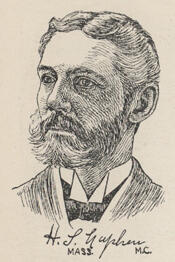
Here you will find contact information for Representative Henry Francis Naphen, including email address, phone number, and mailing address.
| Name | Henry Francis Naphen |
| Position | Representative |
| State | Massachusetts |
| District | 10 |
| Party | Democratic |
| Status | Former Representative |
| Term Start | December 4, 1899 |
| Term End | March 3, 1903 |
| Terms Served | 2 |
| Born | August 14, 1852 |
| Gender | Male |
| Bioguide ID | N000004 |
About Representative Henry Francis Naphen
Henry Francis Naphen (August 14, 1852 – June 8, 1905) was a Democratic U.S. Representative from Massachusetts who served in the United States Congress from 1899 to 1903. Born in Ireland, then a part of the United Kingdom, to John and Jane (Henry) Naphen, he immigrated to the United States as a child with his parents, who settled in Lowell, Massachusetts. In his new home, he was educated by private tutors and in the public schools, receiving a foundation that would prepare him for higher education and a career in law and public service.
Naphen pursued advanced studies at Harvard University, from which he was graduated in 1878. Following his undergraduate education, he attended Boston University Law School to prepare for a legal career. He was admitted to the bar in Suffolk County in November 1879 and commenced the practice of law in Boston. His legal work in the city helped establish his professional reputation and provided an entry into local civic affairs and Democratic Party politics.
Naphen’s public career began at the municipal level in Boston. He served as a member of the Boston School Committee from 1882 until January 1886, a period in which public education in the city was undergoing expansion and reform. While on the School Committee, he served on the standing committees on the Horace Mann School, Sewing, and The Normal School, reflecting his involvement in both general and specialized aspects of educational policy and administration. His work on these committees placed him at the center of decisions affecting teacher training and specialized instruction in the Boston school system.
Building on his municipal experience, Naphen advanced to state office as a member of the Massachusetts State Senate in 1885 and 1886, representing the Fifth Suffolk District. In the Senate he participated in the legislative process at the state level during a period of industrial growth and urbanization in Massachusetts. In addition to his legislative duties, he was appointed a bail commissioner by the justices of the superior court, a position that drew on his legal expertise and entrusted him with responsibilities in the administration of justice. He was also a member of the Ancient and Honorable Artillery Company of Massachusetts, one of the oldest chartered military organizations in the United States, reflecting his engagement with prominent civic and historical institutions in the Commonwealth.
Naphen was elected as a Democrat to the Fifty-sixth and Fifty-seventh Congresses, serving from March 4, 1899, to March 3, 1903, as a Representative from Massachusetts. His service in Congress occurred during a significant period in American history, marked by the aftermath of the Spanish–American War, debates over imperial policy, and the early stirrings of the Progressive Era. In the 1898 election that sent him to Washington, he faced a two-way race against incumbent Republican Congressman Samuel J. Barrows. Naphen won the contest, garnering 17,149 votes to Barrows’s total of 13,909, and thereby secured Democratic representation for his district in the U.S. House of Representatives. During his two terms, he participated in the legislative process and represented the interests of his Massachusetts constituents as part of the Democratic minority in the House.
Although Naphen wished to seek reelection in 1902, internal party dynamics in Massachusetts curtailed his congressional career. William S. McNary, chairman of the Democratic State Committee, sought the nomination for Naphen’s seat and, controlling the apparatus of the district’s Democratic Party, effectively forced Naphen to retire from the race. Confronted with McNary’s organizational strength and influence, Naphen chose to withdraw quietly rather than engage in a divisive intraparty contest, bringing his congressional service to a close at the end of his second term in March 1903.
After leaving Congress, Naphen returned to private life in Boston, resuming his legal practice and remaining a figure identified with the city’s Democratic and civic traditions. He died in Boston on June 8, 1905. His career traced a path from immigrant beginnings in Lowell through higher education at Harvard and Boston University, municipal and state office in Massachusetts, and ultimately service in the national legislature as a member of the U.S. House of Representatives.