Representative Henry Benton Sayler
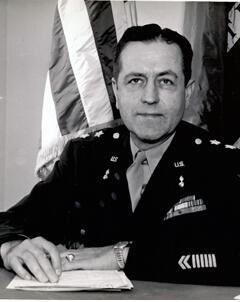
Here you will find contact information for Representative Henry Benton Sayler, including email address, phone number, and mailing address.
| Name | Henry Benton Sayler |
| Position | Representative |
| State | Indiana |
| District | 10 |
| Party | Republican |
| Status | Former Representative |
| Term Start | December 1, 1873 |
| Term End | March 3, 1875 |
| Terms Served | 1 |
| Born | March 31, 1836 |
| Gender | Male |
| Bioguide ID | S000100 |
About Representative Henry Benton Sayler
Henry Benton Sayler (November 4, 1893 – May 7, 1970) was a United States Army officer who rose to the rank of major general and later served one term in the United States Congress as a Republican representing Indiana. During World War II, he was best known for his service as chief ordnance officer of the European Theater of Operations, where he played a central role in organizing and sustaining the materiel support of U.S. forces in combat.
Sayler was born on November 4, 1893, in Huntington, Indiana. He grew up in the Midwest before pursuing a military education that would shape the rest of his life. As a young man, he attended Braden’s Preparatory School in Highland Falls, New York, located near the United States Military Academy at West Point. His performance there led to his appointment to West Point in 1911, marking the beginning of a long and distinguished military career.
At the United States Military Academy, Sayler was a member of the famed Class of 1915, often referred to as “the class the stars fell on” because an unusually large number of its graduates—fifty-nine in all—went on to become general officers. His classmates included future prominent commanders such as Dwight D. Eisenhower, Omar N. Bradley, James Van Fleet, Henry Aurand, Stafford LeRoy Irwin, and John W. Leonard. Sayler graduated in 1915 and was commissioned a second lieutenant in the Coast Artillery Corps on June 12 of that year, entering active service just as the United States was approaching its involvement in World War I.
In the years following World War I, Sayler’s career shifted toward the technical and logistical side of the Army. In 1921, he transferred to the Ordnance Corps, the branch responsible for weapons, ammunition, and related equipment. Over the next decade he served at various military posts across the United States, gaining experience in supply, maintenance, and armament management. He furthered his professional education by attending the Command and General Staff College at Fort Leavenworth, Kansas, in 1931, an important step for officers destined for higher command and staff responsibilities. From 1931 to 1937, he served as a member of the Cavalry Board, contributing to the evaluation and development of equipment and doctrine for one of the Army’s key combat arms during a period of transition and modernization.
By the late 1930s, Sayler had assumed increasingly important ordnance responsibilities. In 1937, he was appointed chief of the General Supply Division in the Office of the Chief of Ordnance in Washington, D.C., where he served until the end of 1938. He was then assigned to the 4th Corps Area as its ordnance officer, overseeing supply and maintenance functions across a major regional command. Subsequently, he became ordnance officer of the First Army, serving under Lieutenant General Hugh Aloysius Drum. These positions placed him at the center of the Army’s efforts to prepare its forces, equipment, and supply systems for the possibility of large-scale conflict.
With the entry of the United States into World War II, Sayler’s West Point classmate Dwight D. Eisenhower, now commanding general of the U.S. Forces in the European Theater of Operations, selected him to serve as chief ordnance officer of the European Theater of Operations, United States Army. In this capacity, Sayler was tasked with planning, assembling, and executing the ordnance support for major operations, beginning with the North African invasion. His responsibilities included ensuring that weapons, vehicles, ammunition, and spare parts were available in sufficient quantity and in the right locations to support rapidly moving and widely dispersed forces.
Sayler’s work was especially critical during the preparations for and execution of the D-Day invasion of Normandy and the subsequent campaign in Western Europe. He confronted and solved a range of complex technical and logistical problems, including the waterproofing of vehicles for amphibious landings and the safe disposal of unexploded bombs and ordnance. Under his direction, the ordnance system contributed substantially to making U.S. forces one of the best-equipped fighting forces in the history of warfare. He remained chief ordnance officer in the European Theater until August 1945, when he returned to Washington to serve as Assistant Chief of Ordnance, acting as deputy to Lieutenant General Levin H. Campbell Jr., the Chief of Ordnance.
For his distinguished service during World War II, Sayler received several high military decorations. He was awarded the Army Distinguished Service Medal, recognizing exceptionally meritorious service to the government in a duty of great responsibility. He also received the Legion of Merit and two Bronze Star Medals, reflecting his significant contributions to the success of U.S. operations in the European Theater and his leadership in the complex field of ordnance support. After the war, he continued to shape the Army’s technical capabilities as chief of research and development in the Ordnance Department, overseeing efforts to incorporate wartime lessons and emerging technologies into future weapons and equipment.
Sayler retired from the United States Army in 1949 with the rank of major general, concluding more than three decades of active service. As a member of the Republican Party representing Indiana, he then contributed to the legislative process during one term in the United States Congress. His service in Congress occurred during a significant period in American history, and he participated in the democratic process by representing the interests of his Indiana constituents and engaging in national policymaking. In his later years, he resided in the South. Henry Benton Sayler died on May 7, 1970, in Savannah, Georgia, at the age of 76. He was buried with full honors at Arlington National Cemetery in Virginia, where he rests alongside his wife, Jessie Sayler.