Representative Henry Carl Schadeberg
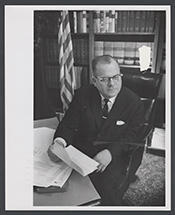
Here you will find contact information for Representative Henry Carl Schadeberg, including email address, phone number, and mailing address.
| Name | Henry Carl Schadeberg |
| Position | Representative |
| State | Wisconsin |
| District | 1 |
| Party | Republican |
| Status | Former Representative |
| Term Start | January 3, 1961 |
| Term End | January 3, 1971 |
| Terms Served | 4 |
| Born | October 12, 1913 |
| Gender | Male |
| Bioguide ID | S000108 |
About Representative Henry Carl Schadeberg
Henry Carl Schadeberg (October 12, 1913 – December 11, 1985) was an American Protestant minister, naval chaplain, and Republican politician from southeast Wisconsin. He served as a Representative from Wisconsin in the United States Congress for four terms, representing Wisconsin’s 1st congressional district from January 3, 1961, to January 3, 1965, and from January 3, 1967, to January 3, 1971. An unabashed conservative and strident anti-communist, he aligned with the conservative wing of the Republican Party and was an active participant in the legislative process during a significant period in American history.
Schadeberg was born in Manitowoc, Wisconsin, the youngest of nine children of George Schadeberg and Rosa Clara (née Brockhoff) Schadeberg. All four of his grandparents were German American immigrants. His father was a masonry contractor and a prominent local public servant, serving seven years on the Manitowoc school board, 17 years on the county board of supervisors, and also on the county board of appeals, as undersheriff, and as a justice of the peace. Henry Schadeberg was raised in this civic-minded environment and was active in his church and church community from an early age. He graduated from Manitowoc’s Lincoln High School in 1931.
After high school, Schadeberg attended Carroll College (now Carroll University) in Waukesha, Wisconsin, enrolling in 1934. While still a student, he began preaching at a Congregational church in East Troy, Wisconsin, foreshadowing a lifelong vocation in the ministry. He completed his bachelor’s degree in 1938 and immediately entered the pastorate, serving three Methodist churches in eastern Walworth County, Wisconsin. Seeking further theological training, he went on to Garrett Biblical Institute in Evanston, Illinois, where he earned a Bachelor of Divinity degree in 1941. On June 18, 1938, he married Ruth Eleanor Hamilton of Waukesha, a fellow Carroll College graduate who had served as president of the national society of phrateres and later worked as a teacher and was active in the American Association of University Women. The couple had four children and remained married for 47 years until his death in 1985.
Following completion of his divinity degree, Schadeberg moved to northern Wisconsin, where he served as pastor of the Methodist church in Oconto for about a year before returning to southern Wisconsin to preach in central Rock County. In 1943, reflecting his growing leadership within the clergy, he was elected the first president of the Evansville Ministerial Association. That same year, in the fall of 1943, he enlisted in the United States Navy as a chaplain during World War II and was commissioned a lieutenant (junior grade). His first assignment was as chaplain to a group of African American sailors operating a naval ammunition depot in Virginia, an experience that informed his later public comments against racial prejudice. In the summer of 1944 he was deployed to the Pacific theater aboard the heavy cruiser USS Louisville (CA-28), serving during the initial phase of the Philippines campaign. After returning to Wisconsin on shore leave in the spring of 1945, he rejoined the Louisville for the Volcano and Ryukyu Islands campaign. Following V-J Day, he was appointed chaplain to Admiral George D. Murray in the Mariana Islands group, received a commendation in the fall of 1945, and returned to the United States in December.
After the war, Schadeberg resumed his pastoral career in Wisconsin. He became pastor of the historic Plymouth Congregational Church in Burlington, Wisconsin, and chaplain of the local American Legion post. He was formally installed as pastor of Plymouth Church in the fall of 1946 and also served in the Navy Reserve, including duties as chaplain for the Burlington Civil Air Patrol. In his sermons and public addresses he increasingly blended religious themes with patriotic and political messages. Drawing on his wartime experiences, he spoke out against racial prejudice and cast the emerging Cold War as a moral struggle, frequently lecturing on “Americanism” and other patriotic ideas that would later shape his political philosophy. Recalled to active duty during the Korean War, he returned to the Navy in 1952, underwent retraining, and was assigned as senior chaplain at the United States Naval Training Center Bainbridge in Maryland, where he was promoted to lieutenant commander. His family joined him there, and he remained on active duty until September 1953. He continued in the Navy Reserve until 1966, ultimately rising to the rank of captain.
Back in Burlington after his Korean War service, Schadeberg remained an influential community and church leader. In 1957, he was appointed chairman of the local committee charged with integrating the staff and personnel of the planned Richard I. Bong Air Force Base into Burlington society, though the base was never completed. That same year he was elected moderator of the Milwaukee Association of Congregational Ministers, and in 1958 he became president of the Burlington chapter of Rotary International. These roles, combined with his American Legion activities and his reputation as a forceful speaker on patriotism and anti-communism, enhanced his public profile and helped pave the way for a political career.
In the fall of 1959, Schadeberg announced his candidacy for Congress, seeking the Republican nomination to challenge first-term Democratic incumbent Gerald T. Flynn in Wisconsin’s 1st congressional district. The district had been a Republican stronghold for most of its history, and Flynn’s narrow 1958 victory in a Democratic wave year made him appear vulnerable. In the Republican primary, Schadeberg faced attorneys Richard Harvey Jr. and Edward Zahn Jr., the latter a former assistant to Labor Secretary James P. Mitchell in the Eisenhower administration. His opponents criticized his lack of legal training and legislative experience, but Schadeberg argued that Congress did not need more professional politicians. Backed by a large volunteer organization, he won the primary with 47 percent of the vote. In the 1960 general election he campaigned on small government, opposition to the welfare state, and warnings against “creeping socialism,” and he defeated Flynn with 53 percent of the vote, beginning his first period of service in the U.S. House of Representatives in January 1961.
During his initial tenure in Congress, encompassing the 87th and 88th Congresses (1961–1965), Schadeberg quickly aligned with the conservative faction of Republicans and with Southern Democrats (Dixiecrats) on many issues. He was appointed to the House Un-American Activities Committee and the House Veterans’ Affairs Committee. At a time when the House Un-American Activities Committee was under intense national scrutiny and calls for its abolition were growing in the wake of the Hollywood blacklist, the downfall of Senator Joseph McCarthy, and a police riot at a 1960 hearing in San Francisco, Schadeberg staunchly defended the committee and questioned the patriotism of those favoring its dissolution. In the 1962 election he again faced Gerald Flynn, who charged that Schadeberg and his conservative allies were obstructing civil rights legislation. Schadeberg nevertheless won re-election by a similar margin to his 1960 victory. In the 88th Congress he voted against the Clean Air Act, reflecting his skepticism of expanding federal regulatory authority, but despite publicly expressing reservations about aspects of the Civil Rights Act of 1964, he ultimately voted in favor of that landmark legislation.
Redistricting in 1963 by the 76th Wisconsin Legislature altered the political landscape of Schadeberg’s district by removing Green County, then considered a reliable source of Republican votes. The change weakened his electoral base. That same year, Wisconsin Young Republicans urged him to run for the United States Senate against Democratic incumbent William Proxmire in 1964, but he chose instead to seek re-election to the House. In the 1964 general election he faced State Senator Lynn E. Stalbaum of Racine, a moderate Democrat who criticized Schadeberg’s near-uniform opposition to the domestic programs of Presidents John F. Kennedy and Lyndon B. Johnson and sought to tie him to Republican presidential nominee Barry Goldwater. In the Democratic wave election of 1964, marked by a landslide defeat for Goldwater and many Republican incumbents, Stalbaum narrowly unseated Schadeberg with 51.5 percent of the vote, a margin of roughly 5,500 votes.
After leaving Congress in 1965, Schadeberg organized a lobbying and congressional affairs firm, Research and Public Affairs Services, Inc., while continuing to speak frequently in his former district. He maintained his strident anti-communist rhetoric but sought to soften his public image. Though he initially hesitated to commit to another campaign, he actively discouraged other Republicans from entering the 1966 primary. In March 1966 he formally announced his candidacy and ran unopposed for the Republican nomination. With early backing from House Minority Leader Gerald R. Ford, he campaigned against what he described as excessive federal spending, congressional “rubber stamping” of President Johnson’s agenda, and mismanagement of the Vietnam War. White backlash against the Voting Rights Act of 1965, which Stalbaum had supported, became a significant undercurrent in the race, even though Schadeberg indicated he would also have voted for the law. In the 1966 rematch he narrowly defeated Stalbaum with about 51 percent of the vote, returning to Congress in January 1967.
Schadeberg’s final two terms, in the 90th and 91st Congresses (1967–1971), continued to reflect his firm conservatism and anti-communist outlook. Stalbaum challenged him again in 1968, and the race was once more close, but Schadeberg secured a fourth term. During this period of social upheaval, he emphasized law and order and traditional values. Following the assassination of Martin Luther King Jr. in 1968 and the ensuing urban unrest, he drew controversy by attributing urban rioting to foreign communist infiltration, consistent with his long-standing tendency to view domestic disorder through a Cold War lens. By 1970, Republican strategists recognized that he faced a difficult re-election campaign. His Democratic opponent that year was Yale-educated economist Les Aspin, who had previously worked as a campaign manager and legislative aide to Senator William Proxmire, as a staff member of the Council of Economic Advisers under President Kennedy, and as an appointee in the Department of Defense under President Johnson. Aspin, 25 years younger than Schadeberg, ran as a vigorous, fiscally conservative candidate with strong command of foreign and defense policy, but focused his campaign on economic issues and inflation, criticizing the Nixon administration’s economic management and calling for new leadership and ideas. Schadeberg relied heavily on law-and-order themes and appeals to traditional values while largely avoiding engagement on broader policy debates. In the general election, Aspin defeated him decisively with nearly 61 percent of the vote, an unusually lopsided result in the normally competitive district, bringing Schadeberg’s congressional service to a close on January 3, 1971.
In his later years, Schadeberg returned to full-time ministry. After leaving Congress, he served for approximately five years as a pastor in Greenville, Michigan, before retiring from active pastoral work. He and his wife then settled on a farm in Rockbridge Baths, Virginia. There he lived a quieter life removed from national politics, though his long record as a minister, naval chaplain, and congressman remained a significant part of his public legacy. Henry Carl Schadeberg died of natural causes at his home in Rockbridge Baths on December 11, 1985, at the age of seventy-two.