Representative Henry Bascom Steagall
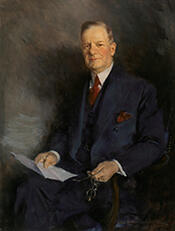
Here you will find contact information for Representative Henry Bascom Steagall, including email address, phone number, and mailing address.
| Name | Henry Bascom Steagall |
| Position | Representative |
| State | Alabama |
| District | 3 |
| Party | Democratic |
| Status | Former Representative |
| Term Start | December 6, 1915 |
| Term End | January 3, 1945 |
| Terms Served | 15 |
| Born | May 19, 1873 |
| Gender | Male |
| Bioguide ID | S000820 |
About Representative Henry Bascom Steagall
Henry Bascom Steagall (May 19, 1873 – November 22, 1943) was a United States Representative from Alabama who served in Congress from 1915 to 1943. A member of the Democratic Party, he represented Alabama’s 3rd Congressional District for 15 consecutive terms, participating in the legislative process during a significant period in American history that encompassed World War I, the Great Depression, and World War II. Over the course of nearly three decades in the House of Representatives, he became a central figure in banking and housing reform and was widely recognized as an influential Southern Democrat.
Steagall was born in Clopton, Dale County, Alabama, on May 19, 1873. His paternal grandfather had emigrated to the United States from England, and Steagall grew up in the rural Wiregrass region of southeast Alabama. He attended the Southeast Alabama Agricultural School at Abbeville, an institution that provided secondary and practical education to young men in the area. He later enrolled in the law department of the University of Alabama at Tuscaloosa, from which he graduated in 1893. After completing his legal studies, he was admitted to the bar and began the practice of law in Alabama, establishing the professional foundation that would lead to his long career in public service.
Steagall’s early career was rooted in local and state government. He served as county solicitor of Dale County from 1902 to 1908, a position in which he prosecuted cases on behalf of the county and gained experience in public law enforcement and administration. While still serving as county solicitor, he was elected as a Democratic member of the Alabama House of Representatives, serving in the state legislature from 1906 to 1907. These roles helped establish his reputation as a capable lawyer and legislator and positioned him for higher office within the Democratic Party at a time when the party dominated Alabama politics.
In 1914, Steagall was elected to the U.S. House of Representatives as a Democrat from Alabama’s 3rd District and took his seat in March 1915. He remained in the House until his death in 1943, serving 15 terms in office. During this long tenure, he represented the interests of his constituents through major national crises, including World War I, the interwar years, and the New Deal era. He became particularly prominent in financial and economic legislation, and his influence grew steadily as he rose in seniority. As a Southern Democrat, he often balanced conservative regional interests with support for selected reform measures, a stance that later commentators described as that of a “conservative as a reformer.”
Steagall’s most significant contributions came through his work on banking and housing policy. He served as chairman of the powerful House Committee on Banking and Currency, from which position he played a central role in shaping New Deal financial legislation. In 1933, at the height of the banking crisis during the Great Depression, he co-sponsored with Senator Carter Glass of Virginia the landmark Glass–Steagall Act. This legislation introduced sweeping banking reforms, including the separation of commercial and investment banking, and established the Federal Deposit Insurance Corporation (FDIC), which provided federal insurance for bank deposits and was designed to restore public confidence in the banking system. The act became one of the cornerstone measures of New Deal financial regulation.
Steagall also played a major role in federal housing policy. In cooperation with Senator Robert F. Wagner of New York, he co-sponsored the Wagner–Steagall National Housing Act, enacted in September 1937. This legislation created the United States Housing Authority, which provided federal subsidies to local public housing agencies to improve housing conditions for low-income families. The act marked a significant expansion of the federal government’s role in housing and urban policy and reflected Steagall’s willingness to support social and economic reforms within a framework acceptable to many Southern Democrats.
During World War II, Steagall continued to support key national security measures. He voted in favor of the Lend-Lease Act in 1941, authorizing the United States to provide military aid and supplies to the United Kingdom and other Allied nations prior to America’s formal entry into the war. His support for Lend-Lease aligned him with the interventionist wing of the Democratic Party that favored aiding the Allies against Axis aggression. Throughout his congressional service, he remained engaged in the broader democratic process and was regarded as an important voice for his Alabama constituents in national debates.
Steagall died in office on November 22, 1943, in Washington, D.C., while still serving in the House of Representatives, and he is listed among the members of Congress who died in office during the first half of the twentieth century. His legacy in law and public service was later recognized when he was inducted into the Alabama Lawyers’ Hall of Fame in 2002. Known for his distinctive surname, he once explained to The Literary Digest that his name was pronounced “stee-gall” (like “tea” and “gall”), with equal stress on each syllable, noting that this pronunciation was common in the South though northerners often rhymed it with “eagle.” Among African Americans in Alabama he was colloquially known as “Marse Henry,” a term reflecting both his prominence and the racial and social hierarchies of his time.