Representative Henry Watterson
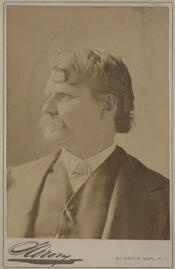
Here you will find contact information for Representative Henry Watterson, including email address, phone number, and mailing address.
| Name | Henry Watterson |
| Position | Representative |
| State | Kentucky |
| District | 5 |
| Party | Democratic |
| Status | Former Representative |
| Term Start | December 6, 1875 |
| Term End | March 3, 1877 |
| Terms Served | 1 |
| Born | February 16, 1840 |
| Gender | Male |
| Bioguide ID | W000209 |
About Representative Henry Watterson
Henry Watterson (February 16, 1840 – December 22, 1921) was an American journalist, author, Confederate soldier, and partial-term United States Representative from Kentucky. A lifelong Democrat like his father, U.S. Representative Harvey Magee Watterson of Tennessee, he became one of the most influential newspaper editors of the post–Civil War era and a prominent public voice on national reconciliation, party politics, and American expansion. For five decades after the American Civil War he was a part-owner and editor of the Louisville Courier-Journal, and he served one term in the U.S. House of Representatives from 1875 to 1877, representing Kentucky as a member of the Democratic Party.
Watterson was born in Washington, D.C., on February 16, 1840, the only child of Harvey Magee Watterson, a lawyer from Shelbyville, Tennessee, and former U.S. Congressman, and his wife Tilithacumi (Talitha) Black of Spring Hill, Tennessee. His father was closely associated with President Andrew Jackson and, in 1843, became publisher of the Washington Union, then the principal newspaper organ of the national Democratic Party. Journalism and public life ran in the family: Watterson’s uncle in Ohio, Stanley Matthews, would become a newspaper editor, lawyer, Union officer during the Civil War, and ultimately a Republican justice of the United States Supreme Court. Sickly as a child and afflicted with very poor eyesight in his only functioning eye, Watterson was educated at home by his mother in Washington and at the family’s residence in Nashville, Tennessee, until about age twelve.
Around the age of twelve, Watterson was sent to Philadelphia, Pennsylvania, for his only formal schooling, at an academy run by an Episcopal priest. There he quickly gravitated toward journalism, running the school paper, the New Era, on a press donated by his father. By his mid-teens he had embarked on a professional newspaper career. In 1856 he moved to New York City, where he worked for various publications, and in 1858 he relocated to Washington to continue in journalism. These early experiences in the nation’s political and media capitals helped shape his understanding of national politics and the power of the press, skills he would later deploy to great effect in both journalism and public office.
With the outbreak of the American Civil War, Watterson returned to Tennessee in 1861 when his father went back to the state. He volunteered for the Confederate States Army and at various times served on the staffs of Generals Joseph E. Johnston, Leonidas Polk, and Nathan B. Forrest. His principal contribution to the Confederate cause, however, was editorial rather than military. He wrote for and helped guide Confederate newspapers, including the Chattanooga Rebel and the Nashville Banner, using his pen to support the Southern war effort. After the Confederacy’s defeat, he briefly edited the Cincinnati Evening Post for six months, then returned to Nashville by September 1865.
In September 1865 Watterson married Rebecca Ewing in Nashville. The couple would have six sons and two daughters, including sons Ewing (born 1868), Henry Jr. (born 1877), and Harvey W. Watterson (1879–1908), and daughters Lady (born 1871) and Ethel Watterson Gilmour (1880–1907). Their household was sufficiently prosperous to employ live-in Irish servants, and by 1880 his parents were also living with them. Professionally, Watterson became editor and part owner of the Nashville Banner, where he launched his influential “New Departure” campaign urging national reconciliation between North and South. During the war he had met Louisville publisher Walter Newman Haldeman, and Watterson ultimately settled in Louisville, Kentucky, to edit the Louisville Journal. In 1868 that paper merged with the Louisville Courier to form the Louisville Courier-Journal, which quickly gained national attention for its reporting and commentary. Watterson became a part-owner and, for roughly five decades after the Civil War, the dominant editorial voice of the Courier-Journal.
Watterson’s prominence in journalism paralleled his growing role in national politics. Initially a leader in the Liberal Republican movement in 1872, he was firmly identified with the Democratic Party by the mid-1870s. He gained notoriety in the disputed presidential election of 1876 when he proposed that hundreds of thousands of Democrats march on Washington to insist on the seating of Samuel J. Tilden, a suggestion that angered President Ulysses S. Grant, who publicly warned that no one would threaten his administration. Watterson was elected as a Democrat to the United States House of Representatives from Kentucky, serving from 1875 to 1877. He was chosen to fill the remainder of the term of Representative Edward Y. Parsons, who had died in office, and during this single term he participated in the legislative process at a critical moment in Reconstruction-era politics, representing the interests of his Kentucky constituents in the House of Representatives.
Although his formal congressional service was brief, Watterson remained deeply involved in Democratic Party affairs and national public life for decades. He was a five-time delegate to the Democratic National Convention, and at the 1892 convention he received a scattering of votes for the vice-presidential nomination. Beyond party politics, he became widely known as a lecturer and orator, addressing issues ranging from sectional reconciliation to American foreign policy. His published works included “History of the Spanish–American War” (1899) and “The Compromises of Life” (1902), which reflected his interest in both contemporary events and broader political philosophy.
As editor of the Courier-Journal, Watterson was often described as “the last of the great personal journalists,” known for colorful, forceful, and sometimes controversial editorials written under the pen name “Marse Henry.” His columns were widely syndicated, reprinted in hundreds of American newspapers, and became an early and influential model of the syndicated opinion column. In the years leading up to and during the First World War, his writings played a significant role in shaping public opinion in favor of U.S. intervention. In 1918 he was awarded the Pulitzer Prize for Editorial Writing for two editorials supporting American entry into the war, “Vae Victis!” and “War Has Its Compensations.” He remained editor of the Courier-Journal until 1919, when the paper, originally founded by Walter Newman Haldeman, was purchased by Robert Worth Bingham. Conflicts with Bingham over the paper’s direction led to Watterson’s retirement and ended his long association with the journal that had made him a national figure.
Henry Watterson died in Jacksonville, Duval County, Florida, on December 22, 1921. His legacy endured in both journalism and public memory. In Louisville, the portion of Interstate 264 from the junction with U.S. Route 31W to its northeastern terminus at Interstate 71 is known as the Watterson Expressway, and a Jefferson County public school in eastern Louisville bears the name Watterson Elementary School. During World War II, the Liberty ship SS Henry Watterson was named in his honor, reflecting the lasting recognition of his contributions as a Pulitzer Prize–winning journalist, influential editor, and former Democratic Representative from Kentucky.