Representative Henry Melville Youmans
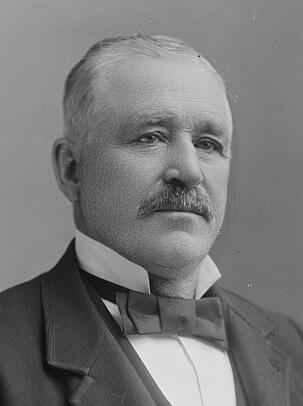
Here you will find contact information for Representative Henry Melville Youmans, including email address, phone number, and mailing address.
| Name | Henry Melville Youmans |
| Position | Representative |
| State | Michigan |
| District | 8 |
| Party | Democratic |
| Status | Former Representative |
| Term Start | December 7, 1891 |
| Term End | March 3, 1893 |
| Terms Served | 1 |
| Born | May 15, 1832 |
| Gender | Male |
| Bioguide ID | Y000027 |
About Representative Henry Melville Youmans
Henry Melville Youmans (May 15, 1832 – July 8, 1920) was an American businessman and Democratic politician from the U.S. state of Michigan who served one term in the United States House of Representatives from 1891 to 1893. Over the course of a long public career, he held municipal, state, and federal offices and was active in the lumber, salt, and agricultural industries.
Youmans was born on May 15, 1832, in Otego, New York, where he attended the common schools. As a young man he entered the railroad industry and was employed by the York & Erie Railroad Company on the Susquehanna division for ten years. This early experience in transportation and commerce preceded his move westward as new economic opportunities opened in the Great Lakes region.
In 1862 Youmans moved to East Saginaw, Michigan, a rapidly developing center of the lumber trade. Beginning in 1863 he engaged in the manufacture of lumber and salt, enterprises that he pursued until 1878. That year he relocated to St. Clair County, Michigan, where he continued his involvement in natural-resource-based industries, engaging in farming and lumbering until 1884. He then returned to East Saginaw, resuming his place in the civic and economic life of the community.
Youmans’s prominence in East Saginaw led to a series of local public offices. He served four terms as an alderman and was elected mayor of East Saginaw in 1886 and 1887. His municipal service helped establish his reputation as a Democratic leader in the region and provided the foundation for his subsequent candidacies for higher office.
In the general election of 1890, Youmans ran as the candidate of the Democratic Party for Michigan’s 8th congressional district. He defeated the incumbent Republican, Aaron T. Bliss, and was elected to the 52nd United States Congress, serving from March 4, 1891, to March 3, 1893. During his single term in the U.S. House of Representatives, a significant period in American history marked by debates over tariffs, monetary policy, and federal expenditures, he participated in the legislative process and represented the interests of his constituents. He served as chairman of the Committee on Expenditures on Public Buildings, overseeing aspects of federal spending related to government facilities. A member of the Democratic Party, Henry Melville Youmans contributed to the legislative process during his one term in office. He was an unsuccessful candidate for reelection in 1892, losing to Republican William S. Linton, and later was again unsuccessful in a congressional race against Joseph W. Fordney in 1902.
After leaving Congress, Youmans continued his public service at the state level. He was elected to the Michigan Senate from the 22nd district, serving in 1897 and 1898. His tenure in the state legislature extended his influence in Michigan politics beyond his earlier municipal and federal roles and reflected his continued engagement with public affairs well into the late nineteenth century.
In his later years, Youmans devoted himself primarily to agricultural pursuits. He engaged in farming in Bridgeport, Michigan, while maintaining his ties to the Saginaw area where he had long resided and conducted business. Henry Melville Youmans died in Saginaw, Michigan, on July 8, 1920. He was interred in Brady Hill Cemetery in Saginaw, closing a life that spanned the era from early railroad expansion through the industrial and political transformations of the late nineteenth and early twentieth centuries.