Senator Herbert Henry Lehman
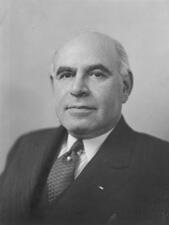
Here you will find contact information for Senator Herbert Henry Lehman, including email address, phone number, and mailing address.
| Name | Herbert Henry Lehman |
| Position | Senator |
| State | New York |
| Party | Democratic |
| Status | Former Representative |
| Term Start | January 3, 1949 |
| Term End | January 3, 1957 |
| Terms Served | 2 |
| Born | March 28, 1878 |
| Gender | Male |
| Bioguide ID | L000224 |
About Senator Herbert Henry Lehman
Herbert Henry Lehman (LEE-mən; March 28, 1878 – December 5, 1963) was an American financier, military officer, and Democratic politician who served as the 45th and first Jewish governor of New York from 1933 to 1942 and represented New York in the United States Senate from 1949 until 1957. A prominent figure in mid‑twentieth‑century public life, he played major roles in state government, international relief efforts during and after World War II, and national politics, and was for much of his Senate career the only Jewish member of that body.
Lehman was born on March 28, 1878, into a German Jewish family; unlike most of his later Jewish constituents in New York, whose roots were in Eastern Europe, his family background was German. He entered the world of finance in the early twentieth century and became a successful businessman before turning to public service. On April 28, 1910, he married Edith Louise Altschul, sister of banker Frank Altschul. The couple had three children: Peter (born 1917), Hilda (born 1921), and John. The family’s later history was deeply marked by World War II: all three children served in the United States military during that conflict, and Peter was killed while on active duty. According to a group history published on April 6, 1944, Peter Lehman was to be awarded the Distinguished Flying Cross, with the medal scheduled to be awarded on his father’s 70th birthday. Peter married and had two daughters, Penny Lehman (born 1940) and Wendy Lehman (born 1942). Hilda married three times—first, in 1940, to Works Progress Administration actor Boris De Vadetzky, of French‑Russian descent; second, in 1945, to U.S. Army Major Eugene L. Paul; and a third time, which also ended in divorce. She had three children: Deborah Wise (born 1947), Peter Wise (born 1949), and Stephanie Wise (born 1951).
At the start of World War I, Lehman sought to contribute to the national war effort. In April 1917 he applied to attend a Citizens’ Military Training Camp at Plattsburgh Barracks, New York. While his application was pending, he volunteered his services to the United States Navy as an expert on textiles needed for uniforms and other wartime clothing and equipment. In this capacity he worked closely with Franklin D. Roosevelt, then Assistant Secretary of the Navy, a relationship Roosevelt later recalled during campaign appearances when the two men ran together as the Democratic nominees for governor and lieutenant governor of New York in 1928. In September 1917 Lehman was commissioned as a captain in the United States Army Ordnance Corps and assigned as chief of the Ordnance Department’s Equipment Section on the staff of the United States Department of War. He was promoted to major in January 1918 and subsequently served as chief of the War Department’s Methods Section and then chief of its Purchase Branch. In October 1918 he was promoted to lieutenant colonel. After the Armistice in November 1918, he participated in the Army’s demobilization as a member of the Board of Contract Adjustment, assistant director of the Office of Purchase, Storage and Traffic, member of the War Department Claims Board, and chairman of the Board of Sales and Contract Termination. He was promoted to colonel in April 1919 and was discharged in June 1919. In July 1919 he was awarded the Army Distinguished Service Medal for exceptionally meritorious and distinguished services in these posts, where his large business experience, breadth of vision, and sound judgment were cited as having been of inestimable value in formulating and supervising the execution of methods and policies for the cancellation and settlement of war contracts and obligations.
Lehman’s political career in New York reached its height in the 1930s. A member of the Democratic Party, he was elected governor of New York in 1932 to succeed Franklin D. Roosevelt, who had been elected President of the United States. Lehman served four terms as governor, winning reelection in 1934 and 1936, and again in 1938, when he was chosen for New York’s first four‑year gubernatorial term. He was the first, and until the 2007 inauguration of Eliot Spitzer, the only Jewish governor of New York. Unlike former governor Al Smith, Lehman strongly supported Roosevelt’s New Deal and implemented a parallel program at the state level. His administration established an unemployment insurance system, improved the state’s workmen’s compensation plan, and enacted minimum wage standards for women and children. He also championed a so‑called “Little Wagner Act” to extend collective bargaining rights to workers engaged in intrastate commerce, who were not covered by the original federal Wagner Act. His tenure was also marked by difficult decisions, including his 1934 refusal to grant clemency to Anna Antonio, an Italian immigrant convicted of hiring hitmen to kill her husband, whom she claimed had been abusive. In October 1941, amid rising global tensions, Lehman declined to participate in a New York fundraising dinner co‑hosted by Lillian Hellman and Ernest Hemingway for anti‑Nazi activists imprisoned in France, explaining that some sponsoring organizations “have long been connected with Communist activities.” Hellman responded that she had not inquired into the politics of committee members and later provided Lehman with a detailed accounting of the funds raised.
Lehman left the governorship to take on major responsibilities in international relief. On December 3, 1942, less than a month before the scheduled end of his final term, he resigned as governor to accept appointment as director of the Office of Foreign Relief and Rehabilitation Operations in the U.S. Department of State. In 1943 he became director‑general of the United Nations Relief and Rehabilitation Administration (UNRRA), an international agency charged with providing emergency relief to populations in areas liberated from Axis control. He served in that capacity until 1946, overseeing large‑scale efforts to supply food, medical care, and other assistance in war‑torn regions.
Herbert Henry Lehman entered the United States Senate as a Democrat from New York in 1949, serving until 1957. His service in Congress encompassed two terms in office during a significant period in American history, including the early Cold War, the Korean War, and the beginnings of the modern civil rights movement. As a member of the Senate, Lehman participated actively in the legislative process and represented the interests of his New York constituents. During much of his Senate career he was the only Jewish senator, a fact that underscored both his prominence and the relative underrepresentation of Jewish Americans in national elective office at the time. He was known for his liberal positions on social welfare, civil liberties, and international cooperation, and he used his experience in state government and international relief to inform his work on national policy.
After his retirement from the Senate in 1957, Lehman remained engaged in public affairs. In the late 1950s and early 1960s he worked with Eleanor Roosevelt and former Secretary of the Air Force Thomas K. Finletter to support the reform Democratic movement in Manhattan, which eventually helped to end the dominance of longtime Tammany Hall boss Carmine DeSapio. He also contributed to civic and cultural life in New York City, including helping to found the Lehman Children’s Zoo in Central Park, later renamed the Tisch Zoo. His career and legacy have been documented and commemorated in various ways, including collections of his papers and correspondence at Columbia University, the Herbert H. Lehman Center for American History at Columbia, and archival film clips of his public appearances, such as his opening speech at the 1939 New York World’s Fair and interviews on the television program “Longines Chronoscope.”
Lehman spent much of the last two years of his life at his home in New York City in increasingly poor health. He died of heart failure on December 5, 1963, at the age of 85. He is interred at Kensico Cemetery in Valhalla, New York.