Senator Herschel Vespasian Johnson
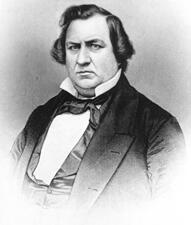
Here you will find contact information for Senator Herschel Vespasian Johnson, including email address, phone number, and mailing address.
| Name | Herschel Vespasian Johnson |
| Position | Senator |
| State | Georgia |
| Party | Democratic |
| Status | Former Representative |
| Term Start | January 1, 1848 |
| Term End | March 3, 1849 |
| Terms Served | 1 |
| Born | September 18, 1812 |
| Gender | Male |
| Bioguide ID | J000139 |
About Senator Herschel Vespasian Johnson
Herschel Vespasian Johnson (September 18, 1812 – August 16, 1880) was an American politician and jurist who served as a United States senator from Georgia, the forty-first governor of Georgia, a Confederate States senator, and the 1860 vice-presidential nominee of the Stephen A. Douglas wing of the Democratic Party. A member of the Democratic Party throughout his public career, he played a prominent role in state and national politics during the turbulent decades preceding, during, and following the American Civil War.
Johnson was born near Farmer’s Bridge in Burke County, Georgia. Details of his early childhood are sparse, but he was raised in the agrarian society of the Georgia countryside, an environment that shaped many of his later political views. He pursued higher education at the University of Georgia in Athens, from which he graduated in 1834. After completing his collegiate studies, he read law at the private law school of Judge William T. Gould in Augusta, Georgia. He was admitted to the bar and embarked on a legal career that would serve as the foundation for his subsequent political and judicial service.
By 1839, Johnson had moved to Jefferson County and began practicing law in Louisville, Georgia. His growing reputation as an attorney soon drew him into electoral politics. In 1843 he made an unsuccessful bid for a seat in the United States Congress. The following year, however, he gained statewide prominence as a presidential elector in the 1844 election, casting his ballot for Democratic candidates James K. Polk and George M. Dallas. In 1844 he relocated to Milledgeville, then the state capital of Georgia, where he continued his legal practice. During the 1850s he acquired the Samuel Rockwell House in Milledgeville as a summer residence, reflecting his rising social and political stature.
Johnson’s first major statewide political contest came in 1847, when he sought the Democratic nomination for governor of Georgia. He lost that nomination to George W. Towns, who went on to win the general election. Nonetheless, Johnson’s standing within the party remained strong. When U.S. Senator Walter T. Colquitt resigned, Governor Towns appointed Johnson to fill the vacancy. Johnson served as a United States senator from Georgia from February 4, 1848, to March 3, 1849, completing one term in office in the Thirtieth Congress. During this period he participated in the legislative process at a time of mounting sectional tensions over slavery and territorial expansion, representing the interests of his Georgia constituents. He did not seek election to a full term and returned to Georgia at the close of his Senate service.
Upon leaving the U.S. Senate, Johnson resumed his legal and judicial career. From 1849 to 1853 he served as a circuit court judge in Georgia, further solidifying his reputation as a capable jurist. He again took part in national politics as a presidential elector in 1852. By 1850 he was regarded as a pro-slavery politician with strong secessionist leanings, reflecting the dominant views of many white Georgia Democrats of the era. His personal involvement in the slave system was extensive: in 1840 he owned 34 enslaved people in Jefferson County; by 1850 he owned 7 enslaved people in Milledgeville and an additional 60 in Jefferson County; and by 1860 he owned 115 enslaved people in Jefferson County, underscoring his deep economic and social investment in slavery.
In 1853 Johnson was elected governor of Georgia and was re-elected in 1855, serving as the state’s forty-first governor from 1853 to 1857. Early in the 1850s he was outspoken in his belief that a Republican victory, particularly that of John C. Frémont in the 1856 presidential election, would justify Southern secession, and during the 1856 campaign he publicly declared that a Frémont victory would be grounds for disunion. However, while serving as governor he gradually shifted his stance and emerged as a strong Unionist, arguing that Southern rights could and should be protected within the federal Union. His gubernatorial administration navigated the intensifying sectional crisis while overseeing the routine governance of the state. In recognition of his service, Johnson County, Georgia, created in 1858, was named in his honor after he left the governorship in 1857.
Johnson returned to the national stage in the fractious presidential election of 1860. When the Democratic Party split over the question of extending slavery into the western territories—Southern Democrats demanding an explicit commitment to expansion and Northern Democrats resisting such a platform—two rival Democratic tickets emerged. To help attract Southern support to the Northern, or Douglas, wing of the party, Johnson was chosen as the vice-presidential nominee to run with Senator Stephen A. Douglas. As the Douglas wing’s vice-presidential candidate, he campaigned on a platform that sought to preserve the Union while accommodating slavery under the doctrine of popular sovereignty, though the divided Democratic vote contributed to the victory of Republican candidate Abraham Lincoln.
With the secession crisis at hand, Johnson continued to play a central role in Georgia politics. In 1861 he served as a delegate to the Georgia state secession convention. Despite his earlier flirtation with secessionist rhetoric, by this time he opposed immediate secession from the Union and argued for a more moderate course. When it became clear that Georgia would secede, however, he acquiesced out of loyalty to his state and signed the Georgia Ordinance of Secession. He subsequently entered the government of the Confederate States of America and served as one of Georgia’s senators in the Second Confederate Congress from 1862 until the end of the Civil War in 1865. In the Confederate Senate, Johnson often took positions critical of the centralizing tendencies of the Confederate government, opposing conscription and the suspension of habeas corpus as infringements on civil liberties and states’ rights.
After the collapse of the Confederacy, Johnson emerged as a significant figure in Georgia’s Reconstruction-era politics. In 1865 he served as president of Georgia’s constitutional convention, which sought to frame a new state constitution acceptable to federal authorities and to guide Georgia’s transition from slavery to a system of free labor, albeit under conditions that still severely constrained the rights of formerly enslaved people. Upon Georgia’s initial readmission to the Union in 1866, the state legislature chose Johnson as a United States senator. However, due to his prior service in the Confederate government and the prevailing policies of Congressional Reconstruction, he was not permitted to take his seat in the U.S. Senate.
In his later years Johnson returned once more to the judiciary. In 1873 he again became a circuit court judge in Georgia, a position he held until his death. He continued to reside principally in Louisville, Jefferson County, where he had long maintained his law practice and plantation interests. Herschel Vespasian Johnson died in Louisville, Georgia, on August 16, 1880, closing a career that had spanned antebellum politics, the Civil War, and Reconstruction, and that had left a complex legacy in both Georgia and national history.