Senator Hiram L. Fong
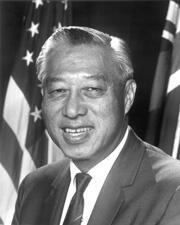
Here you will find contact information for Senator Hiram L. Fong, including email address, phone number, and mailing address.
| Name | Hiram L. Fong |
| Position | Senator |
| State | Hawaii |
| Party | Republican |
| Status | Former Representative |
| Term Start | January 7, 1959 |
| Term End | January 3, 1977 |
| Terms Served | 9 |
| Born | October 15, 1906 |
| Gender | Male |
| Bioguide ID | F000245 |
About Senator Hiram L. Fong
Hiram Leong Fong (born Yau Leong Fong; October 15, 1906 – August 18, 2004) was an American businessman, lawyer, and Republican politician from Hawaii who became one of the first two United States Senators from Hawaii after it achieved statehood in 1959. He was the first Chinese American and the first Asian American to serve in the United States Senate, holding office from 1959 to 1977, and to date remains the only Republican U.S. senator from Hawaii. Over the course of three terms in the Senate, he contributed to the legislative process during a significant period in American history, representing the interests of his constituents and participating actively in the democratic process.
Fong was born in the Kalihi neighborhood of Honolulu on the island of Oahu as the seventh of eleven children. His father, Fong Sau Howe, was of Cantonese origin from what is now Zhuhai in southern China and immigrated to Hawaii in 1872, joining the nearly 45,000 Chinese immigrants who came to work on the islands’ sugar plantations. His father worked as a sugar plantation laborer, and the family’s modest circumstances required all members to contribute from an early age. Fong began working at age four picking beans for cattle feed, and by the age of seven he was employed as a shoeshiner. These early experiences of poverty and hard work shaped his later emphasis on economic opportunity and the “American dream,” a theme later highlighted by Richard Nixon, who remarked in 1960 during a visit to Hawaii that “the American dream is not just a dream, it does come true – Hiram Fong’s life proves it.”
Fong attended local public schools in Honolulu and graduated from President William McKinley High School in 1924, where one of his classmates was Masaji Marumoto, who would later become the first Japanese American justice on the Supreme Court of Hawaii. He continued his education at the University of Hawaii at Mānoa, earning a degree in 1930. Determined to pursue a legal career, he then attended Harvard Law School, from which he received his law degree in 1935. After completing his studies, he returned to Hawaii and began work in the Office of the Prosecuting Attorney of Honolulu, gaining experience in public law and the local court system. In 1938, he entered private practice and helped found the law firm of Fong, Miho, Choy, and Robinson. During World War II, he served as a judge advocate in the United States Army Air Forces, attaining the rank of major, and later retired as a colonel from the United States Air Force Reserve. In 1942, he changed his given name to “Hiram,” reportedly in honor of Hiram Bingham I, an early Protestant missionary in Hawaii.
Fong’s political career began in the era of territorial government. In 1938, the same year he founded his law office, he was elected to the Hawaii Territorial House of Representatives. Over the next decade he emerged as a leading Republican figure, ultimately serving as Speaker of the House from 1948 to 1954. In this role he became one of the foremost leaders in the campaign for Hawaii statehood, advocating for full representation in Congress and equal status with the existing states. As a territorial legislator, he was chosen as a delegate to the 1952 Republican National Convention. However, the long-standing Republican dominance in the territorial legislature came to an end in the 1950s when the Democratic Party of Hawaii successfully ousted many Republican incumbents, and Fong was forced into retirement from the legislature. After leaving elective office, he turned his attention to business, founding several enterprises. In 1952, along with five other island families, he helped start Finance Factors, one of the first industrial and consumer loan companies in Hawaii, created to serve the growing number of minority residents seeking to start businesses and purchase homes.
Following Hawaii’s admission as the 50th state in 1959, Fong sought federal office and was elected one of the state’s first two U.S. Senators, serving alongside Democrat Oren E. Long, a former territorial governor. In the 1959 election he defeated Democrat Frank Fasi by a margin of 52.9 to 47.1 percent. According to contemporaneous accounts, including The Washington Post, his political success was due in part to support from the powerful International Longshore and Warehouse Union. In the Senate, Fong was generally regarded as a moderate Republican. He supported many of President Lyndon B. Johnson’s Great Society initiatives, including the establishment of Medicare in 1965, and he consistently backed civil rights legislation and efforts to eliminate ethnic barriers to immigration. He voted in favor of the Civil Rights Acts of 1960, 1964, and 1968, supported the 24th Amendment to the U.S. Constitution abolishing the poll tax in federal elections, and voted for the Voting Rights Act of 1965, for which he authored an amendment providing for poll watchers to safeguard the election process. He also voted to confirm Thurgood Marshall as the first African American justice on the U.S. Supreme Court. During debate on the Immigration and Nationality Act of 1965, Fong argued that increased immigration from Asia would not fundamentally alter American cultural patterns, estimating that Asians would remain a small fraction of the U.S. population.
Fong was reelected to the Senate in 1964 with 53 percent of the vote, defeating Democrat Thomas Gill, who received 46.4 percent, and again in 1970 by a narrower margin of 51.6 to 48.4 percent over Democrat Cecil Heftel. His 1970 campaign was affected by his strong support for President Richard Nixon’s policies in Vietnam; his backing of the Vietnam War reportedly displeased many Asian American and other constituents in Hawaii and was cited by the Honolulu Star-Bulletin as a factor in his reduced margin of victory. During his Senate tenure, he also became a figure of national prominence within the Republican Party. He was twice honored as Hawaii’s “favorite son” at the Republican National Conventions of 1964 and 1968. At the 1964 convention, he became the first Asian American to receive delegate votes for a major party’s presidential nomination, receiving the votes of the Hawaii and Alaska delegations. His national profile occasionally brought controversy; on one occasion he was booed by an audience for defending George W. Romney, then Secretary of Housing and Urban Development, in the wake of a real-estate industry scandal. Nonetheless, he remained a symbol of minority advancement in American politics and a prominent example of Asian American participation in national public life. In 1976, at the age of 70, Fong chose to retire rather than seek a fourth term, and he was succeeded by Democrat Spark Matsunaga.
Outside of politics, Fong continued to be active in business and civic affairs. He expanded his business interests, including the development of a large botanical garden on the windward side of Oahu. The property, encompassing approximately 725 acres (293 hectares), was opened to the public in 1988 and became known for its extensive tropical plant collections and scenic valley setting. Over the years, however, Fong and his family became embroiled in financial and legal disputes related to their business holdings. Several lawsuits, including litigation involving one of his sons over control and management of family enterprises, led to serious financial strain. Ultimately, these difficulties forced Fong and his wife to declare bankruptcy in 2003.
Fong married Ellyn Lo in 1938, and the couple had four children. A Congregationalist by faith, he remained closely connected to the local community in Honolulu throughout his life. His long public career and his status as the first Asian American U.S. senator made him an enduring figure in Hawaii’s political history and in the broader story of Asian American participation in American government. On August 18, 2004, Hiram Fong died of kidney failure at his home in Honolulu; at the time of his death he was the last living former U.S. senator born in the decade of the 1900s. He was buried in Nuuanu Memorial Park and Mortuary in Honolulu.
Fong took care to preserve the historical record of his life and public service. In August 1998, he donated his papers to the University of Hawaii at Mānoa Library and provided financial support for their preservation and processing. The collection, comprising over a thousand boxes, crates, and trunks, includes papers, photographs, videos, and memorabilia from his congressional tenure and pre-political life, including his law school notes. The archive contains series of Washington, D.C., and Hawaii office files, extensive materials from his work on the Senate Post Office and Civil Service Committee, and various political souvenirs. Approximately 80 boxes of books accompanied the papers, many relating to his Senate committee work; while a few volumes were retained with the congressional collection, most were added to the university’s general library holdings, marked with a specially designed gift bookplate incorporating his distinctive signature. The papers were processed in 2003 by archivist Dee Hazelrigg and are available to researchers by appointment, providing a detailed documentary record of Fong’s role in Hawaii’s transition from territory to statehood and his nearly two decades in the United States Senate.