Senator Hiram Warren Johnson
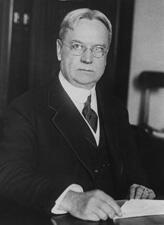
Here you will find contact information for Senator Hiram Warren Johnson, including email address, phone number, and mailing address.
| Name | Hiram Warren Johnson |
| Position | Senator |
| State | California |
| Party | Republican |
| Status | Former Representative |
| Term Start | April 2, 1917 |
| Term End | December 31, 1945 |
| Terms Served | 5 |
| Born | September 2, 1866 |
| Gender | Male |
| Bioguide ID | J000140 |
About Senator Hiram Warren Johnson
Hiram Warren Johnson served as a Senator from California in the United States Congress from 1917 to 1945. A member of the Republican Party, Hiram Warren Johnson contributed to the legislative process during 5 terms in office.
Hiram Warren Johnson’s service in Congress occurred during a significant period in American history. As a member of the Senate, Hiram Warren Johnson participated in the democratic process and represented the interests of constituents.
Hiram Warren Johnson (September 2, 1866 – August 6, 1945) was an American attorney and politician who served as the 23rd governor of California from 1911 to 1917 and represented California in the U.S. Senate for five terms from 1917 to 1945. Johnson achieved national prominence in the early 20th century as a leading progressive and ran for vice president on Theodore Roosevelt’s Progressive ticket in the 1912 presidential election. As a U.S. senator, Johnson voted for American entry into World War I and was later a critic of the foreign policy of both Woodrow Wilson and Franklin D. Roosevelt. Johnson was the only governor of his state from 1856 until 1943 to serve more than one term. Johnson was born in 1866 and worked as a stenographer and reporter before embarking on a legal career in his hometown of Sacramento. After he moved to San Francisco, he worked as an assistant district attorney and gained statewide renown for his prosecutions of public corruption. On the back of this popularity, Johnson won the 1910 California gubernatorial election with the backing of the progressive Lincoln–Roosevelt League. He instituted several progressive reforms, establishing a railroad commission and introducing aspects of direct democracy, such as the power to recall state officials. Having joined with Theodore Roosevelt and other progressives to form the Progressive Party, Johnson won the party’s 1912 vice-presidential nomination. In one of the best third-party performances in U.S. history, the ticket finished second nationally in the popular and electoral votes. Johnson was elected to the U.S. Senate in 1916, becoming a leader of the chamber’s Progressive Republicans. He made his biggest mark in the Senate as an early voice for isolationism but voted for U.S. entry into World War I. He opposed U.S. participation in the League of Nations. He unsuccessfully sought the Republican presidential nomination in 1920 and 1924. Although he supported Democratic nominee Franklin D. Roosevelt in the 1932 presidential election and many of the New Deal programs, by November 1936 he had become hostile to Roosevelt, whom he viewed as a potential dictator. He remained in the Senate until his death in 1945.