Senator Hiram Rhodes Revels
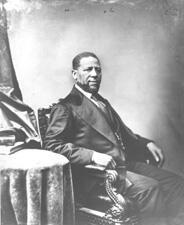
Here you will find contact information for Senator Hiram Rhodes Revels, including email address, phone number, and mailing address.
| Name | Hiram Rhodes Revels |
| Position | Senator |
| State | Mississippi |
| Party | Republican |
| Status | Former Representative |
| Term Start | January 1, 1870 |
| Term End | March 3, 1871 |
| Terms Served | 1 |
| Born | September 27, 1827 |
| Gender | Male |
| Bioguide ID | R000166 |
About Senator Hiram Rhodes Revels
Hiram Rhodes Revels (September 27, 1827 – January 16, 1901) was an American Republican politician, minister in the African Methodist Episcopal Church, and college administrator who became the first African American to serve in either house of the United States Congress. Born free in Fayetteville, North Carolina, to parents of African and European ancestry, he grew up in a slave state but was legally free from birth. As a young man he was apprenticed as a barber, a trade that enabled him to travel and support himself while pursuing religious study and antislavery work. Seeking greater opportunity and safety, he later lived and worked in the free state of Ohio, where he voted before the Civil War, an experience that would later be cited in debates over his eligibility for the Senate.
Revels pursued an education unusual for African Americans of his generation. He studied at seminaries and religious institutions in the North and Midwest, including in Indiana and at Knox College in Galesburg, Illinois, although he did not complete a formal degree. He was ordained in the African Methodist Episcopal (AME) Church and began a career as an itinerant minister, preaching in states such as Indiana, Illinois, Kansas, and Missouri. His ministry combined religious leadership with advocacy for the rights and moral uplift of Black communities. Because of his antislavery views and his work among free and enslaved African Americans, he was at times arrested or threatened in slaveholding states, but he continued to build a reputation as a capable preacher and organizer.
During the American Civil War, Revels supported the Union cause and used his position as a clergyman to aid African American enlistment. He helped organize two regiments of the United States Colored Troops and served as a chaplain, ministering to Black soldiers and assisting in recruitment and morale. After the war, he settled in Mississippi, where he transferred from the AME Church to the Methodist Episcopal Church and became a prominent religious leader. By the late 1860s he was stationed at Natchez, Mississippi, as pastor in charge of the Methodist Episcopal congregation there. Although comparatively new to the state’s political life—he had not previously voted in Mississippi, attended political meetings, or made political speeches—he was widely regarded as a man of ability and above-average intelligence, and he was presumed to be a Republican in sympathy with Reconstruction policies.
Revels’s entry into formal politics came during Reconstruction. In January 1870 he was invited to present the opening prayer in the Mississippi state legislature. Contemporary observers, including Congressman John R. Lynch, later wrote that this prayer—described as one of the most impressive and eloquent ever delivered in the Mississippi Senate chamber—made a profound impression on legislators and helped propel Revels to higher office. At that time, as in every state, the legislature elected United States senators. On January 20, 1870, the Mississippi legislature elected Revels, by a vote of 81 to 15, to fill the unexpired term for one of Mississippi’s two seats in the U.S. Senate, a seat that had been vacant since 1861 when Senator Albert G. Brown withdrew upon Mississippi’s secession. A member of the Republican Party, Revels thus began what would be one term of service in Congress, from 1869 to 1871 in historical reckoning and formally from February 25, 1870, to March 3, 1871, during a significant period in American history.
When Revels arrived in Washington, D.C., Southern Democrats in the Senate opposed seating him, and the question of his eligibility prompted two days of intense debate in February 1870. The Senate galleries were packed with spectators for this historic event. Opponents based their argument on the 1857 Dred Scott decision, which had held that people of African ancestry could not be citizens of the United States. They contended that no Black man had been a citizen before the ratification of the Fourteenth Amendment in 1868, and therefore Revels could not meet the constitutional requirement of nine years’ prior citizenship for a senator. Supporters of Revels responded with both technical and far‑reaching constitutional arguments. Some pointed to his long-standing status as a free man who had voted in Ohio and argued that he had been a citizen before Dred Scott and that the decision could not retroactively strip him of citizenship. Others noted his mixed ancestry and contended that Dred Scott should not be read to apply to all persons of partial African descent. More fundamentally, Republican senators argued that the Civil War and the Reconstruction amendments had overturned Dred Scott and that the subordination of the Black race was no longer compatible with the Constitution. Senator Charles Sumner of Massachusetts declared that “the time has passed for argument” and that by admitting Revels, the Senate would help make the Declaration of Independence’s assertion of equality a reality. On February 25, 1870, on a largely party-line vote of 48 to 8, with Republicans in favor and Democrats opposed, the Senate voted to seat Revels. As he took the oath of office, everyone in the galleries reportedly stood to witness the swearing-in of the first African American senator.
In the United States Senate, Revels served on the Committee on Education and Labor and the Committee on the District of Columbia at a time when Congress directly administered the District. Much of the Senate’s work centered on Reconstruction. While Radical Republicans pressed for continued punishment of former Confederates, Revels advocated compromise and moderation, supporting amnesty and the restoration of full citizenship to ex-Confederates who swore an oath of loyalty to the United States. At the same time, he vigorously supported racial equality and worked to reassure his colleagues about the capabilities and intentions of African Americans. In his maiden speech on March 16, 1870, he urged the reinstatement of Black legislators in the Georgia General Assembly who had been illegally expelled by white Democrats, stating that African Americans did not seek advancement at the expense of their white fellow citizens. He opposed efforts to maintain segregated public schools in Washington, D.C., speaking against an amendment by Senator Allen G. Thurman of Ohio that would have kept the schools segregated and arguing instead for integration. He nominated a young Black man for appointment to the United States Military Academy at West Point, though the nominee was ultimately denied admission. Revels also successfully intervened on behalf of Black workers who had been barred from employment at the Washington Navy Yard because of their race. He supported legislation to develop infrastructure in Mississippi, including bills to grant lands and rights of way for the construction of the New Orleans and Northeastern Railroad and to fund levees on the Mississippi River. The Northern press praised his oratorical abilities, and his conduct, along with that of other African American members of Congress, led Representative James G. Blaine of Maine to describe the Black legislators of Reconstruction as “studious, earnest, ambitious men, whose public conduct would be honorable to any race.”
Revels’s Senate term lasted a little over one year, ending on March 3, 1871. After leaving Congress, he returned to Mississippi and was appointed the first president of Alcorn Agricultural and Mechanical College (now Alcorn State University), a historically Black land-grant institution located in Claiborne County, Mississippi. He served as president from 1871 to 1873 and played a central role in organizing the college, recruiting faculty, and shaping its early curriculum to provide both classical and practical education for African American students. His leadership at Alcorn reflected his belief in education as the foundation for Black advancement in the postwar South. Although his initial tenure ended amid political disputes within the state’s Republican Party, he remained an influential figure in Mississippi’s educational and religious life and later returned to Alcorn in administrative and teaching roles.
In his later years, Revels became increasingly critical of what he saw as corruption and manipulation within Reconstruction-era politics. He lamented that, since Reconstruction, many African Americans had been “enslaved in mind by unprincipled adventurers” who sought power by exploiting racial divisions and party loyalty. He condemned demagogues who insisted that Black voters support notoriously corrupt candidates in the name of party unity and who tried to keep alive the bitterness of the Civil War for personal gain. At the same time, he argued that, in Mississippi, the hatred created by the conflict had largely faded except where kept alive by such unprincipled men. Throughout this period, he remained active as a Methodist Episcopal minister in Holly Springs, Mississippi, where he became an elder in the Upper Mississippi District. He served for a time as editor of the Southwestern Christian Advocate, a leading Methodist newspaper, and taught theology at Shaw College (now Rust College), a historically Black college founded in 1866 in Holly Springs. Later in his life, he continued to serve again as a minister, maintaining his dual commitment to religious service and the moral and educational uplift of African Americans.
Hiram Rhodes Revels died on January 16, 1901, while attending a church conference in Aberdeen, Mississippi. He was buried in Hillcrest Cemetery in Holly Springs, Mississippi. His career as a senator from Mississippi from 1869 to 1871, his role as the first African American member of the United States Congress, and his subsequent work as an educator and clergyman made him a central figure in the political and civic history of Reconstruction and its aftermath.