Representative Hiram Sanford Stevens
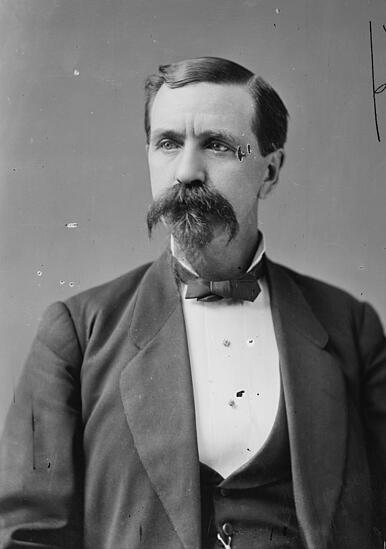
Here you will find contact information for Representative Hiram Sanford Stevens, including email address, phone number, and mailing address.
| Name | Hiram Sanford Stevens |
| Position | Representative |
| State | Arizona |
| District | At-Large |
| Party | Democratic |
| Status | Former Representative |
| Term Start | December 6, 1875 |
| Term End | March 3, 1879 |
| Terms Served | 2 |
| Born | March 20, 1832 |
| Gender | Male |
| Bioguide ID | S000880 |
About Representative Hiram Sanford Stevens
Hiram Sanford Stevens (March 20, 1832 – March 22, 1893) was an American businessman and Democratic politician who became one of the wealthiest and most influential figures in early Arizona Territory. He served two terms as Arizona Territory’s delegate in the United States House of Representatives from 1875 to 1879 and three times in the Arizona Territorial Legislature, contributing to the legislative process during a significant period in American history. As a member of the House of Representatives, he participated in the democratic process and represented the interests of his constituents in the developing territory.
Stevens was born in Weston, Windsor County, Vermont, on March 20, 1832. He grew up in Weston, where he obtained only a limited formal education and, according to the 1850 census, worked as a farmer. Seeking broader opportunities, he left Vermont in 1851 and enlisted in the United States Army, joining Company I of the 1st U.S. Dragoons. During his three-year enlistment he saw frontier service in the New Mexico Territory, including action against Apache groups. He received an honorable discharge at Fort Thorn after completing his term of service, an experience that introduced him to the Southwest, where he would spend the rest of his life.
Following his discharge, Stevens moved into what would become Arizona, proceeding to Tucson after a brief stop along the San Pedro River. Near Sentinel Peak he operated a ranch before turning to trade and opening a store in Sacaton in 1858. That same year, on August 28, 1858, he was baptized at a Catholic church in Tucson under the name “Steven Augustus Hiram,” marking his formal entry into the predominantly Catholic community of southern Arizona. With the outbreak of the American Civil War, Stevens left Tucson for a time, but he returned in 1864 as federal authority was reestablished in the territory. On May 11, 1864, Governor John N. Goodwin appointed him one of Tucson’s “councillors,” giving him an early role in local governance and signaling his emergence as a civic leader.
Stevens’s business career expanded rapidly after his return to Tucson. In 1865 he formed a partnership with fellow merchant Samuel C. Hughes to supply the “Mariposa Store,” and over the following years the two men engaged in a variety of mercantile, ranching, and mining ventures, sometimes joined by Hughes’s younger brother, Thomas. Their business relationship was reinforced by family ties: Stevens married Petra Santa Cruz, while Hughes married her older sister, Atanacia, making the partners brothers-in-law. The Stevenses adopted two children, Elisa and Thomas. From 1866 until 1872, Stevens served as post trader at Fort Buchanan and Fort Crittenden, supplying goods to soldiers and settlers, although he was eventually forced to close this operation when it was discovered that he had been selling alcohol to soldiers in violation of regulations. Undeterred, he continued to build his commercial interests, and in 1876 he and Hughes organized Hughes, Stevens & Company, a firm active in cattle, mercantile, and mining enterprises. At the height of his career, Stevens also owned a sheep ranch in Colorado and was estimated to be worth about US$150,000, making him one of the richest men in Arizona Territory.
Stevens’s growing prominence in business naturally drew him into territorial and local politics. He served as Tucson city treasurer and Pima County tax assessor and sat multiple times on the Pima County Board of Supervisors, helping to shape local fiscal and administrative policy. In 1868 he was elected to the 5th Arizona Territorial Legislature, representing Pima County in the House of Representatives (the lower house), and the session even met in a building he owned. He was returned to the legislature twice more, serving in the Council (upper house) of both the 6th and 7th Arizona Territorial Legislatures. These legislative roles, combined with his local offices, established him as a key Democratic figure in territorial politics and prepared him for service as Arizona Territory’s delegate to Congress.
In 1874, when Richard Cunningham McCormick declined to seek reelection as Arizona Territory’s delegate in the United States House of Representatives, Stevens emerged as a leading contender for the position. At the Democratic convention in Phoenix in May 1874, he narrowly lost the formal nomination to John A. Rush by an eight-to-seven vote, with delegates from Yavapai and Yuma counties not yet arrived. When Rush refused the nomination and withdrew on July 24, 1874, the general election became a five-way race in which all candidates ran as Independents. Stevens and Charles T. Hayden favored Democratic policies, while Curtis Coe Bean and John Smith advocated Republican positions; a fifth candidate, stagecoach driver David G. Beardsley, ran as the “workingman’s candidate.” Contemporary accounts suggested that Stevens enlisted the territory’s gamblers to support his campaign by loaning them money to wager on his victory, allowing them to keep any winnings while requiring only the return of the original stakes. The election was also marked by controversy when the Yavapai County Board of Supervisors threw out 650 questionable votes for Bean. Final certified results gave Stevens 1,442 votes, Bean 1,076, Smith 638, Hayden 13, and Beardsley 7, securing Stevens’s election as territorial delegate.
Stevens took up his duties in Washington, D.C., during a period of national reconstruction and western expansion. Rumors of a possible special session of Congress prompted him to leave Arizona for the capital on March 3, 1875, although the special session was never called. While waiting for the 44th Congress to convene in December 1875, he attended to his business interests from afar. Once seated as Arizona Territory’s delegate, he introduced a series of legislative proposals aimed at strengthening the territory’s institutional framework and economic prospects. Among his initiatives were requests for federal funds to construct a territorial capital and penitentiary, the creation of a port of entry in Tucson to facilitate trade with Mexico, and improvements to navigation along the Colorado River. One of his notable legislative successes was a bill allowing the Arizona Territorial Legislature to override the governor’s veto with a two-thirds vote, thereby increasing local self-governance. By contrast, his proposal to make the territorial governor an elective rather than a presidentially appointed office was defeated. A member of the Democratic Party, Stevens thus contributed to the legislative process during two terms in office, representing Arizona Territory’s interests in the national legislature.
On June 21, 1876, Stevens announced that he would seek a second term as territorial delegate. His principal opponents were Granville H. Oury and William H. Hardy; Curtis Coe Bean initially entered the race but withdrew to attend to his business affairs. Territorial newspapers generally expected Stevens to win reelection, but the contest again involved disputes over the vote count. When returns were tallied, the Yavapai County Board of Supervisors, by a two-to-one vote, attempted to disqualify 168 votes for Stevens on the grounds that they came from two towns whose residents had not yet paid their poll tax, even though the tax was not due until December 31 and the board accepted votes from other similarly situated towns that had favored a different candidate. A provision of territorial law requiring the Territorial Secretary to accept the canvass provided by the County Recorder thwarted the board’s effort, and Stevens was declared the winner with a plurality. Final results were 1,194 votes for Stevens, 1,049 for Hardy, and 1,007 for Oury. In the 45th Congress he continued to press for Arizona’s needs, introducing additional appropriation measures and seeking to modify the amount of land reserved for army use at Fort Lowell. He also successfully advocated for enlarging the Arizona Territorial Legislature to reflect population growth to about 40,000 residents, increasing the Council from nine to twelve members and the House of Representatives from eighteen to twenty-four members. On June 7, 1878, he announced his intention to run for a third term, but in the ensuing five-way race that year he was unsuccessful, placing third and ending his congressional service in 1879.
After leaving Congress, Stevens returned to Arizona and resumed his business pursuits. In the early 1880s he purchased a ranch near Sahuarita and became part owner of the largest general store in Tucson, further consolidating his role in the region’s commercial life. He also became a moneylender, charging the prevailing interest rate of 2 percent per month, and continued to invest in local enterprises. When Tucson debated converting its street lighting system from gas to electricity in 1884, Stevens emerged as a major opponent of the change; after his death it was revealed that he owned 100,000 shares of Tucson Gas Company stock, underscoring his financial stake in the existing system. Beyond business, he contributed to the community’s institutional and cultural development. He served as the second president of the Arizona Pioneers’ Historical Society, supported religious life by donating land on which Tucson’s first Protestant church was built, and was credited with planting the area’s first pepper trees, adding to the city’s early urban landscape.
Stevens’s later years were overshadowed by financial and personal difficulties. By early 1893 his business affairs had declined, and creditors filed for attachment against his property four days before his death. On March 22, 1893, in Tucson, he died from a self-inflicted gunshot wound after first shooting his wife, Petra, and inflicting only a minor injury. Contemporary investigations concluded that his financial reverses, though serious, were not sufficient in themselves to explain his actions and attributed the tragedy to a period of severe mental distress. His funeral, held in Tucson’s Catholic cemetery, was one of the largest the city had ever seen, reflecting his long-standing prominence in territorial society. His remains were later reinterred in Tucson’s Evergreen Cemetery. In 1899, Stevens Avenue, just north of downtown Tucson, was named in his honor, commemorating his role as a frontier businessman, territorial legislator, and Arizona’s delegate to the United States Congress.