Representative Homer Le Grand Lyon
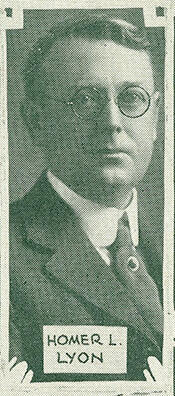
Here you will find contact information for Representative Homer Le Grand Lyon, including email address, phone number, and mailing address.
| Name | Homer Le Grand Lyon |
| Position | Representative |
| State | North Carolina |
| District | 6 |
| Party | Democratic |
| Status | Former Representative |
| Term Start | April 11, 1921 |
| Term End | March 3, 1929 |
| Terms Served | 4 |
| Born | March 1, 1879 |
| Gender | Male |
| Bioguide ID | L000543 |
About Representative Homer Le Grand Lyon
Homer Le Grand Lyon (March 1, 1879 – May 31, 1956) was a Democratic U.S. Representative from North Carolina who served four consecutive terms in the United States Congress from 1921 to 1929. Born in Elizabethtown, Bladen County, North Carolina, he grew up in the post-Reconstruction South, where his early years were shaped by the region’s evolving political and social landscape. His upbringing in a small North Carolina community helped form the local ties and regional awareness that later informed his public service and representation in Congress.
Lyon received his early education in the public schools of Elizabethtown before attending Davis Military School in Winston, North Carolina, an institution that combined academic instruction with military discipline and training. He subsequently enrolled in the law department of the University of North Carolina at Chapel Hill, the state’s flagship public university and a leading center for legal education in the South. His legal studies there prepared him for a career in the practice of law and public affairs at a time when the legal profession was closely intertwined with political life in North Carolina.
In 1900, Lyon was admitted to the bar and commenced the practice of law in Whiteville, North Carolina, in Columbus County. Establishing his practice in this growing community, he quickly became active in Democratic Party politics. From 1901 to 1921 he served as a delegate to every Democratic State convention, reflecting his continuous engagement in party organization and state-level policymaking. His prominence within the party extended to the national stage, as he was chosen a delegate to the Democratic National Convention in 1904, and again many years later in 1940, underscoring his long-standing influence and sustained involvement in Democratic politics over several decades.
Lyon’s legal and political career advanced significantly when he was appointed and served as solicitor of the eighth judicial district of North Carolina from 1913 to 1920. In this capacity, roughly equivalent to a district attorney, he was responsible for prosecuting criminal cases on behalf of the state, gaining substantial courtroom experience and public visibility. His tenure as solicitor coincided with a period of progressive-era reforms and World War I, during which the state and nation grappled with changes in criminal law, public order, and social policy. This prosecutorial role further solidified his reputation as a capable lawyer and public official and provided a platform for his subsequent election to national office.
Lyon was elected as a Democrat to the Sixty-seventh Congress and to the three succeeding Congresses, serving from March 4, 1921, to March 3, 1929. Representing North Carolina in the U.S. House of Representatives during a significant period in American history marked by the aftermath of World War I, the beginning of Prohibition, and the economic expansion of the 1920s, he participated in the legislative process and the broader democratic governance of the nation. As a member of the House of Representatives, he worked to represent the interests of his constituents in North Carolina, contributing to debates and legislation that affected both his district and the country at large. His four terms in office reflected consistent electoral support and the confidence of his district’s voters in his leadership and judgment.
During his congressional service, Lyon was part of a Democratic delegation from a predominantly rural, agricultural state undergoing gradual industrialization and social change. While specific committee assignments and legislative initiatives are less extensively documented, his service coincided with major national issues, including agricultural policy, veterans’ affairs following World War I, and the early regulatory responses to a rapidly modernizing economy. Within this context, Lyon’s role as a Democratic representative from North Carolina placed him among those Southern lawmakers who sought to balance regional priorities with emerging national concerns in the 1920s. After four terms, he chose not to be a candidate for renomination in 1928, thereby concluding his congressional career at the close of the Sixty-ninth Congress.
Following his departure from Congress, Lyon returned to Whiteville, North Carolina, where he resumed the private practice of law. He continued to be a respected figure in the legal community and in Democratic Party circles, drawing on his extensive experience in both state and national public life. He practiced law actively until his retirement in 1950, marking a legal career that spanned half a century and included service as a local attorney, judicial district solicitor, and member of the U.S. House of Representatives. His continued participation in party affairs, including his role as a delegate to the 1940 Democratic National Convention, demonstrated his enduring engagement with political developments long after leaving elective office.
Homer Le Grand Lyon died in Whiteville, North Carolina, on May 31, 1956. He was interred in Memorial Cemetery, leaving behind a legacy of sustained public service at the local, state, and national levels. His life and career reflected the trajectory of a Southern Democrat who rose from small-town origins to national office, maintained close ties to his home communities, and remained active in law and politics over the course of several transformative decades in North Carolina and American history.