Senator Hopkins Lacy Turney
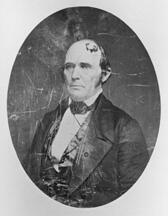
Here you will find contact information for Senator Hopkins Lacy Turney, including email address, phone number, and mailing address.
| Name | Hopkins Lacy Turney |
| Position | Senator |
| State | Tennessee |
| Party | Democratic |
| Status | Former Representative |
| Term Start | September 4, 1837 |
| Term End | March 3, 1851 |
| Terms Served | 4 |
| Born | October 3, 1797 |
| Gender | Male |
| Bioguide ID | T000430 |
About Senator Hopkins Lacy Turney
Hopkins Lacy Turney (October 3, 1797 – August 1, 1857) was a Democratic U.S. Representative and United States Senator from Tennessee who served in Congress during a significant period in American history. He was born in the Smith County settlement of Dixon Springs, Tennessee, where he spent his early years. As a youth, he was apprenticed to a tailor, learning a trade before turning to public service and the law. In 1818 he served in the Seminole War, an experience that preceded his entry into professional and political life.
Following his military service, Turney studied law and was admitted to the bar, beginning his legal practice in Jasper, Tennessee. He later moved to Winchester, Tennessee, where he continued to practice law and established himself as a prominent attorney. During this period he also became a slave owner, reflecting the social and economic structures of the antebellum South. His growing legal reputation and local standing led him into state politics, and he was first elected to the Tennessee House of Representatives in 1828, marking the beginning of his formal political career.
Turney’s personal life was closely tied to Tennessee as well. In 1826 he married Teresa Francis, the daughter of Miller Francis and Hannah Henry. Teresa Francis was born on December 9, 1809, and died on September 5, 1879. The couple had nine children. Among them was Peter Turney, born September 22, 1827, who would later become a significant figure in Tennessee’s judicial and political history, serving as Chief Justice of the Tennessee Supreme Court from 1870 to 1893 and as governor of Tennessee from 1893 to 1897.
Turney entered national politics as a member of the Democratic Party. He was elected to the U.S. House of Representatives and served three consecutive terms from 1837 to 1843, in the Twenty-fifth through Twenty-seventh Congresses. In the House he represented Tennessee during a time of growing sectional tension and national debate over economic policy, territorial expansion, and the institution of slavery. His service in the House established him as a reliable Democratic voice and a representative of his state’s interests in the federal legislature.
After a two-year hiatus from Congress, during which he returned to Tennessee, Turney was elected by the Tennessee General Assembly to the United States Senate. He served as a Senator from Tennessee from 1845 to 1851, completing one six-year term in that body. His Senate service, which spanned the late 1840s into the early 1850s, coincided with a critical era in American history marked by the Mexican–American War, the acquisition of new territories, and the intensifying national debate over the expansion of slavery. During his tenure in the Senate, he contributed to the legislative process and participated in the democratic governance of the nation, representing the interests of his Tennessee constituents.
While in the Senate, Turney held important committee leadership positions. He served as chairman of the U.S. Senate Committee on Retrenchment for four years, a committee concerned with reducing government expenditures and promoting fiscal economy. He also served as chairman of the U.S. Senate Committee on Patents and the Patent Office for two years, overseeing matters related to intellectual property and the administration of the patent system at a time of growing American innovation and industrial development. Through these roles, he played a part in shaping federal policy on government efficiency and technological progress.
At the conclusion of his Senate term in 1851, Turney did not return to Congress but instead resumed his law practice in Winchester, Tennessee. He continued in active legal work until shortly before his death. Hopkins Lacy Turney died on August 1, 1857, and was buried in Winchester. His career encompassed service in the Tennessee House of Representatives, three terms in the U.S. House of Representatives, and a full term in the U.S. Senate, reflecting a long engagement with public life at both the state and national levels during a formative period in the history of Tennessee and the United States.