Representative Horace Boardman Smith
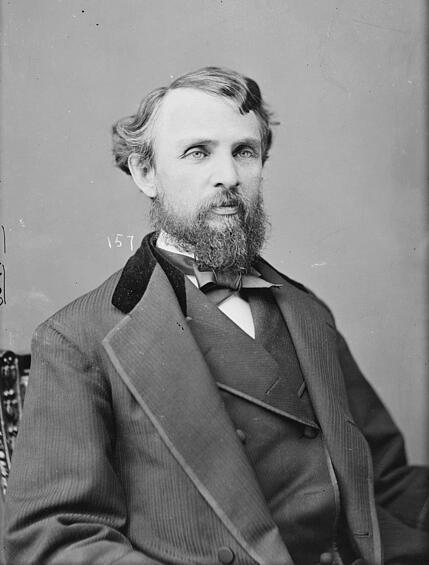
Here you will find contact information for Representative Horace Boardman Smith, including email address, phone number, and mailing address.
| Name | Horace Boardman Smith |
| Position | Representative |
| State | New York |
| District | 28 |
| Party | Republican |
| Status | Former Representative |
| Term Start | March 4, 1871 |
| Term End | March 3, 1875 |
| Terms Served | 2 |
| Born | August 18, 1826 |
| Gender | Male |
| Bioguide ID | S000552 |
About Representative Horace Boardman Smith
Horace Boardman Smith (August 18, 1826 – December 26, 1888) was a Republican U.S. Representative from New York who served in the United States Congress from 1871 to 1875. He was born in Whitingham, Windham County, Vermont, where he spent his early years before pursuing formal education. Raised in New England during a period of rapid national expansion and increasing sectional tension, he developed an early interest in classical learning and the law, which would shape his professional and political career.
Smith pursued classical studies and attended Williams College in Williamstown, Massachusetts, one of the leading liberal arts institutions of the era. He graduated in 1847, receiving a traditional classical education that emphasized rhetoric, philosophy, and the foundations of law and government. Following his graduation, he read law in the customary manner of the time, studying under established practitioners rather than attending a formal law school, and prepared for admission to the bar.
In 1850 Smith was admitted to the bar and commenced the practice of law in Elmira, Chemung County, New York. Elmira, then a growing commercial and transportation center in the Southern Tier of New York, provided a promising setting for a young attorney. Smith quickly became involved in local affairs and held several local offices, building a reputation as a capable lawyer and public servant. His legal practice and civic engagement led to increasing public responsibilities and recognition within the community.
Smith’s judicial career began when he was appointed or elected to serve as judge of Chemung County in 1859 and 1860. In this capacity he presided over local legal matters at a time when New York’s courts were adapting to the social and economic changes of the mid-nineteenth century. His service on the county bench further enhanced his standing in the legal profession and in Republican Party circles, positioning him for higher office as the Civil War and Reconstruction reshaped the political landscape.
Smith was elected as a Republican to the Forty-second and Forty-third Congresses, serving in the U.S. House of Representatives from March 4, 1871, to March 3, 1875. Representing a New York district during the Reconstruction era, he contributed to the legislative process over two terms in office and participated in the democratic governance of the post–Civil War United States. During the Forty-third Congress he served as chairman of the Committee on Elections, a significant assignment that placed him at the center of disputes over contested House seats and questions of electoral integrity at a time when the nation was still grappling with the political consequences of the war and Reconstruction policies. He was not a candidate for renomination in 1874, thus concluding his congressional service after four years.
After leaving Congress, Smith returned to Elmira and resumed the practice of law, continuing his legal career there until 1883. His post-congressional years were marked by ongoing professional activity and influence in the legal community of upstate New York. In 1883 he advanced again to the judiciary when he became a justice of the supreme court of New York State, serving on that court from 1883 to 1888. As a justice of the state supreme court, he handled significant civil and criminal matters within New York’s unified trial court of general jurisdiction, reflecting the high level of trust placed in his legal judgment and experience.
Smith remained on the bench until shortly before his death. He retired to his home in Elmira, where he died on December 26, 1888. He was interred in Woodlawn Cemetery in Elmira, a burial place for many of the city’s prominent citizens. Through his service as a local judge, county official, member of Congress, and justice of the New York Supreme Court, Horace Boardman Smith played a notable role in the legal and political life of New York during the latter half of the nineteenth century.