Representative Horatio Chapin Burchard
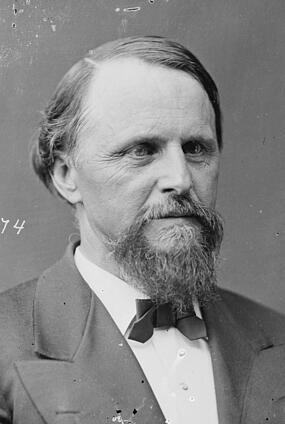
Here you will find contact information for Representative Horatio Chapin Burchard, including email address, phone number, and mailing address.
| Name | Horatio Chapin Burchard |
| Position | Representative |
| State | Illinois |
| District | 5 |
| Party | Republican |
| Status | Former Representative |
| Term Start | March 4, 1869 |
| Term End | March 3, 1879 |
| Terms Served | 5 |
| Born | September 22, 1825 |
| Gender | Male |
| Bioguide ID | B001070 |
About Representative Horatio Chapin Burchard
Horatio Chapin Burchard (September 22, 1825 – May 14, 1908) was a U.S. Representative from Illinois, the fifteenth director of the United States Mint, a member of the International Statistical Institute, and is often regarded as the father of the Consumer Price Index (CPI). A Republican, he served five consecutive terms in the United States House of Representatives from 1869 to 1879, participating in the legislative process during a transformative decade in American political and economic history and representing the interests of his Illinois constituents.
Burchard was born on September 22, 1825, in Marshall, Oneida County, New York. He spent his early years in upstate New York, where he received his preliminary education in local schools. Demonstrating academic promise, he pursued higher education in the liberal arts, a course that would prepare him for a professional career in law and public service. His early life in a region shaped by reform movements and rapid economic change helped form the background for his later interest in public finance and statistical analysis.
After completing his preparatory studies, Burchard attended Hamilton College in Clinton, New York, an institution known for its classical curriculum and emphasis on public affairs. He graduated in 1850. Following his graduation, he studied law and was admitted to the bar, beginning the legal career that would serve as his entry point into politics. Seeking opportunity in the expanding Midwest, he moved to Illinois, where he established a law practice. His legal work, combined with growing involvement in local civic affairs, positioned him as a rising figure in the emerging Republican Party during the years leading up to and following the Civil War.
Burchard’s political career advanced steadily in Illinois, where he became active in state and local Republican circles. His reputation as a capable lawyer and thoughtful public servant led to his election to the United States House of Representatives. He entered Congress as a Republican Representative from Illinois in 1869 and served until 1879, completing five terms in office. His decade in the House coincided with Reconstruction and the nation’s postwar economic development, and he participated in the democratic process at a time when Congress was grappling with issues of national reunification, industrial expansion, and federal fiscal policy. During these years, he contributed to legislative deliberations and represented the concerns of his district as the country adjusted to the social and economic consequences of the Civil War.
Following his congressional service, Burchard continued his involvement in federal public service, most notably in the field of monetary administration and statistics. He was appointed the fifteenth director of the United States Mint, a position in which he oversaw aspects of the nation’s coinage and contributed to the federal government’s understanding of monetary and price trends. His work in this role, and his broader engagement with statistical analysis, led to his recognition as the “father of the Consumer Price Index,” reflecting his pioneering efforts to systematize the measurement of changes in consumer prices and the cost of living—an innovation that would become central to modern economic policy and analysis.
Burchard’s expertise in statistics and economics also brought him international recognition. He became a member of the International Statistical Institute, an indication of his standing among contemporaries in the emerging global community of statisticians and economists. Through this affiliation and his federal service, he helped advance the professionalization of statistical methods and the use of quantitative data in public policy, linking American practice to broader international developments in economic measurement.
In his later years, Burchard remained associated with public and professional life, known for his contributions to both legislative affairs and economic statistics. He lived to see the United States enter the twentieth century, a period in which many of the fiscal and statistical tools he had helped to shape grew in importance. Horatio Chapin Burchard died on May 14, 1908. His career, spanning law, politics, monetary administration, and statistical innovation, left a lasting imprint on congressional history and on the federal government’s approach to measuring and understanding the nation’s economic conditions.