Representative Howard P. "Buck" McKeon
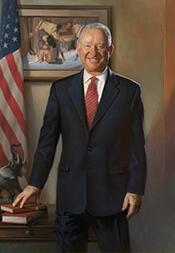
Here you will find contact information for Representative Howard P. "Buck" McKeon, including email address, phone number, and mailing address.
| Name | Howard P. "Buck" McKeon |
| Position | Representative |
| State | California |
| District | 25 |
| Party | Republican |
| Status | Former Representative |
| Term Start | January 5, 1993 |
| Term End | January 3, 2015 |
| Terms Served | 11 |
| Born | September 9, 1938 |
| Gender | Male |
| Bioguide ID | M000508 |
About Representative Howard P. "Buck" McKeon
Howard Philip “Buck” McKeon is an American businessman and politician who served as a Representative from California in the United States Congress from January 3, 1993, to January 3, 2015. A member of the Republican Party, he represented California’s 25th congressional district for 11 consecutive terms and became a prominent figure in defense policy, ultimately chairing the House Committee on Armed Services. His long tenure in the House of Representatives spanned a significant period in American history, during which he participated in the democratic process and represented the interests of his constituents in northern Los Angeles County and surrounding areas.
McKeon was born on September 9, 1938, in Los Angeles, California, and grew up in the region that he would later represent in Congress. He attended Brigham Young University in Provo, Utah, where he studied business and graduated with a Bachelor of Science degree. Before entering public office, he built a career in the private sector, gaining experience in business management and finance that would later inform his work on economic and budgetary issues in Congress.
Prior to his election to the U.S. House of Representatives, McKeon was active in local government and community affairs in California. He served on the William S. Hart Union High School District Board and later became a member of the Santa Clarita City Council. He was elected the first mayor of the newly incorporated City of Santa Clarita in 1987, helping to guide its early development and municipal organization. His local government service established his reputation as a conservative leader focused on fiscal responsibility, public safety, and community growth.
McKeon was first elected to Congress in 1992 and took office on January 3, 1993. Over the course of 11 terms, he contributed to the legislative process on a wide range of issues, with a particular emphasis on national defense, veterans’ affairs, and education. Early in his congressional career, he served on the House Committee on Education and the Workforce, where he worked on policies affecting student loans and higher education. As a member of the House of Representatives, Howard P. “Buck” McKeon participated in the democratic process and represented the interests of his constituents during periods marked by post–Cold War realignment, the wars in Iraq and Afghanistan, and evolving national security challenges.
McKeon’s most influential role in Congress came through his service on the House Committee on Armed Services, where he rose through the ranks to become chairman. He served as chairman of the committee from January 2011 until the end of the 113th Congress in January 2015. In that capacity, he oversaw annual defense authorization legislation, military readiness, personnel policy, and major weapons programs. The U.S. Congress oversees the defense budget primarily through two yearly bills: the National Defense Authorization Act (NDAA) and defense appropriations bills. The authorization bill determines the agencies responsible for defense, establishes funding levels, and sets the policies under which money will be spent, and McKeon played a central role in shaping these measures during his chairmanship.
His leadership was recognized in the naming of the Carl Levin and Howard P. “Buck” McKeon National Defense Authorization Act for Fiscal Year 2015, a National Defense Authorization Act proposed as H.R. 4435 and ultimately passed as H.R. 3979 (Pub. L. 113–291). The Howard P. “Buck” McKeon National Defense Authorization Act for Fiscal Year 2015 was introduced into the United States House of Representatives on April 9, 2014, by Rep. Buck McKeon (R-CA). It was referred to the United States House Committee on Armed Services and to its Subcommittees on Military Personnel; Readiness; Tactical Air and Land Forces; Intelligence, Emerging Threats and Capabilities; Seapower and Projection Forces; and Strategic Forces. On May 8, 2014, the House Armed Services Committee ordered the bill reported (amended) by a vote of 61–0 after 12 hours of debate and consideration of hundreds of amendments; House Report 113-446 on the bill was released on May 13, 2014. According to the House Armed Services Committee, which oversaw the legislation, the bill was “the comprehensive legislation to authorize the budget authority of the Department of Defense and the national security programs of the Department of Energy.” The total appropriations that were authorized amounted to approximately $600 billion for fiscal year 2015. The bill set the Pentagon’s base budget level at $495.8 billion, included an overseas contingency operations budget of $79.4 billion, and authorized an additional $17.9 billion for defense programs in the Department of Energy. It also proposed to keep the Air Force’s fleet of A-10 attack aircraft at a cost of $635 million and banned any additional base closures despite Pentagon requests for a new round of base realignment and closure.
The 2015 NDAA, named in honor of McKeon and Senator Carl Levin, chair of the Senate Armed Services Committee, recognized that both men were leaving their committee posts at the end of the 113th Congress; Levin retired from the Senate, and McKeon left his chairmanship and his House seat. The legislation, introduced as H.R. 4435 and ultimately enacted through H.R. 3979, was signed into law on December 19, 2014. The bill that was passed began as an unrelated measure, the Protecting Volunteer Firefighters and Emergency Responders Act, which was later replaced by the defense authorization text. Among its many provisions, the act incorporated the National Park Service 100th Anniversary Commemorative Coin Act and established several new national park units, including Blackstone River Valley National Historical Park, Harriet Tubman Underground Railroad National Historical Park, Harriet Tubman National Historical Park, Manhattan Project National Historical Park, and Valles Caldera National Preserve, and it authorized Coltsville National Historical Park. Sections 841 to 843 of the act, known as the Never Contract with the Enemy Act, required the Secretary of Defense to establish programs in each global military command to ensure that contracting, grants, and cooperative agreements did not facilitate the payment of funds or provision of goods and services to persons or entities actively opposing United States or coalition forces in contingency operations, extending to a global context provisions that had previously applied only to combat operations in Iraq and Afghanistan.
Budgetary and policy analyses of McKeon’s 2015 defense authorization measure underscored its scope. Based on legislative language for H.R. 4435 provided on May 9, 2014, the Congressional Budget Office (CBO) estimated that enacting the bill would decrease net direct spending by $1 million in 2015 but increase such spending by $1 million over the 2015–2024 period, triggering pay-as-you-go procedures. A provision authorizing special immigrant visas for certain Afghan allies was projected to increase direct spending by $70 million over that 10-year period, offset by an equivalent increase in receipts from sales of material from the National Defense Stockpile. The bill also required the Secretary of Defense to award the Purple Heart to certain service members killed or wounded in attacks in the United States that were motivated or inspired by foreign terrorist organizations, a change estimated to increase military retirement payments by about $1 million over the 2015–2024 period. Earlier versions of the bill would have exempted the Department of Defense from certain energy efficiency rules in the Energy Independence and Security Act of 2007, but that provision was removed prior to final passage. Debate on the legislation was expected to address military sexual assault, base closures, and immigration, and one provision, Section 3003, the “Southeast Arizona Land Exchange,” drew opposition from many Native American groups, including the Affiliated Tribes of Northwest Indians and the Great Plains Tribal Chairmen’s Association, because it would permit a subsidiary of the Rio Tinto mining conglomerate, Resolution Copper, to acquire 2,400 acres of the Tonto National Forest, including Oak Flat, a site considered sacred by the San Carlos Apache Tribe.
Howard P. “Buck” McKeon left Congress at the conclusion of the 113th United States Congress in January 2015, concluding 22 years of service in the House of Representatives. After his departure, he remained associated with defense and national security issues through consulting and advisory roles in the private sector, drawing on his long experience with the Armed Services Committee and the defense authorization process. His congressional career is particularly marked by his leadership on the National Defense Authorization Act and by the 2015 measure that bears his name, reflecting his influence on U.S. defense policy and his role in overseeing the budget authority of the Department of Defense and the national security programs of the Department of Energy.