Representative Hubert Utterback
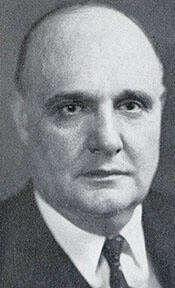
Here you will find contact information for Representative Hubert Utterback, including email address, phone number, and mailing address.
| Name | Hubert Utterback |
| Position | Representative |
| State | Iowa |
| District | 6 |
| Party | Democratic |
| Status | Former Representative |
| Term Start | January 3, 1935 |
| Term End | January 3, 1937 |
| Terms Served | 1 |
| Born | June 28, 1880 |
| Gender | Male |
| Bioguide ID | U000036 |
About Representative Hubert Utterback
Hubert Utterback (June 28, 1880 – May 12, 1942) was an Iowa jurist, educator, and Democratic politician who served very briefly on the Iowa Supreme Court and later represented Iowa’s 6th congressional district in the United States House of Representatives for one term from 1935 to 1937. He was the only Democrat elected by Iowa’s 6th congressional district from its creation in 1920 until 1956 and was a cousin of John G. Utterback, who served in Congress from Maine from 1933 to 1935.
Utterback was born on a farm near Hayesville, Keokuk County, Iowa, on June 28, 1880. He attended rural schools in the area and pursued further study at Hedrick Normal and Commercial College in Hedrick, Iowa. Seeking higher education in the law, he enrolled at Drake University in Des Moines, Iowa, from which he graduated before undertaking legal studies. After completing his legal training, he was admitted to the bar and commenced the practice of law in Des Moines.
Alongside his early legal practice, Utterback developed a substantial career in legal education. He joined the faculty of Drake University Law School as an instructor in 1908 and remained in that role until 1935, influencing several generations of Iowa lawyers. From 1911 to 1933 he also lectured in law at Still College in Des Moines, an institution now known as Des Moines University. Beyond his academic and professional work, he was active in civic and social policy circles, serving as a member of the Iowa State Conference of Social Work and chairing its legislative committee from 1923 to 1925, where he helped shape discussions on social welfare legislation in the state.
Utterback’s judicial career began at the municipal level. He served as a judge of the police court of Des Moines from 1912 to 1914, gaining experience in local criminal and civil matters. In 1915 he was elevated to the bench of the Ninth Iowa Judicial District, where he served as a district judge until 1927. His reputation as a jurist led to his involvement in a notable and unusual episode in Iowa judicial history. Following the death of Iowa Supreme Court Justice E. A. Morling less than a month before the 1932 general election, a controversy arose over whether the vacancy could be filled by election so close to the end of Morling’s term or whether the seat would remain filled by appointment until the scheduled expiration of the term. Republican George C. Claussen was appointed to replace Morling and began serving on the Iowa Supreme Court. Nonetheless, the seat was placed on the 1932 general election ballot, with Claussen nominated by the Republican Party and Utterback nominated by the Democratic Party. Utterback outpolled Claussen, received a certificate of election, and began serving on the Iowa Supreme Court on December 5, 1932, in Claussen’s place. A legal challenge followed, and a trial court ruled that no vacancy had legally existed for election purposes. The Iowa Supreme Court upheld that ruling, concluding that the seat had not been open to election and that Utterback’s election was therefore a nullity. As a result, his service on the Iowa Supreme Court ended on April 16, 1933, and Claussen was reinstated.
Transitioning to national politics, Utterback emerged as a prominent Democrat during the New Deal era. In the 1934 election he ran for the U.S. House of Representatives from Iowa’s 6th congressional district and defeated the incumbent Republican, Cassius C. Dowell. A member of the Democratic Party, he was elected to the Seventy-fourth Congress and served from January 3, 1935, to January 3, 1937. His term in Congress coincided with a significant period in American history, as the federal government expanded its role in response to the Great Depression. As a member of the House of Representatives, Utterback contributed to the legislative process, participated in the democratic governance of the nation, and represented the interests of his Iowa constituents during the early years of the New Deal. His election marked a rare Democratic breakthrough in a district that otherwise consistently favored Republicans.
In 1936 Utterback chose not to seek re-election to his House seat, instead entering the Democratic primary for the United States Senate from Iowa. He was defeated in that primary by the sitting governor, Clyde L. Herring. In the same election cycle, Cassius C. Dowell recaptured the 6th district House seat for the Republicans by defeating Democrat Harry Dunlap. Utterback attempted to return to Congress in 1938, again seeking election from Iowa’s 6th congressional district, but Dowell prevailed easily in their rematch. The district would not elect another Democrat to Congress until 1956, when Merwin Coad narrowly defeated James I. Dolliver by 198 votes in one of Iowa’s closest congressional elections.
After leaving Congress, Utterback remained active in public service and party affairs. He served as chairman of the Iowa State Board of Parole from 1937 to 1940, overseeing matters related to parole policy and the administration of criminal justice in the state. During the same period, from 1937 to 1940, he also served as a State Democratic National Committeeman, helping to guide the Democratic Party’s organization and strategy in Iowa at a time when the party was consolidating its New Deal coalition.
Hubert Utterback died in Des Moines, Iowa, on May 12, 1942. He was interred in Glendale Cemetery in Des Moines.