Representative Ignatius Donnelly
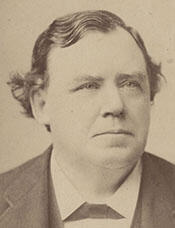
Here you will find contact information for Representative Ignatius Donnelly, including email address, phone number, and mailing address.
| Name | Ignatius Donnelly |
| Position | Representative |
| State | Minnesota |
| District | 2 |
| Party | Republican |
| Status | Former Representative |
| Term Start | December 7, 1863 |
| Term End | March 3, 1869 |
| Terms Served | 3 |
| Born | November 3, 1831 |
| Gender | Male |
| Bioguide ID | D000417 |
About Representative Ignatius Donnelly
Ignatius Loyola Donnelly (November 3, 1831 – January 1, 1901) was an American Congressman, Minnesota political leader, populist writer, and advocate of a range of controversial theories in history and science. He served as a Representative from Minnesota in the United States Congress from 1863 to 1869, completing three terms as a member of the Republican Party during a critical period encompassing the Civil War and early Reconstruction. He later became nationally known for his writings on Atlantis, catastrophism, and the Shakespeare authorship question, which are widely regarded as examples of pseudoscience and pseudohistory.
Donnelly was born in Philadelphia, Pennsylvania, the youngest son of Philip Carrol Donnelly and Catherine Gavin Donnelly. His parents were immigrants from Fintona, County Tyrone, Ireland; Philip had begun his life in America as a peddler before studying medicine at the Philadelphia College of Medicine, while Catherine helped support the family by operating a pawn shop. One of Ignatius’s siblings, Eleanor C. Donnelly, became a noted Catholic writer. Admitted to the prestigious Central High School of Philadelphia, the second-oldest public high school in the United States, he studied under the presidency of educator John S. Hart and excelled particularly in literature. By the age of eighteen he had written a long poem, “The Mourner’s Vision” (1850), an early indication of his literary ambitions.
After deciding on a legal career, Donnelly entered the law office of Benjamin Brewster, who would later serve as Attorney General of the United States. He read law in Brewster’s office and was admitted to the bar in 1852. In 1855 he married Katherine McCaffrey; the couple had three children. That same year he resigned his clerkship, entered active politics by delivering campaign speeches for Democratic candidates, and involved himself in communal home-building schemes. During the 1850s he drifted away from the Catholic Church and thereafter did not participate in any organized religion. In 1857, amid rumors of a financial scandal, he moved west to the Minnesota Territory and settled in Dakota County, where he and several partners launched a utopian community known as Nininger City. The Panic of 1857, however, undermined the project, doomed the cooperative farm and town, and left Donnelly heavily in debt.
Donnelly quickly entered Minnesota politics, now as a Republican. He ran unsuccessfully for the territorial and then state legislature in 1857 and 1858, but established a reputation as a powerful and persuasive public speaker. This prominence led to his election as lieutenant governor of Minnesota, a post he held from 1860 to 1863. In 1862 he was elected to the U.S. House of Representatives as a Republican from Minnesota, taking his seat in the 38th Congress in March 1863. He was reelected to the 39th and 40th Congresses, serving continuously until March 3, 1869. During these three terms in office he was identified with the Radical Republicans and participated actively in the legislative debates of the Civil War and Reconstruction era. He represented the interests of his Minnesota constituents while supporting measures to secure the rights of formerly enslaved people, including advocacy for extending the powers of the Freedmen’s Bureau to provide education so that freedmen could protect themselves once federal supervision ended. He was also an early supporter of women’s suffrage.
After leaving Congress in 1869, Donnelly remained a central figure in Minnesota politics and in emerging agrarian and populist movements. He served in the Minnesota State Senate from 1874 to 1878 and again from 1891 to 1894, and in the Minnesota House of Representatives from 1887 to 1888 and 1897 to 1898. Between and around these terms he returned periodically to his law practice and to writing. He was an organizer of the Minnesota Farmers’ Alliance and became a leading spokesman for farmers and laborers who felt disadvantaged by railroads, banks, and industrial interests. In 1877 he addressed a gathering of about 10,000 people, reading a preamble he had drafted for the platform of what became the People’s Party. Slightly revised, this twelve-paragraph document was adopted at the party’s first national convention in Omaha in 1892 and became one of the most widely circulated statements of the Populist credo, denouncing political corruption, biased newspapers, and the domination of the economy by corporate power. Donnelly played a key leadership role in the People’s Party, which grew out of the National Farmers’ Alliance and advocated the abandonment of the gold standard, the adoption of free silver, the abolition of national banks, a graduated income tax, direct election of U.S. senators, civil service reform, and an eight-hour workday. He was nominated for Vice President of the United States by the People’s Party in 1900 and also ran unsuccessfully for governor of Minnesota that year. Earlier, he had made a losing campaign for Congress as a Democrat in 1884. Although he was a prominent critic of railroad influence and supported government regulation of railroads, he received $10,000 from the Lake Superior and Mississippi Railroad Company, a fact later cited by critics of his populist stance.
Parallel to his political career, Donnelly pursued an extensive literary and speculative writing career that brought him international notoriety. In 1882 he published “Atlantis: The Antediluvian World,” his best-known work, in which he argued that the mythical lost continent of Atlantis, described by Plato in the dialogues “Timaeus” and “Critias,” had been a real, advanced civilization destroyed in a great flood. He proposed that Atlantis had been the common source of ancient civilizations in Europe, Africa—especially Egypt—and the Americas, drawing on the controversial interpretations of the Maya by Charles Étienne Brasseur de Bourbourg and Augustus Le Plongeon. Donnelly further suggested that Atlantis had been the original home of an “Aryan” race whose red-haired, blue-eyed descendants survived in Ireland, which he described as the “Garden of Phoebus” (Hyperborea) of Western mythologists. The book sold well and is widely credited with popularizing the modern image of Atlantis as an antediluvian civilization and contributing to later currents of “Mayanism.” In 1883 he followed it with “Ragnarok: The Age of Fire and Gravel,” arguing that a near-collision between Earth and a massive comet in prehistoric times had caused the biblical Flood, the destruction of Atlantis, and the extinction of the mammoth. These catastrophist works influenced later speculative writers, including, indirectly, Immanuel Velikovsky.
Donnelly’s fascination with hidden histories extended to the Shakespeare authorship controversy. In 1887 he published “The Shakespeare Myth,” and in 1888 “The Great Cryptogram: Francis Bacon’s Cipher in Shakespeare’s Plays,” in which he claimed to have discovered ciphers proving that Francis Bacon was the true author of Shakespeare’s works. He also wrote an “Essay on the Sonnets of Shakespeare” and later “The Cipher in the Plays, and on the Tombstone” (1899). To promote his theories he traveled to England to arrange publication of “The Great Cryptogram” by Sampson Low and debated his thesis—“Resolved, that the works of William Shakespeare were composed by Francis Bacon”—before the Oxford and Cambridge Unions, where it was rejected. The book was a commercial and critical failure and damaged his scholarly reputation. Nonetheless, his broader concept of “hyperdiffusionism,” which sought to explain similarities in world mythologies by positing ancient global catastrophes and cultural diffusion, later attracted the attention of literary figures such as J. R. R. Tolkien, who acknowledged in his 1939 essay “On Fairy-Stories” that diffusion might play a role in the formation of myth and whose fictional island of Númenor has been linked to Donnelly’s Atlantis ideas.
In addition to his speculative non-fiction, Donnelly wrote several works of fiction and political commentary. Under the pseudonym “Edmund Boisgilbert” he published the dystopian science fiction novel “Caesar’s Column” (1890), set in the year 1988 and depicting a violent workers’ revolt against a global oligarchy, and the novel “Doctor Huguet” (1891). He also authored “The Golden Bottle; or, The Story of Ephraim Benezet of Kansas” (1892), “The Bryan Campaign for the American People’s Money” (1896), and other tracts supporting populist monetary reform. His writings on Atlantis, catastrophism, and cryptographic readings of Shakespeare have been rejected by mainstream scholars and scientists; critics such as Gordon Stein have described him as a promoter of pseudoscience and noted that much of his argumentation was highly questionable or incorrect. Nevertheless, his books enjoyed wide circulation in his lifetime and influenced later esoteric and occult currents, aligning him with figures such as Helena Blavatsky, Rudolf Steiner, and James Churchward in the broader landscape of late nineteenth- and early twentieth-century speculative thought.
Donnelly’s personal life was marked by both stability and loss. His first wife, Katherine McCaffrey Donnelly, died in 1894. Four years later, in 1898, he married his secretary, Marian Hanson. He continued to write and to participate in politics into his final years. Ignatius Donnelly died on January 1, 1901, in Minneapolis, Minnesota, at the age of sixty-nine. He was buried in Calvary Cemetery in St. Paul, Minnesota. His personal and family papers, which document his legal, political, and literary activities, are preserved at the Minnesota Historical Society. During the 1930s an effort was made to establish a state park at his former home in Nininger near Hastings, Minnesota; although the house still stood in 1939, the campaign failed and the structure was later demolished.