Representative Iris Faircloth Blitch
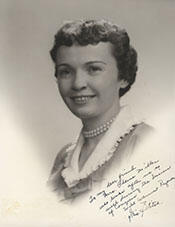
Here you will find contact information for Representative Iris Faircloth Blitch, including email address, phone number, and mailing address.
| Name | Iris Faircloth Blitch |
| Position | Representative |
| State | Georgia |
| District | 8 |
| Party | Democratic |
| Status | Former Representative |
| Term Start | January 5, 1955 |
| Term End | January 3, 1963 |
| Terms Served | 4 |
| Born | April 25, 1912 |
| Gender | Female |
| Bioguide ID | B000561 |
About Representative Iris Faircloth Blitch
Iris Faircloth Blitch (April 25, 1912 – August 19, 1993) was a United States Representative from Georgia and a member of the Democratic Party who served four terms in Congress from 1955 to 1963. She was the fourth woman to represent Georgia in Congress and the first woman from the state to win a regularly scheduled general election to the U.S. House of Representatives. Over the course of her public career she became known both as a vocal advocate for women’s political participation and as a staunch supporter of racial segregation.
Blitch was born on April 25, 1912, near Vidalia, Toombs County, Georgia. Details of her early childhood are sparse in the public record, but she grew up in rural southeastern Georgia at a time when agriculture dominated the region’s economy and social life. This background in a predominantly agrarian community would later shape both her professional pursuits and her political priorities, particularly her attention to the interests of farmers and small business owners in her district.
In 1929 Blitch attended the University of Georgia in Athens, reflecting an early commitment to higher education at a time when relatively few women in the South pursued university study. Two decades later, in 1949, she furthered her education by attending South Georgia College in Douglas, Georgia. Between and after these periods of study, she married and settled in Homerville, Clinch County, Georgia, where she and her husband managed a diverse set of enterprises. Together they operated a farm and engaged in cattle and timber production, as well as businesses involving naval stores, fertilizer, and a pharmacy. This combination of agricultural and commercial experience grounded her later legislative focus on rural development, business regulation, and economic issues affecting small communities.
Blitch’s formal political career began in the immediate post–World War II era. In 1946 she was elected to the Georgia Senate, marking her entry into elective office at the state level. She moved to the Georgia House of Representatives with her election in 1948, though she was unsuccessful in her bid for reelection to that body in 1950. Undeterred, she returned to the Georgia Senate with a successful campaign in 1952 and served there through December 31, 1954. Concurrently, from 1948 through 1954, she held a significant party role as Georgia’s Democratic National Committee member, giving her influence in both state and national party affairs. Her growing public profile was underscored when, five days after her 1954 election to the state Senate, she appeared on the popular American television program “What’s My Line?,” an unusual national media exposure for a Southern female politician of that era.
Building on her state legislative experience and party leadership, Blitch ran for the U.S. House of Representatives in 1954 as a Democrat from Georgia’s 8th congressional district. She won the election and entered the 84th Congress on January 3, 1955, beginning a congressional tenure that would span four consecutive terms through January 3, 1963. Her service in the House took place during a period of major national transformation, including the early civil rights movement, the Eisenhower and Kennedy administrations, and the beginnings of the New Frontier. As a member of the House of Representatives, she participated in the legislative process and represented the interests of her largely rural and small-town constituents, drawing on her background in farming and business to inform her positions on economic and agricultural policy.
Blitch’s congressional record reflected both her advocacy for women’s participation in public life and her firm opposition to racial integration. She was frequently described as a vocal advocate for women’s rights in the sense of encouraging women’s political engagement and leadership, and she herself was a prominent example of a woman achieving high elective office in mid-20th-century Georgia. At the same time, she was a staunch segregationist. In 1956 she joined 100 other Southern members of Congress in signing the Southern Manifesto, a document condemning the Supreme Court’s decision in Brown v. Board of Education and pledging resistance to school desegregation. She was reelected three times after her initial victory, continuing to serve in the 85th, 86th, and 87th Congresses, but chose not to seek reelection in 1962, citing severe arthritis as the reason for her retirement from the House.
After leaving Congress, Blitch’s political affiliations evolved in response to the shifting partisan landscape of the South. In 1964 she left the Democratic Party and publicly endorsed Republican presidential nominee Barry Goldwater, aligning herself with his conservative stance and opposition to aspects of the federal civil rights agenda. In subsequent years, however, she returned to the Democratic fold, notably switching back to support Democrat Jimmy Carter during his campaign for governor of Georgia, reflecting both personal and regional political realignments in the late 1960s and early 1970s. Although she no longer held elective office, her endorsements and party activities demonstrated her continued engagement in political life.
In her later years, Blitch resided on St. Simons Island, Georgia, where she lived until 1988. That year she moved to San Diego, California, to be closer to her daughter. Iris Faircloth Blitch died in San Diego on August 19, 1993. Her remains were returned to Georgia, and she was buried in Pine Forest Cemetery in Homerville, the community where she had lived and conducted much of her business and political life.