Senator Irving McNeil Ives
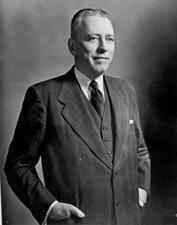
Here you will find contact information for Senator Irving McNeil Ives, including email address, phone number, and mailing address.
| Name | Irving McNeil Ives |
| Position | Senator |
| State | New York |
| Party | Republican |
| Status | Former Representative |
| Term Start | January 3, 1947 |
| Term End | January 3, 1959 |
| Terms Served | 2 |
| Born | January 24, 1896 |
| Gender | Male |
| Bioguide ID | I000050 |
About Senator Irving McNeil Ives
Irving McNeil Ives (January 24, 1896 – February 24, 1962) was an American politician, liberal Republican, and founding dean of the Cornell University School of Industrial and Labor Relations, who served as a United States Senator from New York from 1947 to 1959. Over two terms in the Senate, he was known as a specialist in labor and civil rights legislation and participated actively in the legislative process during a significant period in American history, representing the interests of his New York constituents. Before his Senate service, he spent sixteen years in the New York State Assembly, where he rose to the posts of Minority Leader, Speaker, and Majority Leader and gained national attention for pioneering anti-discrimination and labor measures. He voted in favor of the Civil Rights Act of 1957 and was widely regarded as a leading figure among liberal Republicans of his era.
Ives was born in Bainbridge, New York, to George Albert and Lucie Hough (née Keeler) Ives. His family traced its American roots to English ancestors who arrived in Boston, Massachusetts, in 1635, later helping to found the Quinnipiac Colony in 1638, and subsequently living in Vermont before settling in New York in 1795. His father worked in the coal and feed business, and Ives was educated in the public schools of Bainbridge and Oneonta. He graduated from Oneonta High School in 1914, laying the foundation for a career that would combine academic distinction, military service, and public life.
Following high school, Ives attended Hamilton College for two years before the United States entered World War I in 1917. He enlisted in the U.S. Army and served overseas with the 5th Division in France and Germany, primarily assigned to the 61st Infantry Regiment. He took part in major campaigns, including the Meuse-Argonne and Saint-Mihiel offensives, and was honorably discharged as a first lieutenant in 1919. After the war he returned to Hamilton College, where he completed his studies and received a Bachelor of Arts degree in 1920. He graduated as a member of Phi Beta Kappa, reflecting both his academic achievement and his early promise as a leader.
Ives began his professional career in the financial sector, working as a bank clerk for the Guaranty Trust Company in New York City from 1920 to 1923, earning $25 per week. In 1920 he married Elizabeth Minette Skinner; the couple had one son, George, and remained married until her death in 1947. In 1923 he joined Manufacturers Trust Company and was placed in charge of the bank’s business activities in Upstate New York, prompting his move to Norwich. He remained with Manufacturers Trust until 1930, when he entered the general insurance business in Norwich. These early business experiences, particularly in banking and insurance, informed his later legislative work on economic, labor, and commercial issues.
On February 18, 1930, Ives was elected to the New York State Assembly from Chenango County to fill the vacancy caused by the resignation of Bert Lord. He was reelected many times and served continuously until 1946, sitting in the 153rd through the 165th New York State Legislatures. Within the Assembly, he quickly rose in influence: he served as Minority Leader in 1935 and was elected Speaker in 1936. His reelection as Speaker was opposed by some fellow liberal Republicans who disagreed with his stance against Governor Herbert H. Lehman’s proposed social welfare program, and Ives ultimately stepped aside in favor of Oswald D. Heck. Heck, in turn, named Ives Majority Leader, a position he held from 1937 to 1946. During these years, Ives emerged as a leading architect of state labor and industrial policy.
From 1938 to 1946, Ives chaired the State Joint Legislative Committee on Industrial and Labor Conditions, a role in which he earned national recognition. He sponsored the landmark Ives–Quinn Act of 1945, the first state law in the United States to prohibit discrimination in employment on the basis of race, creed, color, or national origin. He also introduced legislation creating the New York State Department of Commerce and establishing the New York State School of Industrial and Labor Relations at Cornell University. When the school was founded, he became its first dean, serving from 1945 to 1947 and helping to shape it into a leading institution for the study of labor relations. In addition, he served on the New York State War Council from 1942 to 1946, chaired the New York State Temporary Commission Against Discrimination from 1944 to 1945, and chaired the New York State Temporary Commission on Agriculture from 1945 to 1946, further broadening his expertise in economic, agricultural, and civil rights issues.
In 1946, when Democratic Senator James M. Mead chose to run for Governor of New York, Ives sought and won election to Mead’s vacated United States Senate seat. In the general election he faced former Governor Herbert H. Lehman and became the first Republican to be endorsed by the New York American Federation of Labor. Ives defeated Lehman by a margin of 52 percent to 47 percent and became the first Republican to represent New York in the Senate since James W. Wadsworth Jr., who had been defeated for reelection in 1926. As a senator, Ives continued his focus on labor and civil rights. Although considered a moderate and liberal Republican, he supported the Taft–Hartley Act in 1947 and voted to override President Harry S. Truman’s veto, a decision that cost him much of his longstanding support from organized labor. He served as a delegate to the 1948 Republican National Convention in Philadelphia, which nominated his friend and fellow New York liberal, Governor Thomas E. Dewey. That same year, following the death of his first wife, he married his longtime secretary, Marion Mead Crain.
Ives was reelected to the Senate in 1952, defeating Brooklyn Borough President John Cashmore by 55 percent to 36 percent. In that election he received the largest number of votes ever won to that time by a candidate in New York and carried all but three of the state’s sixty-two counties. A strong supporter of General Dwight D. Eisenhower, he served as a delegate to the 1952 Republican National Convention in Chicago, which nominated Eisenhower for the presidency. In 1954, Ives ran unsuccessfully for governor of New York in one of the closest gubernatorial contests in the state’s history, losing to Democrat W. Averell Harriman by 11,125 votes. He remained active in national party affairs and was a delegate to the 1956 Republican National Convention in San Francisco. In the Senate he co-sponsored, with Senator John F. Kennedy, a 1958 bill aimed at correcting abuses within organized labor that had been disclosed in hearings before the Senate Select Committee on Improper Activities in Labor and Management, commonly known as the Rackets Committee. During his Senate tenure, he also cast a notable vote in favor of the Civil Rights Act of 1957, underscoring his long-standing commitment to civil rights legislation.
In 1958, Ives declined to seek a third term in the Senate, effectively concluding his congressional career after twelve years of service from 1947 to 1959. He returned to private life in New York, remaining a respected voice on labor, civil rights, and public policy. On February 24, 1962, he died at Chenango Memorial Hospital in Norwich, New York, at the age of sixty-six. He was buried at Greenlawn Cemetery in Bainbridge, New York, near his birthplace. His legacy is commemorated in several ways: Ives Hall at Cornell University is named in his honor, reflecting his foundational role in the School of Industrial and Labor Relations, and his Senate desk is preserved in the permanent collections of the Chenango County Historical Society. Archival collections, including his publications held at Cornell’s Kheel Center for Labor-Management Documentation and Archives, continue to document his contributions to labor policy, civil rights, and mid-twentieth-century American politics.