Representative Isaac R. Sherwood
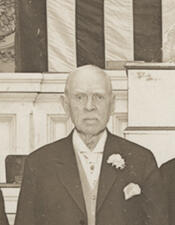
Here you will find contact information for Representative Isaac R. Sherwood, including email address, phone number, and mailing address.
| Name | Isaac R. Sherwood |
| Position | Representative |
| State | Ohio |
| District | 9 |
| Party | Democratic |
| Status | Former Representative |
| Term Start | December 1, 1873 |
| Term End | March 3, 1925 |
| Terms Served | 9 |
| Born | August 13, 1835 |
| Gender | Male |
| Bioguide ID | S000355 |
About Representative Isaac R. Sherwood
Isaac Ruth Sherwood (August 13, 1835 – October 15, 1925) was an American politician, newspaper editor, and Union Army officer who became a long-serving Representative from Ohio in the United States Congress. Over the course of his public life he served nine terms in the House of Representatives between 1873 and 1925, at first as a Republican and later as a Democrat, and emerged as a noted pacifist during World War I. A prominent figure in Ohio journalism and politics, he was closely associated with Toledo, Ohio, where he lived for much of his adult life.
Sherwood was born in Stanford, Dutchess County, New York, on August 13, 1835. He attended local public schools before pursuing further study at the Hudson River Institute in Claverack, New York. Seeking broader educational opportunities, he moved west to Ohio and enrolled at Antioch College. He subsequently studied law at the Ohio Law College in Poland, Ohio, completing his formal education in 1857. That same year he entered the world of journalism as editor of the Williams County Gazette in Bryan, Ohio, beginning a dual career in newspapers and public service that would continue for decades. Sherwood married Kate Brownlee Sherwood (1841–1914), a writer of popular patriotic poetry who became well known in her own right; the couple had two children, James and Lenore.
Sherwood’s political career began in local office shortly before the Civil War. In October 1860 he was elected probate judge of Williams County, Ohio. His judicial service, however, was cut short by the outbreak of war in 1861. Responding to President Abraham Lincoln’s call for volunteers in April 1861, Sherwood resigned his judgeship and enlisted as a private in the 14th Ohio Infantry. He later transferred to the 111th Ohio Infantry, where he initially served as adjutant and ultimately mustered out with the regiment as lieutenant colonel. Sherwood took part in the Carolinas campaign, the final major campaign in the Eastern Theater of the Civil War. In recognition of his conspicuous service at the Battle of Franklin, President Lincoln nominated him on February 25, 1865, for appointment as a brevet brigadier general of volunteers, to rank from February 27, 1865; the United States Senate confirmed the appointment on March 10, 1865. After the war he became a companion of the Ohio Commandery of the Military Order of the Loyal Legion of the United States, reflecting his continued association with veterans of the Union Army.
Mustered out of the military on June 27, 1865, Sherwood moved to Toledo, Ohio, where he resumed and expanded his journalistic career. He became editor of the Toledo Daily Commercial and also wrote political editorials for The Cleveland Leader, gaining a reputation as an influential Republican voice in Ohio politics. As a member of the Republican Party, he was elected Ohio Secretary of State in 1868 and reelected in 1870. Building on this statewide prominence, Sherwood successfully ran for the United States House of Representatives in 1872. He entered Congress as a Representative from Ohio in 1873, beginning service in the Forty-third Congress. This initial term marked the start of a long association with the national legislature, during which he contributed to the legislative process and represented the interests of his Ohio constituents during a significant period in American history.
After his first term in Congress ended, Sherwood returned to journalism and local office while remaining active in state politics. He went back to northern Ohio and became owner and editor of the Toledo Journal from 1875 to 1884, using the paper as a platform for political commentary and party advocacy. During this period he was elected probate judge of Lucas County in 1878 and again in 1881, extending his earlier judicial experience to a larger and more urban constituency. In 1885 he assumed the editorship of the Canton News-Democrat, a position he held for about a decade, further solidifying his standing as a leading Democratic-leaning editor in Ohio. Although he had briefly supported the platform of the National Greenback Party in the 1870s, advocating monetary reform in response to postwar economic conditions, he formally identified himself with the Democratic Party in 1879 and remained a Democrat for the rest of his life.
Sherwood’s later congressional career unfolded under the Democratic banner and spanned the early twentieth century. He was nominated as the Democratic candidate for Representative from Ohio’s 18th congressional district in 1896 but was defeated. A decade later, in 1906, he was elected to the United States House of Representatives as a Democrat and returned to Congress. From that election he served seven consecutive terms, remaining in the House from 1907 until he failed to win reelection in 1920. Across his service from 1873 to 1925, he thus accumulated nine terms in the House of Representatives. During World War I he became nationally known for his pacifist views. He refused to support the United States declaration of war and voted against conscription, arguing that the nation should not become involved in a European conflict. These positions, taken at a time of intense patriotic fervor, were deeply unpopular in his home state, where many Ohioans regarded his stance as unpatriotic, and they contributed to his defeat in the 1920 election.
Despite that setback, Sherwood’s political career did not end immediately. In 1922 he was again elected to the House of Representatives, adding one more term to his long record of congressional service. He served until 1925 but was defeated in his bid for reelection in 1924, closing more than half a century of intermittent public service that had begun before the Civil War. Over the course of his career he had served as a Republican and then as a Democrat, held judicial office at the county level in two different Ohio counties, twice served as Ohio Secretary of State, and represented Ohio in Congress during periods of Reconstruction, industrialization, and global war.
After completing his final term in Congress in 1925, Sherwood retired from active politics and returned to Toledo. His retirement was brief. He died in Toledo on October 15, 1925, only a few months after leaving office, and was buried in Woodlawn Cemetery in that city. His life encompassed service as a Civil War officer, newspaper editor, state official, and long-time member of the United States House of Representatives, and he remained a notable figure in Ohio’s political and journalistic history.