Representative Isaac S. Struble
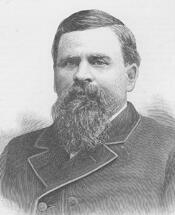
Here you will find contact information for Representative Isaac S. Struble, including email address, phone number, and mailing address.
| Name | Isaac S. Struble |
| Position | Representative |
| State | Iowa |
| District | 11 |
| Party | Republican |
| Status | Former Representative |
| Term Start | December 3, 1883 |
| Term End | March 3, 1891 |
| Terms Served | 4 |
| Born | November 3, 1843 |
| Gender | Male |
| Bioguide ID | S001028 |
About Representative Isaac S. Struble
Isaac Sterling Struble (November 3, 1843 – February 17, 1913) was an American politician and four-term Republican Representative from Iowa’s 11th congressional district, serving in the United States House of Representatives from March 4, 1883, to March 3, 1891. A resident of Plymouth County, Iowa, he emerged from a notably political family and became best known in Congress as a leading opponent of plural marriage in the Utah Territory. Over the course of his four consecutive terms, he contributed actively to the legislative process during a significant period in American history, representing the interests of his northwestern Iowa constituents as a member of the Republican Party.
Struble was born on November 3, 1843, into a large family that would become deeply involved in public affairs. He was one of seven sons, six of whom survived to adulthood and were politically active. Among his brothers were John T. Struble of Iowa and George R. Struble, who served as speaker of the Iowa House of Representatives. This family environment fostered a strong interest in civic life and public service. Struble later became the granduncle of Bob Struble, Sr., and the great-granduncle of Bob Struble, Jr., extending the family’s political and public-service legacy into the twentieth century.
Before his entry into national politics, Struble established himself in Iowa, particularly in Plymouth County and the city of LeMars, where he became a prominent local figure. His early career included service as a soldier, an experience that shaped his later legislative priorities, especially his concern for veterans and members of the armed services. By the early 1880s he was firmly identified with the Republican Party and with the growing communities of northwestern Iowa, which were undergoing rapid development and seeking stronger representation in Washington.
Struble’s congressional career was made possible by changes following the 1880 federal census, which increased Iowa’s delegation in the U.S. House of Representatives from nine to eleven members. The 1881 Iowa General Assembly, during the period when his brother George R. Struble was midway through his term as speaker of the Iowa House of Representatives, reapportioned the state’s nine-district map into an eleven-district map. Plymouth County and much of northwestern Iowa were placed in a newly created Eleventh District. In 1882, Isaac Struble secured the Republican nomination to become the first representative of this new district and then won the general election, entering the Forty-eighth Congress. He joined a freshman class so large that it constituted a majority of the House membership, a circumstance that has not been repeated.
During the three subsequent elections of 1884, 1886, and 1888, Struble was renominated by acclamation at Republican district conventions, reflecting his strong standing within the party. In each of those general elections he defeated Democratic and Greenback Party opponents, and by the end of his third term he was described by the New York Times as “exceptionally popular.” Throughout his four terms, from 1883 to 1891, he enjoyed considerable popularity among rank-and-file citizens in his district; a small town founded during this period was named Struble in his honor. He was regarded by colleagues as “always considered a strong member,” and he devoted significant effort to constituent services, including securing federal projects such as the Sioux City public building bill of 1890.
Struble’s most prominent work in Congress came through his service on the House Committee on Territories, which he chaired during his fourth term. In that role he played an important part in the admission to the Union of six western states—Idaho, Montana, Washington, Wyoming, and North and South Dakota—and in the organization of Oklahoma Territory. A cultural conservative of the nineteenth-century type, he was a strong supporter of prohibition and an outspoken opponent of bigamy and plural marriage. Working with Senator Shelby M. Cullom of Illinois, he advanced the Cullom–Struble Bill, which proposed stringent sanctions against polygamy, including the exclusion of the Utah Territory from statehood. The bill was on the verge of passage in 1890 when it was effectively preempted by the 1890 Manifesto of the Church of Jesus Christ of Latter-day Saints, in which the church formally disavowed new polygamous marriages.
Struble’s legislative record also included support for high protective tariffs, notably the McKinley Tariff of 1890. This stance proved controversial in his largely agricultural district, where many farmers feared that retaliatory trade measures would damage agricultural exports. The tariff’s unpopularity contributed to a national backlash against the Republican Party and to the Democratic landslide in the 1890 elections, which reduced Republicans from a narrow majority of 51 percent of House seats to a minority holding only about 27 percent. In Struble’s own district, the 1890 Republican nominating convention became protracted and contentious; after forty-three ballots, the nomination went instead to George D. Perkins, a newspaper editor and former state senator from Sioux City, who went on to hold the seat from 1891 to 1899. Struble thus concluded his congressional service at the end of the Fifty-first Congress in March 1891.
Upon his final return to Iowa from Washington in March 1891, Struble’s popularity at home was evident in the reception he received in LeMars. Greeted at the train station by a large crowd and the local Striker’s Band, he appeared on a prepared stage where the mayor and other dignitaries offered welcoming remarks before he delivered a farewell address. As reprinted in the LeMars Sentinel, his speech reflected on the burdens and responsibilities of congressional service alongside such figures as Speaker Thomas Brackett Reed, future Speaker Joseph G. Cannon, and future President William McKinley. He discussed the proper limits of partisanship, the nature of political patronage, and the heavy demands of committee work and constituent service—an early articulation of what would later be understood as the “ombudsman” role of a member of Congress.
In his later years, Struble remained identified with the causes that had defined his public life, including prohibition and moral reform, positions that, along with his opposition to plural marriage, had earned him both admirers and determined opponents. His work on behalf of veterans and his efforts to secure federal improvements for his district left a lasting imprint on northwestern Iowa. Isaac Sterling Struble died on February 17, 1913, closing a career that had spanned the formative decades of Iowa’s political development and the nation’s westward expansion.