Representative Isaac Whitbeck Van Schaick
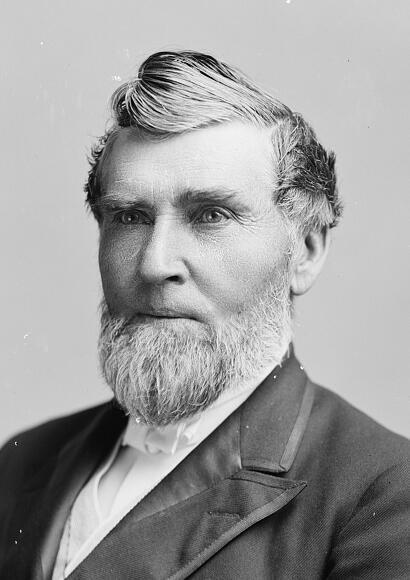
Here you will find contact information for Representative Isaac Whitbeck Van Schaick, including email address, phone number, and mailing address.
| Name | Isaac Whitbeck Van Schaick |
| Position | Representative |
| State | Wisconsin |
| District | 4 |
| Party | Republican |
| Status | Former Representative |
| Term Start | December 7, 1885 |
| Term End | March 3, 1891 |
| Terms Served | 2 |
| Born | December 7, 1817 |
| Gender | Male |
| Bioguide ID | V000058 |
About Representative Isaac Whitbeck Van Schaick
Isaac Whitbeck Van Schaick (December 7, 1817 – August 22, 1901) was an American businessman and Republican politician who served two terms in the United States House of Representatives from Wisconsin between 1885 and 1891. A prominent figure in Wisconsin politics in the late nineteenth century, he represented Milwaukee County in Congress, served six years in the Wisconsin State Senate, and two years in the Wisconsin State Assembly. Over the course of his public career, he contributed to the legislative process at both the state and federal levels, and his family’s political legacy extended to his nephew, Aaron Van Schaick Cochrane, who also became a member of Congress.
Van Schaick was born in Coxsackie, Greene County, New York, on December 7, 1817. He was educated in the common schools of his native town and worked on his father’s farm in his youth, gaining early experience in agricultural labor and rural life. As a young man he entered business, engaging in the manufacture of glue in New York, an enterprise that introduced him to commercial and industrial pursuits that would shape much of his later career.
In 1842, in Athens, New York, Van Schaick married Eliza Sanderson, the daughter of John Sanderson and Margaret Whitfield. The marriage linked him to a family that would later play a role in his business activities in the Midwest. After establishing himself in business in New York, he joined the broader movement of Americans heading west in the mid-nineteenth century, seeking new economic opportunities in the rapidly developing cities along the Great Lakes.
Van Schaick moved to Chicago, Illinois, in 1857, at a time when that city was emerging as a major commercial center. In 1861 he relocated to Milwaukee, Wisconsin, where he entered the flour-milling business in partnership with members of his wife’s family. Following the American Civil War, he traveled to Arkansas and worked in the cotton industry, reflecting the postwar expansion of Northern business interests into the South. After approximately three years in Arkansas, he returned to Milwaukee and resumed his life and activities there, consolidating his position as a businessman and local leader.
Van Schaick’s formal political career began at the municipal level. In 1871 he was elected to the Milwaukee Common Council, where he gained experience in local governance and urban affairs. He advanced to state office as a member of the Wisconsin State Assembly, serving terms in 1873 and 1875. Building on this legislative experience, he was elected to the Wisconsin State Senate, in which he served from 1877 to 1882, completing six years in the upper house of the state legislature. During this period he became a recognized Republican figure in Wisconsin politics, participating in the development of state policy during a time of industrial growth and political realignment.
Van Schaick entered national politics in the 1880s. A member of the Republican Party, he was elected as a Republican to the Forty-ninth Congress in 1884 as the representative of Wisconsin’s 4th congressional district, which included Milwaukee County. His service in the U.S. House of Representatives began on March 4, 1885, and occurred during a significant period in American history marked by debates over tariffs, labor issues, and economic policy. He participated in the democratic process and represented the interests of his constituents in Milwaukee County. He declined to be a candidate for renomination in 1886 and was succeeded by Henry Smith of the Union Labor Party. In 1888, Van Schaick returned to the political arena and defeated Smith for election to the Fifty-first Congress, again representing Wisconsin’s 4th district. In that contest he received 22,212 votes to 20,685 for Smith, who ran on the Democratic and Labor tickets, while Socialist candidate John Schuler received 527 votes and Prohibitionist candidate George Heckendorn received 302 votes. Van Schaick served this second term in Congress from March 4, 1889, to March 3, 1891. He was not a candidate for renomination in 1890 and was succeeded by Democrat John Lendrum Mitchell at the conclusion of his term.
After leaving Congress, Van Schaick remained active in Wisconsin politics for a time. In 1892 he ran unsuccessfully for the Wisconsin State Senate from the 4th district, losing to Democrat James W. Murphy. This marked the end of his efforts to return to elective office. Two years later, in 1894, he moved to Catonsville, Maryland, where he lived in retirement. There he spent his later years away from the public spotlight, having completed a long career that spanned local, state, and national service.
Isaac Whitbeck Van Schaick died in Catonsville, Maryland, on August 22, 1901. His remains were returned to his native region and interred in Athens Cemetery, Athens, New York, reflecting his enduring ties to the state of his birth. His wife, Eliza Sanderson Van Schaick, survived him but died two years later, in 1903. His life and career left a record of business enterprise and Republican political leadership in Wisconsin during a transformative era in American public life.