Senator J. James Exon
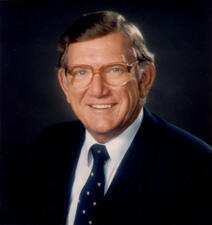
Here you will find contact information for Senator J. James Exon, including email address, phone number, and mailing address.
| Name | J. James Exon |
| Position | Senator |
| State | Nebraska |
| Party | Democratic |
| Status | Former Representative |
| Term Start | January 15, 1979 |
| Term End | January 3, 1997 |
| Terms Served | 9 |
| Born | August 9, 1921 |
| Gender | Male |
| Bioguide ID | E000284 |
About Senator J. James Exon
John James Exon (August 9, 1921 – June 10, 2005) was an American businessman and Democratic politician who served as the 33rd Governor of Nebraska from 1971 to 1979 and as a United States Senator from Nebraska from 1979 to 1997. Over the course of three terms in the Senate, he represented Nebraska’s Class 2 seat, becoming the only Democrat ever to hold that seat and never losing an election in his political career. His public service spanned a significant period in late 20th-century American history, during which he participated actively in the legislative process and represented the interests of his Nebraska constituents.
Exon was born in Geddes, Charles Mix County, South Dakota, on August 9, 1921, and grew up in nearby Lake Andes, South Dakota. His family had deep political roots; his grandfather was instrumental in founding the Democratic Party of South Dakota. In 1939, Exon moved to Nebraska to attend the University of Omaha (now the University of Nebraska Omaha), where he studied from 1939 to 1941. With the onset of World War II, he joined the United States Army Signal Corps in 1942. He served overseas for two years in New Guinea, the Philippines, and Japan, rising to the rank of master sergeant. Exon was honorably discharged in December 1945 and continued his military involvement in the Army Reserve until 1949.
After the war, Exon settled permanently in Nebraska and embarked on a business career. He initially worked as the branch manager of a financial services institution in Fremont, Nebraska. In 1953, he founded Exon Office Supplies in Lincoln, later known as Exon’s Inc., and served as its president until 1971. His business became well known in the state, and in 1972, when Esso (Standard Oil Company of New Jersey) changed its name to Exxon, Nebraska Secretary of State Allen J. Beermann declined to register the new corporate name in the state because of the preexisting Exon’s Inc. Exon later stated that he received an unspecified settlement from Exxon in exchange for renaming his company the J.J. Exon Company. His success in business and his growing involvement in civic affairs helped lay the groundwork for his entry into politics.
Exon’s political career began at the grassroots level as a Democratic precinct worker. He rose steadily within the party, serving as a member of the Nebraska Democratic State Central Committee from 1964 to 1968 and as a member of the Democratic National Committee from 1968 to 1970. He was a delegate to the 1964 Democratic National Convention for Nebraska and subsequently served as a delegate to every Democratic National Convention from 1972 through 2004. In 1970, while serving as chair of the Nebraska Democratic Party, Exon decided to run for governor. His first bid for public office was successful: he defeated incumbent Republican Governor Norbert Tiemann in the 1970 election. With the gubernatorial term newly extended to four years beginning with Tiemann’s 1966 victory, Exon’s own re-election in 1974 in a landslide made him the first person to serve eight years as governor of Nebraska.
As governor from 1971 to 1979, Exon developed a reputation as a fiscal conservative. He repeatedly used his veto power to restrain what he viewed as excessive legislative spending, vetoing 141 bills in his final seven years in office, an average of about 20 per year. His fiscal policies, including efforts to keep state budgets under control, contributed to his popularity with many Nebraska voters. At the same time, his record reflected the social and political tensions of the era. Exon was a vocal opponent of gay rights. As a gubernatorial candidate, he criticized a “homophile studies” course at the University of Nebraska–Lincoln taught by professor Louis Crompton. In 1977, as governor, he vetoed legislation that would have legalized consensual same-sex intercourse, denouncing “perverts, homos, and gays.” The Nebraska Legislature overrode his veto, making Nebraska one of the earlier states to decriminalize same-sex intercourse despite his opposition.
Exon’s statewide popularity as governor carried over into his 1978 campaign for the United States Senate. Running as a Democrat in a traditionally Republican-leaning state, he won the election with 68 percent of the vote and entered the Senate on January 3, 1979. He was re-elected in 1984 in what became the closest race of his career, prevailing by approximately 25,000 votes, and again in 1990, serving a total of three terms until January 3, 1997. In the Senate, Exon was generally regarded as a moderate Democrat, often aligning with Republicans on fiscal and defense issues. He served on the Senate Committee on Armed Services and became a strong defender of the B-2 stealth bomber program, arguing that it was vital to national security. During his Senate tenure, he also helped sponsor the Exon–Florio Amendment, which authorized the federal government to block foreign takeovers or mergers involving U.S. companies when such transactions were deemed a threat to national security.
Exon’s Senate record reflected a mix of fiscal restraint, national security concerns, and socially conservative positions. On October 19, 1983, he was one of only four Democratic senators to vote against the bill establishing the federal Martin Luther King Jr. Day holiday; President Ronald Reagan signed the legislation into law the following month. In 1988, Exon drew scrutiny for taking ten vacations paid for by lobbying groups, a practice that later came under increasing ethical criticism in Congress. In October 1991, he was one of eleven Democratic senators who voted to confirm Clarence Thomas to the United States Supreme Court in a closely divided 52–48 vote. In budget matters, Exon played a central role in efforts to reduce federal spending, helping to write and secure support in 1994 for a $14 billion reduction in the U.S. budget, which he described as his proudest political achievement. Late in his Senate career, he authored the Communications Decency Act of 1996, the first major congressional attempt to regulate internet content with the stated goal of restricting access to online pornography. The act was later struck down unanimously by the U.S. Supreme Court as an unconstitutional infringement of First Amendment protections.
Exon retired from the Senate in 1997, concluding 26 consecutive years in statewide office as governor and senator. After leaving Congress, he continued to engage in national security issues. He served on a congressional advisory committee led by former CIA Director John M. Deutch that examined the threat posed by weapons of mass destruction. In its report, Exon warned of the grave dangers should such weapons fall into the hands of terrorists and urged the creation of a federal agency with responsibilities similar to what would later become the Department of Homeland Security. His post-Senate activities reflected his longstanding concern with defense and national preparedness, themes that had marked much of his legislative career.
In his later years, Exon faced health challenges, including treatment for cancer, though in 2003 he stated that his condition was not “highly malignant.” He remained a respected figure in Nebraska politics and in the Democratic Party, continuing to attend national conventions through 2004. John James Exon died of natural causes on June 10, 2005, at Madonna Rehabilitation Hospital in Lincoln, Nebraska. In recognition of his long service to the state, he became the first person to lie in state for public viewing in the rotunda of the Nebraska State Capitol. He was buried at Wyuka Cemetery in Lincoln, Nebraska, leaving behind a legacy as a dominant figure in late 20th-century Nebraska politics, a three-term United States senator, and a two-term governor who never lost an election.