Representative J. Ross Mickey
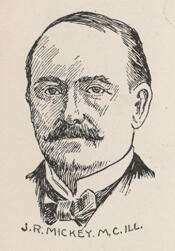
Here you will find contact information for Representative J. Ross Mickey, including email address, phone number, and mailing address.
| Name | J. Ross Mickey |
| Position | Representative |
| State | Illinois |
| District | 15 |
| Party | Democratic |
| Status | Former Representative |
| Term Start | December 2, 1901 |
| Term End | March 3, 1903 |
| Terms Served | 1 |
| Born | January 5, 1856 |
| Gender | Male |
| Bioguide ID | M000694 |
About Representative J. Ross Mickey
J. Ross Mickey (January 5, 1856 – March 20, 1928) was a U.S. Representative from Illinois and a member of the Democratic Party who served one term in the United States Congress from 1901 to 1903. Born on a farm in Eldorado Township, McDonough County, Illinois, he spent his early years in a rural setting typical of mid-19th-century central Illinois. He attended the local public schools, reflecting the expansion of common-school education in the post–Civil War era, and later pursued further studies at Lincoln College in Lincoln, Illinois, an institution associated with providing classical and preparatory education to young men of the region.
After completing his formal education, Mickey embarked on a career in teaching. He taught in the public schools of Macomb, McDonough County, Illinois, for a number of years, thereby establishing himself in the community and gaining experience in public service and local affairs. During this period he developed an interest in the law, studying the subject while continuing his professional responsibilities. His legal studies culminated in his admission to the bar in 1889, after which he commenced the practice of law in Macomb. From 1889 until 1898 he built a legal practice that positioned him as a prominent attorney in McDonough County.
Mickey’s growing stature in the legal profession led to his election as judge of McDonough County in 1898 for a four-year term. His election to the county judgeship reflected the confidence of local voters in his judgment and legal ability. He served on the bench until February 22, 1901, when he resigned before the completion of his term, having been elected to the United States House of Representatives. This transition from the county judiciary to national legislative office marked a significant step in his public career and mirrored the broader pattern of local officials moving into federal service at the turn of the twentieth century.
As a Democrat, Mickey was elected to the Fifty-seventh Congress and served from March 4, 1901, to March 3, 1903, representing his Illinois constituency in the U.S. House of Representatives during a significant period in American history characterized by industrial expansion, the aftermath of the Spanish-American War, and the early stirrings of the Progressive Era. During his single term in office, he participated in the legislative process, contributed to debates, and represented the interests of his constituents in Illinois. Although positioned to seek further advancement, he declined to be a candidate for renomination in 1902, thereby limiting his congressional service to one term.
Following the conclusion of his term in Congress, Mickey returned to Macomb and resumed the practice of law. His post-congressional legal work continued the professional trajectory he had established before entering national politics, and he remained a figure of standing in the local bar. In addition to his legal practice, he became prominently involved in fraternal and mutual benefit activities, reflecting the importance of such organizations in early twentieth-century American civic life.
Mickey served as president of the Mystic Workers of the World, a fraternal benefit society, from 1908 to 1918. In this capacity he oversaw the organization during a decade that encompassed both economic change and World War I, a period in which mutual aid and insurance societies played a significant role in providing security to working- and middle-class families. After his tenure as president, he continued his association with the Mystic Workers of the World as a director from 1918 until his death, underscoring his long-term commitment to the organization and to the broader fraternal movement.
J. Ross Mickey died in Excelsior Springs, Missouri, on March 20, 1928. He was interred in Oakwood Cemetery in Macomb, Illinois, returning in death to the community where he had taught school, practiced law, held judicial office, and built much of his public career. His life reflected the trajectory of a late nineteenth- and early twentieth-century Midwestern lawyer-politician who rose from rural beginnings to serve in both local judicial office and the national legislature, and who remained engaged in civic and fraternal affairs well into his later years.